
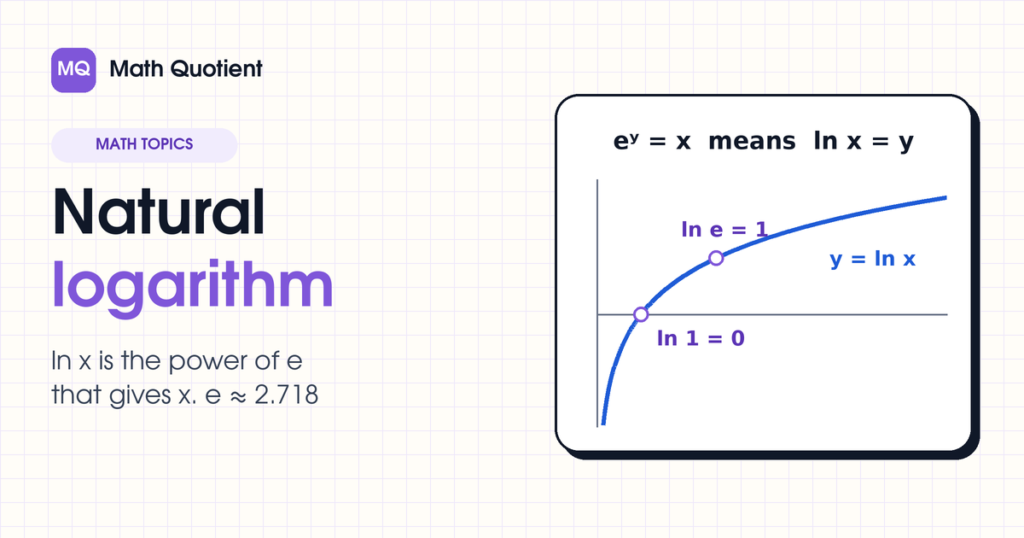
The natural logarithm, written ln x, is the power you raise e to, to get x. The number e is about 2.718. So ln 20 is about 3, because e³ is about 20.1.
ln undoes e. e undoes ln.
ey = x means ln x = y
What e is, and why the natural logarithm uses it
The natural logarithm always uses the base e, so ln x asks: “e to what power gives x?” The number e is about 2.71828, and it never ends or repeats. Here is where it comes from. Put AED 1 in an account that pays 100% a year, split into n equal parts, with interest added each time.
| Number of parts, n | Money after 1 year, (1 + 1/n)ⁿ |
|---|---|
| 1 | AED 2.00 |
| 10 | AED 2.5937 |
| 100 | AED 2.7048 |
| 1,000 | AED 2.7169 |
| 1,000,000 | AED 2.71828 |
The money gets closer to e but never passes it. So e appears wherever growth never stops. (The rate is made up.)
Why “natural”? The slope of eˣ equals its own height at every point. So ln x has the simplest derivative of any logarithm: 1/x.
Five natural logarithm facts to know by heart
Because e⁰ = 1
Because e¹ = e
ln undoes e
e undoes ln, for x > 0
Fact 5: ln x only exists for x > 0. No power of e is 0 or negative, so ln 0 and ln(−3) are not defined. Between 0 and 1, ln x is negative: ln 0.5 ≈ −0.693.
The log laws work for ln too. For example, ln(e³x) = 3 + ln x.
Solving equations with e and the natural logarithm: 3 worked examples
Example 1: solve eˣ = 5
Take ln of both sides: ln eˣ = ln 5.
ln undoes e, so the left side is x.
x = ln 5 ≈ 1.609. Check: e1.609 ≈ 5.
Example 2: solve 3e2x − 4 = 11
Get e2x alone first. Add 4: 3e2x = 15. Divide by 3: e2x = 5.
Take ln: 2x = ln 5.
x = (ln 5) ÷ 2 ≈ 0.805. Keep ln 5 exact until the last step.
Example 3: solve ln(x − 2) = 3
Raise e to both sides: eln(x − 2) = e³, so x − 2 = e³.
x = 2 + e³ ≈ 22.09.
Check: x − 2 = e³ is positive, so the answer is allowed.
Where you meet this: growth that never stops. At a steady rate r a year, an amount doubles in (ln 2) ÷ r years, and ln 2 ≈ 0.693. At 3.5% (r = 0.035), that is about 19.8 years. This is the “rule of 70”.
The graph of ln x, and its derivative 1/x
- It crosses the x-axis at (1, 0) and passes (e, 1) and (e², 2).
- It never touches the y-axis. Near x = 0, ln x falls without limit.
- It rises for ever, but slowly: ln 1,000 is only about 6.91.
The derivative: d/dx (ln x) = 1/x, for x > 0. At x = 2 the slope is 0.5, and at x = 10 it is 0.1. So the curve gets flatter.
With the chain rule: d/dx ln(f(x)) = f′(x) ÷ f(x). So d/dx ln(x² + 1) = 2x ÷ (x² + 1).
Going back, ∫ (1/x) dx = ln|x| + C. For the integral of ln x itself, see integrating ln x.
ln or log? Which key to press
| You see | Base | Calculator key |
|---|---|---|
| ln x | e ≈ 2.718 | ln |
| log x on a calculator | 10 | log |
| eˣ | e | Shift then ln, on most calculators |
To switch: ln x = log x × ln 10, and ln 10 ≈ 2.303. Our exponents page covers the powers that logs undo.
Common mistakes with the natural logarithm
- ln(5x) as 5 ln x. ln(5x) = ln 5 + ln x. Only ln(x⁵) = 5 ln x.
- Taking ln of each term in 3e2x − 4 = 11. Get e2x alone first.
- Mixing (ln x)² and ln(x²). At x = e, the first is 1 and the second is 2.
- Pressing log for ln. log 5 ≈ 0.699, but ln 5 ≈ 1.609.
- Rounding ln 5 to 1.6 first. You get 0.8, not 0.805.
Check this with the Free BMI Maths Test
- Writes ln(5x) = 5 ln x: CNC, concept not clear.
- Takes ln before getting e2x alone: CNC, concept not clear.
- Copies (ln x)² as ln(x²) from one line to the next: CWV, copied a wrong value.
- Presses log when the question says ln: DRC, did not read carefully.
- Rounds too early and loses the last digit: CMT, calculation mistake.
The Free BMI Maths Test finds which of the 6 mistake types your child makes, and their real maths level. About the Free BMI Maths Test
Test prep corner
The natural logarithm in JEE Main maths
NTA’s JEE Main 2027 maths topic list names logarithmic and exponential functions in Unit 7 (differentiation) and Unit 8 (integrals). These are JEE-style questions, not real past questions.
JEE-style: Find the sum of all real x that satisfy e2x − 5eˣ + 6 = 0.
Let t = eˣ. Then t² − 5t + 6 = 0, so t = 2 or 3. So x = ln 2 or ln 3, and the sum is ln 6, about 1.792. Trap: adding the t values to get 5.
JEE-style: If f(x) = ln(x + √(x² + 1)), find f′(x).
Chain rule: f′(x) = (1 + x/√(x² + 1)) ÷ (x + √(x² + 1)). The top is (√(x² + 1) + x) ÷ √(x² + 1), so most of it cancels. f′(x) = 1/√(x² + 1). Trap: stopping at 1/(x + √(x² + 1)) and forgetting the inside’s derivative.
Ten more, across units, in our JEE-style maths questions with answers.
Facts checked on 14 November 2026 on the NTA JEE Main 2027 topic list.
Quick check: 4 questions on the natural logarithm
1. What is ln e⁴?
Not quite. ln undoes e, so the e goes away.
Yes! e to the power 4 gives e⁴, so ln e⁴ = 4.
Not quite. ln gives the power, not a product.
2. Solve eˣ = 10.
Not quite. That is the answer for 10ˣ = 10.
Not quite. x is a power, so you cannot divide by e.
Yes! Take ln of both sides.
3. Which of these is not defined?
Not quite. 0.2 is positive, so ln 0.2 exists. It is about −1.609.
Yes! No power of e is negative.
Not quite. ln 1 = 0.
4. What is the derivative of ln(3x)?
Yes! 3 ÷ (3x) = 1/x. Or: ln(3x) = ln 3 + ln x.
Not quite. Divide the 3 by the inside, 3x.
Not quite. You forgot the inside’s derivative, 3.
Got 2 or fewer right? Book the Free BMI Maths Test to find the cause.
Questions people ask about the natural logarithm
What does ln mean in maths?
ln is the natural logarithm, the logarithm with base e. ln x is the power of e that gives x, so ln e² = 2.
What is the value of e?
e is about 2.71828. It is the limit of (1 + 1/n)ⁿ as n gets very large. Like π, it never ends and never repeats.
Is ln the same as log?
Not on a calculator. There, log means base 10 and ln means base e. ln x is about 2.303 times log x.
Keep exploring
Still mixing up ln and log?
The Free BMI Maths Test finds your child’s real maths level and the reason for each mistake.