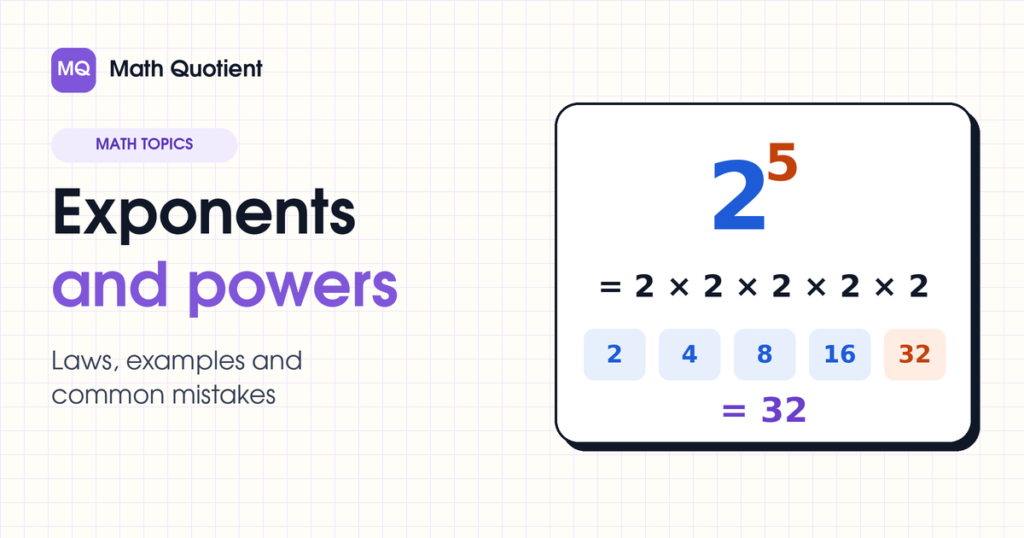
Exponents, also called powers, tell you how many times to multiply a number by itself. 2⁵ means 2 × 2 × 2 × 2 × 2, which is 32. This page covers what a power means and all the exponent laws, including zero, negative and fraction powers.
Small number up high, big answer.
25 = 2 × 2 × 2 × 2 × 2 = 32
Hello, curious mind!
What are exponents in maths?
An exponent is the small raised number that says how many times the base is used in a multiplication.
In 3⁴, the base is 3 and the exponent is 4. So 3⁴ = 3 × 3 × 3 × 3 = 81. We read it as “3 to the power 4”. You may also see the word “index”, and “indices” for more than one.
Base
The number that is multiplied.
Exponent
How many 3s you multiply.
Power
The base and exponent together.
Value
The answer when you work it out.
Remember this
The exponent counts the bases. It never multiplies the base.
Why a⁰ = 1 and why negative powers are fractions
Follow the powers of 3 down the table. Each time the exponent goes down by 1, the value is divided by 3. Keep going past 3¹ and the pattern tells you what 3⁰ and 3⁻¹ must be.
| Power | Value | How you get it |
|---|---|---|
| 3⁴ | 81 | 3 × 3 × 3 × 3 |
| 3³ | 27 | 81 ÷ 3 |
| 3² | 9 | 27 ÷ 3 |
| 3¹ | 3 | 9 ÷ 3 |
| 3⁰ | 1 | 3 ÷ 3 |
| 3⁻¹ | 1/3 | 1 ÷ 3 |
| 3⁻² | 1/9 | 1/3 ÷ 3 |
So a zero power always gives 1. A negative power gives a fraction, not a negative number: 3⁻² = 1/3² = 1/9.
The laws of exponents, with 3 worked examples
The laws work when the bases are the same. Each one comes from counting how many times the base is used.
Example 1: simplify (a⁴ × a⁵) ÷ a³
Multiply, so add the exponents: a⁴ × a⁵ = a⁹.
Divide, so take away the exponents: a⁹ ÷ a³ = a⁶.
Check with a = 2: (16 × 32) ÷ 8 = 64, and 2⁶ = 64.
Example 2: a negative power of a fraction, (2/5)⁻²
A negative power means “1 over”. For a fraction, that is the same as flipping it: (2/5)⁻² = (5/2)².
Square the top and the bottom: 25/4 = 6.25. The answer is positive.
Example 3: a fraction power, 323/5
The bottom number, 5, means a fifth root. 2⁵ = 32, so the fifth root of 32 is 2.
The top number, 3, means a cube: 2³ = 8.
Check: 8⁵ and 32³ are both 32,768.
Exponent laws card
One table to save on your phone. a and b are not 0.
| Law | Rule | Example |
|---|---|---|
| Multiply | am × an = am+n | 5² × 5⁴ = 5⁶ |
| Divide | am ÷ an = am−n | 7⁸ ÷ 7⁵ = 7³ |
| Power of a power | (am)n = amn | (x³)⁴ = x¹² |
| Power of a product | (ab)n = anbn | (3y)² = 9y² |
| Power of a fraction | (a/b)n = an/bn | (2/3)³ = 8/27 |
| Zero power | a⁰ = 1 | 9⁰ = 1 |
| Negative power | a−n = 1/an | 10⁻³ = 1/1,000 |
Fraction powers join them: am/n is the n-th root of a, raised to the power m.
Common mistakes with exponents
- Multiplying the exponents. a² × a³ is a⁵, not a⁶. Test it with a = 2: 4 × 8 = 32, which is 2⁵.
- Reading −3² as (−3)². The power acts on the 3 only, so −3² = −9. With a bracket, (−3)² = 9.
- Thinking a⁰ = 0. 7⁰ = 1. Look back at the pattern table.
- Thinking 2⁻³ is negative. 2⁻³ = 1/8 = 0.125. It is small, but positive.
- Working out 2³ as 6. That is 2 × 3. The right answer is 2 × 2 × 2 = 8.
Check this with the Free BMI Maths Test
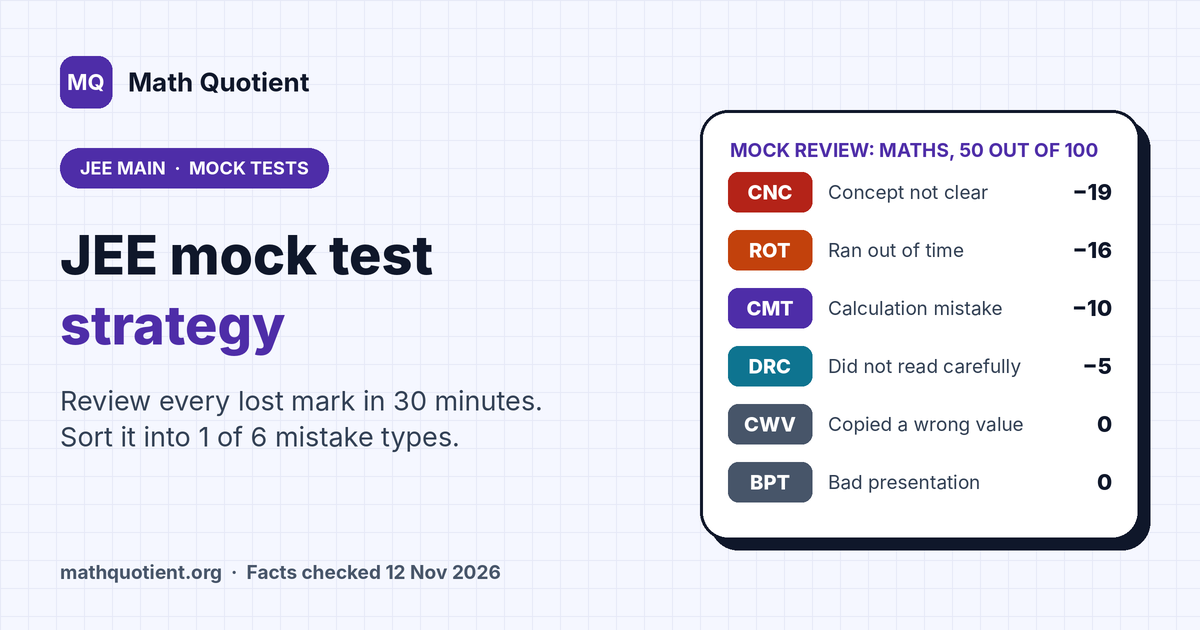
- Multiplies the powers instead of adding them: CNC, concept not clear.
- Reads −3² as (−3)²: DRC, did not read carefully.
- Thinks a⁰ = 0: CNC, concept not clear.
- Thinks 2⁻³ is a negative number: CNC, concept not clear.
- Works out 2³ as 6: CMT, calculation mistake.
The Free BMI Maths Test finds which of the 6 mistake types your child makes, and their real maths level. About the Free BMI Maths Test
Test prep corner
Exponents in SAT and JEE Main maths
College Board lists “Equivalent expressions” as a question type in the Advanced Math area of SAT maths. Exponent laws help you rewrite such expressions. These are SAT-style and JEE-style practice questions, not real past questions.
SAT-style: x and y are positive. Which expression is equal to (x⁶y⁻²)1/2?
Power of a power: multiply each exponent by 1/2. x⁶ becomes x³ and y⁻² becomes y⁻¹. So the answer is x³y⁻¹, which is x³/y. Check: (x³/y)² = x⁶/y².
JEE-style: Solve 4ˣ − 3 × 2ˣ − 4 = 0.
4ˣ = (2²)ˣ = (2ˣ)². Let t = 2ˣ. Then t² − 3t − 4 = 0, so (t − 4)(t + 1) = 0, and t = 4 or t = −1. A power of 2 is always positive, so 2ˣ = 4 and x = 2. Check: 16 − 12 − 4 = 0.
Practise more with our SAT-style maths practice questions, or read the JEE Main maths guide.
Facts checked on 9 November 2026 on satsuite.collegeboard.org.
Quick check: 5 exponent questions
1. What is 4³?
Not quite. 12 is 4 × 3.
Yes! 4 × 4 × 4 = 64.
Not quite. 81 is 3⁴, the other way round.
2. Simplify y⁷ ÷ y².
Yes! Divide, so take away: 7 − 2 = 5.
Not quite. You added. Divide means take away.
Not quite. You divided the exponents.
3. What is 6⁰?
Not quite. Any base except 0 to the power 0 is 1.
Not quite. 6 is 6¹.
Yes! 6 ÷ 6 = 1, so 6⁰ = 1.
4. What is 5⁻²?
Not quite. A negative power is a fraction, not a negative number.
Yes! 5⁻² = 1/5² = 1/25.
Not quite. That is 5 × −2.
5. Solve 2ˣ = 32.
Not quite. That is 32 ÷ 2.
Yes! 32 = 2⁵, so x = 5.
Not quite. That is 32 − 2.
Got 2 or fewer right? Book the Free BMI Maths Test to find the cause.
Questions people ask about exponents
Why is any number to the power 0 equal to 1?
Divide any power by itself, for example 5³ ÷ 5³. The answer is 1. The divide law also gives 5³⁻³ = 5⁰. So 5⁰ must be 1. This works for every base except 0.
What does a negative power mean?
It means 1 divided by the positive power. For example, 10⁻² = 1/10² = 1/100 = 0.01. With a positive base, the answer is still positive.
What is a fraction power?
The bottom of the fraction is a root and the top is a power. So 27 to the power 1/3 is the cube root of 27, which is 3. And 9 to the power 3/2 is 3³, which is 27.
Is (−2)² the same as −2²?
No. (−2)² = (−2) × (−2) = 4. But −2² means −(2 × 2) = −4. Without a bracket, the power acts only on the 2.
Keep exploring
Do powers and signs still mix your child up?
The Free BMI Maths Test finds your child’s real maths level and the reason for each mistake.
Written by Himanshu Jain
B.Tech, IIT Delhi. Founder of Math Quotient.