
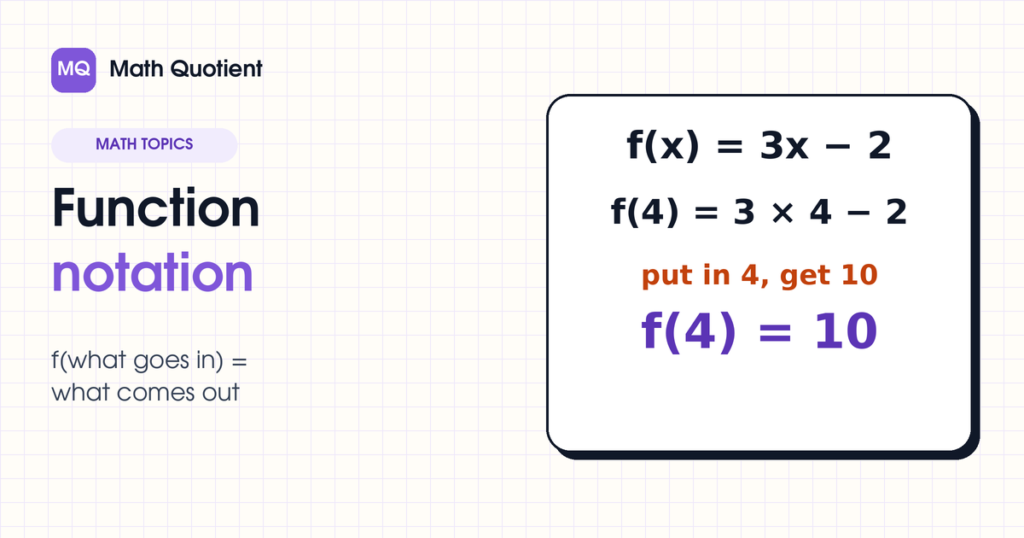
A function is a rule that gives exactly one output for each input. Function notation writes it as f(x), read “f of x”: f names the rule, x is the input, and f(x) is the output.
Put a number in. One number comes out.
f(4) = 3 × 4 − 2 = 10
Hello, curious mind!
What is a function in maths?
A function takes each input and gives back exactly one output. The inputs are often called x. The outputs are often called y or f(x).
A vending machine is like a function: press B4, and you always get the same drink.
y = 3x − 2 is a function. The circle x² + y² = 25 is not: x = 3 gives y = 4 and y = −4.
How to read function notation
- f(x) = 3x − 2 says “f multiplies x by 3, then takes away 2”.
- f(4) = 10 says “put in 4, get 10”. So (4, 10) is on the graph.
- f(x) does not mean f times x. The brackets hold the input.
Remember this
f(what goes in) = what comes out.
How to use function notation: 3 worked examples
Example 1: put in a number
f(x) = 2x² − 5x + 1. Find f(3) and f(−2).
Swap every x for 3: f(3) = 2(3)² − 5(3) + 1 = 18 − 15 + 1 = 4.
Swap every x for (−2), in brackets: f(−2) = 2(−2)² − 5(−2) + 1.
(−2)² = 4, so this is 8 + 10 + 1 = 19.
Example 2: put in an expression
g(x) = x² + 4x. Find g(a − 1).
Swap every x for (a − 1): g(a − 1) = (a − 1)² + 4(a − 1).
Expand: a² − 2a + 1 + 4a − 4.
g(a − 1) = a² + 2a − 3. This is not g(a) − 1, which is a² + 4a − 1.
Example 3: work back from the output
A bike shop charges C(n) = 30 + 8n dirhams for n hours (made-up prices). What does C(4) mean? For how many hours does AED 110 pay?
C(4) = 30 + 32 = 62. So 4 hours cost AED 62.
Now the output is known: 30 + 8n = 110, so 8n = 80.
n = 10 hours. Here you solve for the input. You do not work out C(110).
Domain and range
The domain is the set of inputs you may use. The range is the set of outputs you get. With real numbers, two things block an input.
| Function | What blocks an input | Domain | Range |
|---|---|---|---|
| k(x) = 1 ÷ (x − 4) | dividing by 0 at x = 4 | every x except 4 | every y except 0 |
| m(x) = √(x + 3) | a square root of a negative | x ≥ −3 | y ≥ 0 |
| p(x) = x² + 1 | nothing | every x | y ≥ 1 |
The range of p starts at 1, because x² is never negative.
Is a graph a function? Two line tests
- Vertical line test. If any up-and-down line meets the graph twice, it is not a function. The circle fails it.
- Horizontal line test. If any across line meets the graph twice, the function is not one-one. For f(x) = x², f(2) = f(−2) = 4, so it is not one-one.
One-one means different inputs give different outputs. Only a one-one function has an inverse.
Composite and inverse functions
A composite function feeds one output into the next function. f(g(x)) means: do g first, then f. Work from the inside out.
Take f(x) = 2x + 1 and g(x) = x².
- f(g(3)) = f(9) = 19.
- g(f(3)) = g(7) = 49.
Same functions, different order, different answers.
An inverse function undoes the rule. To find f⁻¹ for f(x) = 2x + 1, write y = 2x + 1, then make x the subject: x = (y − 1) ÷ 2. So f⁻¹(x) = (x − 1) ÷ 2.
Check: f⁻¹(19) = 18 ÷ 2 = 9, and f(9) = 19. The −1 in f⁻¹ is not a power. f⁻¹(x) is not 1 ÷ f(x).
Common function notation mistakes
- f(x) as multiplication. You cannot divide by f.
- Taking away outside, not inside. g(a − 1) is not g(a) − 1.
- No brackets round a negative input. Without them, f(−2) comes out as 3, not 19.
- The wrong order in a composite. f(g(3)) = 19, but doing f first gives 49.
- A copied sign. One flipped sign changes every output.
- f⁻¹ as a reciprocal. f⁻¹(19) = 9, but 1 ÷ f(19) = 1/39.
Check this with the Free BMI Maths Test
- Reads f(x) as f times x: CNC, concept not clear.
- Works out g(a − 1) as g(a) − 1: CNC, concept not clear.
- Writes −2² = −4 in f(−2), so gets 3, not 19: CMT, calculation mistake.
- Does f first in f(g(3)): DRC, did not read carefully.
- Copies the rule 2x² − 5x + 1 with + 5x: CWV, copied a wrong value.
- Writes f⁻¹(x) as 1 ÷ f(x): CNC, concept not clear.
The Free BMI Maths Test finds which of the 6 mistake types your child makes, and their real maths level. About the Free BMI Maths Test
Test prep corner
Functions in SAT and JEE Main maths
College Board lists “Linear functions” in SAT Algebra and “Nonlinear functions” in Advanced Math. In NTA’s JEE Main 2027 maths list, Unit 1 names “one-one, into and onto functions” and “the composition of functions”. These are SAT-style and JEE-style questions, not past questions.
SAT-style: The function p is defined by p(x) = 4x − 7. If p(k) = 21, what is the value of p(k + 2)?
4k − 7 = 21, so k = 7. Then p(9) = 36 − 7 = 29. Fast way: 2 more in adds 4 × 2 = 8 out. Trap: 23.
JEE-style: f(x) = (x + 1)/(x − 1), x ≠ 1. What is f(f(x))? (A) x (B) 1/x (C) −x (D) (x − 1)/(x + 1)
Top: (x + 1)/(x − 1) + 1 = 2x/(x − 1). Bottom: (x + 1)/(x − 1) − 1 = 2/(x − 1). Divide: x, answer (A). So f is its own inverse. Trap: (D) is 1 ÷ f(x).
Lines first? See what a linear equation is. Then try our SAT-style maths practice questions, with full working.
Facts checked on 14 November 2026 on satsuite.collegeboard.org and jeemain.nta.nic.in.
Quick check: 5 function questions
1. f(x) = x² − 3. What is f(−4)?
Yes! (−4)² = 16, and 16 − 3 = 13.
Not quite. (−4)² is +16, not −16.
Not quite. Square it, do not double it.
2. Which set of pairs is NOT a function?
Not quite. Inputs may share an output.
Yes! Input 1 has two outputs.
Not quite. One output each.
3. What is the domain of h(x) = 1 ÷ (x + 6)?
Yes! x = −6 makes the bottom 0.
Not quite. −7 works too.
Not quite. 6 + 6 = 12, not 0.
4. f(x) = x + 5 and g(x) = 3x. What is g(f(1))?
Not quite. That is f(g(1)).
Not quite. Put f(1) = 6 into g.
Yes! f(1) = 6, then g(6) = 18.
5. f(x) = 4x. What is f⁻¹(20)?
Not quite. f⁻¹ is not 1 ÷ f.
Yes! f(5) = 20.
Not quite. That is f(20).
Got 2 or fewer right? Book the Free BMI Maths Test to find the cause.
Questions people ask about function notation
What does f(x) mean?
It is the output of the function f when the input is x. It does not mean f times x.
What is the domain of a function?
The set of inputs you may use. Leave out inputs that divide by 0 or take the square root of a negative.
How do you know if a graph is a function?
Use the vertical line test. If any up-and-down line meets the graph twice, it is not a function.
Keep exploring
Does your child mix up f(a − 1) and f(a) − 1?
The Free BMI Maths Test finds your child’s real maths level and the reason for each mistake.