
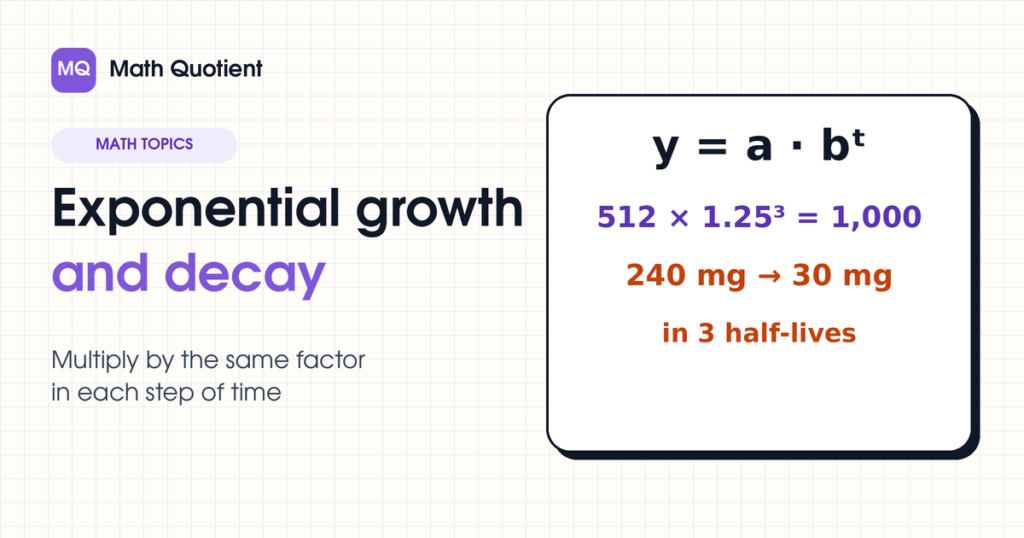
Exponential growth and decay happen when an amount is multiplied by the same factor in each equal step of time. A factor above 1 makes it grow. A factor between 0 and 1 makes it shrink, but never to zero.
Multiply, do not add.
y = a · bt
Hello, curious mind!
What is exponential growth and decay?
Each step changes the amount by a fixed share, not a fixed amount. Start three rows at 100.
| Step | 0 | 1 | 2 | 3 | 4 |
|---|---|---|---|---|---|
| Add 25 (linear) | 100 | 125 | 150 | 175 | 200 |
| × 1.25 (growth) | 100 | 125 | 156.25 | 195.31 | 244.14 |
| × 0.8 (decay) | 100 | 80 | 64 | 51.2 | 40.96 |
After step 1 the growth row pulls away: each 25% is of a bigger number. The decay drops shrink (20, 16, 12.8), so it never hits zero.
Remember this
Same difference each step: linear. Same ratio each step: exponential.
The exponential growth and decay formula
y = a · bt: a is the start (t = 0), b is the factor for one step, t counts the steps.
| You are told | The factor b | Model |
|---|---|---|
| Up 30% each year | 1 + 0.30 = 1.3 | y = a · 1.3t |
| Doubles every 3 hours | 2, once per 3 hours | y = a · 2t/3 |
| Halves every 8 days | ½, once per 8 days | y = a · (½)t/8 |
The factor is what is left after the change: a 30% fall leaves 70%, so b = 0.7. For “every 3 hours”, divide t by 3.
Exponential growth and decay examples: 3 worked sums
All numbers are made up.
Example 1: growth by a percent
A mangrove nursery has 512 seedlings. The count rises by 25% each year. How many after 3 years?
Up 25% means b = 1.25. The model is y = 512 · 1.25t.
Step by step: 512 → 640 → 800 → 1,000.
1,000 seedlings. The yearly gain grows: 128, 160, 200.
Example 2: decay by a percent
A garden tank holds 2,000 litres and loses 10% of what is left each day. How much is left after 3 days?
Down 10% leaves 90%, so b = 0.9.
2,000 × 0.9 = 1,800, then 1,620, then 1,458.
1,458 litres. It lost 542 litres, not 600, as each 10% is of a smaller amount.
Example 3: a doubling time
A yeast culture has 50 cells and doubles every 3 hours. How many cells after 12 hours?
The model is N = 50 · 2t/3. At t = 12, the power is 12 ÷ 3 = 4.
24 = 16, and 50 × 16 = 800.
800 cells.
Half-life and doubling time without logarithms
List the halvings or doublings. A tracer has a half-life of 8 days: half is left after each 8 days. It starts at 240 mg.
- 0 days: 240 · 8 days: 120 · 16 days: 60 · 24 days: 30 mg
- 32 days: 15 · 40 days: 7.5 mg
After 24 days, 3 half-lives, 30 mg is left: (½)3 = ⅛ of the start. When does it first fall below 10 mg? It is above at 32 days and below at 40, so between 32 and 40 days. The exact time, about 36.7 days, needs a logarithm.
Linear vs exponential growth: which wins?
Exponential growth passes linear growth in the end, even from a slower start. Town A adds 2,500 people a year. Town B grows 10% a year. Both start at 20,000.
| Year | Town A (+2,500) | Town B (× 1.1) |
|---|---|---|
| 1 | 22,500 | 22,000 |
| 5 | 32,500 | 32,210 |
| 6 | 35,000 | 35,431 |
| 15 | 57,500 | 83,545 |
In year 1, 10% of 20,000 is only 2,000, so Town A leads. Town B’s gain grows, and it leads from year 6.
Find the factor from two readings
A count goes from 1,000 to 1,331 in 3 years, with the same factor each year. Then b3 = 1,331 ÷ 1,000 = 1.331. Since 113 = 1,331, b = 1.1. That is 10% a year, not 33.1% ÷ 3 ≈ 11.03%.
Common mistakes with exponential growth and decay
Six slips, each tied to an example above.
Check this with the Free BMI Maths Test
- Uses b = 0.1 for a 10% fall: CNC, concept not clear.
- Takes 200 litres a day and gets 1,400: CNC, concept not clear.
- Works out 512 × 1.25 × 3 = 1,920 in place of 512 × 1.25³: CMT, calculation mistake.
- Counts 24 days as 24 half-lives: DRC, did not read carefully.
- Copies 1.25 as 1.52: CWV, copied a wrong value.
- Writes (512 × 1.25)³: only b takes the power: BPT, bad presentation.
The Free BMI Maths Test finds which of the 6 mistake types your child makes, and their real maths level. About the Free BMI Maths Test
Test prep corner
Exponential growth and decay in SAT and JEE Main maths
College Board names exponential equations in SAT Advanced Math. NTA’s JEE Main 2027 maths list names exponential functions (Unit 7) and separation of variables (Unit 9). These are SAT-style and JEE-style questions, not past questions.
SAT-style: A table shows x = 0, 1, 2, 3 and y = 81, 54, 36, 24. Which equation fits? (A) y = 81 − 27x (B) y = 81(2/3)x (C) y = 81(1/3)x (D) y = 24(3/2)x
Each y is ⅔ of the one before, and the start is 81: (B). Trap: (A) fits only the first step; the gaps are 27, 18, 12.
JEE-style: A population N grows with dN/dt = kN, where k is a constant. It doubles in 3 hours. How long does it take to become 8 times its first size?
dN/N = k dt, so N = N0ekt. Doubling in 3 hours: e3k = 2. Then 8 = 23 = e9k: 9 hours. Trap: 12 hours treats it as linear.
Money growth is on simple and compound interest. Then try our SAT-style maths practice questions.
Facts checked on 14 November 2026 on satsuite.collegeboard.org and jeemain.nta.nic.in.
Quick check: 5 growth and decay questions
1. Which equation shows exponential decay?
Yes! 0.6 is between 0 and 1.
Not quite. Same drop each step: linear.
Not quite. x is not in the power.
2. A count starts at 30 and doubles every 4 hours. What is it after 12 hours?
Not quite. That adds, not doubles.
Not quite. Three doublings make × 8.
Yes! 30 × 8 = 240.
3. A value falls by 35% each year. What is the factor b?
Not quite. That is the part lost.
Yes! 65% is left.
Not quite. That is a rise.
4. The half-life is 10 years. What share is left after 30 years?
Not quite. Halve three times.
Yes! (½)³ = ⅛.
Not quite. That is 20 years.
5. Which is bigger in the long run?
Not quite. It leads, but not for ever.
Yes! It passes 1,000x near x = 1,424.
Not quite. They meet once, then part.
Got 2 or fewer right? Book the Free BMI Maths Test to find the cause.
Questions people ask about exponential growth and decay
What is the difference between exponential growth and decay?
Both multiply by one factor each step. Growth: more than 1. Decay: between 0 and 1.
What is the exponential growth and decay formula?
y = a · b to the power t. For a rise of r, b = 1 + r. For a fall of r, b = 1 − r.
Does exponential decay ever reach zero?
No. Each step keeps a fixed share, so it gets closer to zero but never reaches it.
Keep exploring
Does your child mix up growth and decay?
The Free BMI Maths Test finds your child’s real maths level and the reason for each mistake.