
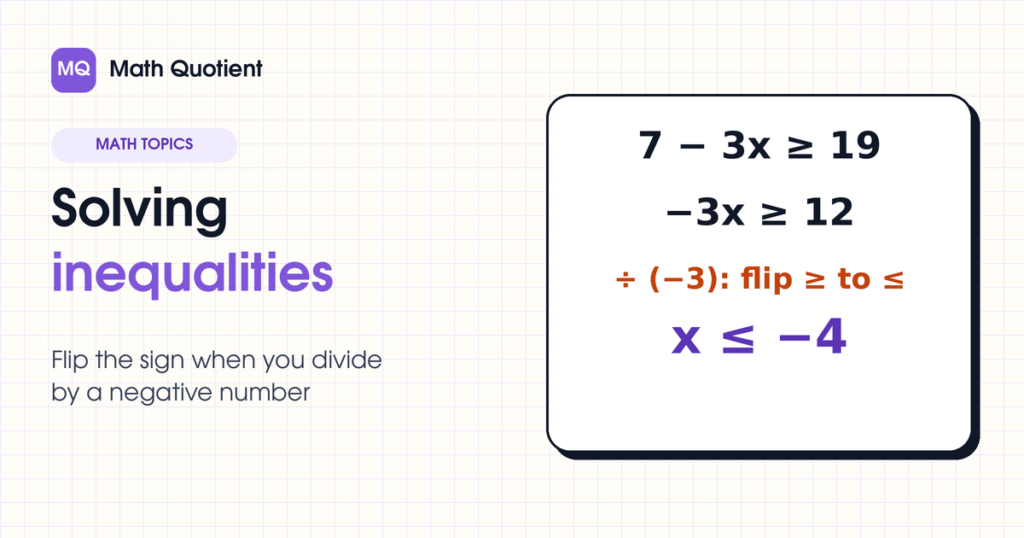
Solving inequalities works like solving equations, with one extra rule. When you multiply or divide both sides by a negative number, flip the sign. The answer is a range of numbers, not one number.
The answer is a stretch of the number line.
−2 < x ≤ 3
Hello, curious mind!
What are inequalities?
An inequality says that one side is bigger or smaller than the other. An equation says two sides are equal. An inequality uses one of four signs.
| Sign | Read it as | Example | Is the end number in? |
|---|---|---|---|
| < | less than | x < 4 | No |
| > | greater than | x > 4 | No |
| ≤ | less than or equal to | x ≤ 4 | Yes |
| ≥ | greater than or equal to | x ≥ 4 | Yes |
“No more than 7 kg of hand luggage” is weight ≤ 7.
Remember this
A line under the sign means equal is allowed.
Solving inequalities: when the sign flips
Do the same thing to both sides, as with an equation. Only one move flips the sign.
- Add or subtract any number, even a negative one: keep the sign.
- Multiply or divide by a positive number: keep the sign.
- Multiply or divide both sides by a negative number: flip the sign. < becomes >, and ≤ becomes ≥.
Why? 2 < 5 is true. Multiply both sides by −1: −2 is to the right of −5, so −2 > −5. A negative number turns the order round.
How to solve inequalities: 3 worked examples
Example 1: divide by a negative number
Solve 7 − 3x ≥ 19.
Subtract 7 from both sides: −3x ≥ 12. No flip yet.
Divide both sides by −3. This is a negative number, so flip ≥ to ≤.
x ≤ −4.
Check: x = −5 gives 22 ≥ 19, true. x = 0 gives 7 ≥ 19, false. Good.
Example 2: a double inequality
Solve −5 < 4x + 3 ≤ 15, and list the whole numbers that work.
Subtract 3 from all three parts: −8 < 4x ≤ 12.
Divide all three parts by 4: −2 < x ≤ 3.
The whole numbers are −1, 0, 1, 2 and 3. −2 is not in, as the sign is <.
Example 3: a word problem with “at most”
A taxi ride costs AED 12 to start plus AED 2.50 for each km (made-up fares). You have AED 50. How many whole km can you go?
The cost must be at most 50: 12 + 2.5k ≤ 50.
Subtract 12: 2.5k ≤ 38. Divide by 2.5: k ≤ 15.2.
Round down: 15 km. 16 km costs AED 52.
Show the answer: number lines and interval notation
An open circle means the end number is not in. A filled circle means it is in.
Interval notation uses brackets. Round ( ) means “not in”. Square [ ] means “in”. Infinity, ∞, always gets a round bracket.
| Inequality | Number line | Interval |
|---|---|---|
| x ≤ −4 | filled circle at −4, shade left | (−∞, −4] |
| −2 < x ≤ 3 | open at −2, filled at 3, shade between | (−2, 3] |
Quadratic and two-variable inequalities
A quadratic inequality: use the signs of the factors
Solve x² − x − 12 < 0.
Factorise: (x − 4)(x + 3) < 0. The graph crosses zero at x = −3 and x = 4.
A product is negative when the factors have opposite signs. That happens only between the roots.
−3 < x < 4. Test x = 0: 0 − 0 − 12 = −12, which is less than 0. Good.
For x² − x − 12 > 0, take the outside: x < −3 or x > 4. The U-shaped graph is below the x-axis only between the roots.
Never multiply by x
Solve 3/x < 1. Multiplying by x gives x > 3, but x could be negative, and then the sign must flip. In fact every negative x works, as 3/x is then negative. The full answer is x < 0 or x > 3. Safe method: write (3 − x)/x < 0 and check the signs of the top and bottom.
Two variables: shade a region
For y > 2x − 1, draw the line y = 2x − 1 dashed (points on it are not in). Test (0, 0): 0 > −1 is true, so shade that side.
Common mistakes when solving inequalities
- No flip after dividing by a negative. In Example 1 this gives x ≥ −4, but x = 0 fails.
- A flip where none is needed. x − 6 > −2 gives x > 4, with no flip.
- Multiplying by x. In 3/x < 1 this loses every negative answer.
- Rounding the wrong way. k ≤ 15.2 means 15 whole km, not 16.
- Copying the sign wrongly. ≥ copied as > drops the end number.
- The wrong circle or bracket. < and > get open circles and round brackets.
Check this with the Free BMI Maths Test
- Divides by −3 and keeps ≥: CNC, concept not clear.
- Flips the sign after subtracting a negative number: CNC, concept not clear.
- Multiplies 3/x < 1 by x and loses the negative answers: CNC, concept not clear.
- Rounds 15.2 km up to 16 when the question says at most AED 50: DRC, did not read carefully.
- Copies ≥ from the question as >: CWV, copied a wrong value.
- Uses a filled circle for <, or writes (3, −2]: BPT, bad presentation.
The Free BMI Maths Test finds which of the 6 mistake types your child makes, and their real maths level. About the Free BMI Maths Test
Test prep corner
Inequalities in SAT and JEE Main maths
College Board lists “Linear inequalities in 1 or 2 variables” as an SAT Algebra skill. NTA’s JEE Main 2027 maths topic list does not name inequalities as a topic. You still use them there, for example for real roots of a quadratic (Unit 2). These are SAT-style and JEE-style questions, not past questions.
SAT-style: A van can carry at most 1,200 kg. The driver weighs 80 kg and each box weighs 35 kg. What is the greatest number of boxes the van can carry with the driver?
80 + 35b ≤ 1,200, so 35b ≤ 1,120 and b ≤ 32: 32 boxes. Trap: forgetting the driver gives 34.
JEE-style: For which values of k does x² + kx + 9 = 0 have real roots? (A) −6 < k < 6 (B) k ≤ −6 or k ≥ 6 (C) k ≥ 6 only (D) every k
Real roots need k² − 36 ≥ 0, so (k − 6)(k + 6) ≥ 0, the outside of the roots: k ≤ −6 or k ≥ 6, answer (B). Trap: (C) forgets the negative k.
Equations first? See what a linear equation is. Then try our SAT-style maths practice questions, with full working.
Facts checked on 14 November 2026 on satsuite.collegeboard.org and jeemain.nta.nic.in.
Quick check: 5 inequality questions
1. Solve −2x > 10.
Not quite. Flip the sign.
Yes! Divide by −2 and flip.
Not quite. 10 ÷ (−2) is −5, not 5.
2. Which interval means 1 ≤ x < 6?
Yes! 1 is in, 6 is out.
Not quite. The brackets are swapped.
Not quite. 6 is not in, as the sign is <.
3. Solve x² < 25.
Not quite. x = −6 fails.
Not quite. That is the answer to x² > 25.
Yes! Between the roots −5 and 5.
4. What is the smallest whole number with 3x + 4 > 19?
Not quite. 5 is not in.
Yes! x > 5, so 6.
Not quite. 6 also works.
5. Is the point (2, 1) a solution of y ≥ 3x − 4?
Not quite. 1 ≥ 2 is false.
Yes! 1 ≥ 2 is false.
Not quite. The line style changes nothing here.
Got 2 or fewer right? Book the Free BMI Maths Test to find the cause.
Questions people ask about inequalities
What are inequalities in maths?
Statements that one side is bigger or smaller than the other.
When do you flip the inequality sign?
Only when you multiply or divide both sides by a negative number. Adding or subtracting never flips it.
How do you solve a quadratic inequality?
Factorise and find the roots. Less than 0: between the roots. Greater than 0: outside them (when the x² term is positive).
Does your child forget to flip the sign?
The Free BMI Maths Test finds your child’s real maths level and the reason for each mistake.