
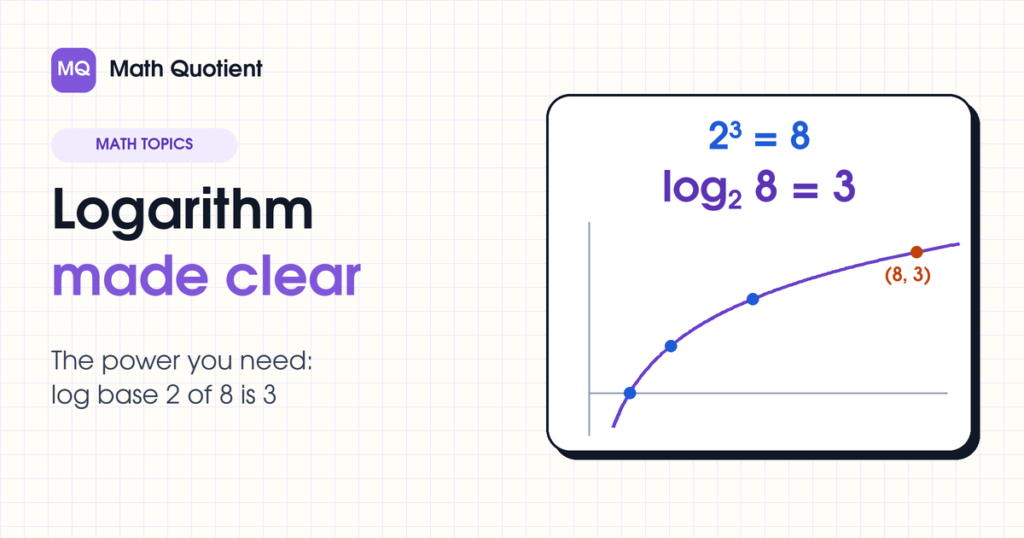
A logarithm is the power you need. log₂ 8 = 3, because 2³ = 8. This page covers the meaning, the log laws, change of base and log equations.
A log undoes a power.
2³ = 8 ⇔ log₂ 8 = 3
Hello, curious mind!
What is a logarithm?
logb x = y means by = x. The small number b is the base. The answer y is the power you put on the base to get x.
Read log₂ 8 as “log base 2 of 8”.
- log₁₀ 1,000 = 3, because 10³ = 1,000.
- log₂ (1/8) = −3, because 2⁻³ = 1/8. A log can be negative.
- log₅ 1 = 0, because 5⁰ = 1. The log of 1 is 0 in every base.
Two bases have short names. “log” with no base often means base 10, the common log. “ln” means base e, where e ≈ 2.718. That is the natural log.
Two rules always hold. The base is positive and not 1. The number inside, x, must be greater than 0. See exponents and powers for how powers work.
Remember this
A log answers one question: what power?
How to work out a logarithm: 3 worked examples
Example 1: find log₃ 81
Ask: 3 to what power gives 81?
Count up: 3, 9, 27, 81. That is 3⁴.
log₃ 81 = 4.
Example 2: simplify log₆ 4 + log₆ 9
Same base, and the logs are added. So multiply the numbers inside: log₆ (4 × 9) = log₆ 36.
6² = 36, so the answer is 2.
Example 3: solve 2ˣ = 10
2³ = 8 and 2⁴ = 16, so x is between 3 and 4.
Take log₁₀ of both sides: x log 2 = log 10 = 1.
x = 1 ÷ log 2 = 1 ÷ 0.30103 ≈ 3.3219. Check: 2 to the power 3.3219 ≈ 10.
The log laws, with the wrong use next to each
Each law comes from an exponent law. The bases must match. The last column shows a slip that looks right but is false.
| Law | Right use | Wrong use |
|---|---|---|
| Product: log(mn) = log m + log n | log₂ 32 = log₂ 4 + log₂ 8 = 2 + 3 = 5 | log₂ (4 + 4) is not log₂ 4 + log₂ 4. It is 3, not 4. |
| Quotient: log(m/n) = log m − log n | log₃ (243/9) = 5 − 2 = 3 | log₃ 243 ÷ log₃ 9 = 5/2. That is a different number. |
| Power: log(mᵏ) = k log m | log₂ (8⁵) = 5 × 3 = 15 | (log₂ 8)² = 9, but log₂ (8²) = 6. |
| Change of base: logb x = log x ÷ log b | log₄ 32 = log₂ 32 ÷ log₂ 4 = 5/2 | Upside down: log₂ 4 ÷ log₂ 32 = 0.4. |
Which law do I use? Logs added: product. Logs taken away: quotient. A power inside: power law. A base your calculator does not have: change of base. No law splits log(m + n).
Not sure of a rule? Test it with numbers: 2 log 5 + log 4 = log 100 = 2.
Log equations and the “is x allowed?” check
Solve log x + log(x − 3) = 1, with base 10.
Product law: log(x(x − 3)) = 1.
Undo the log: x(x − 3) = 10¹ = 10.
x² − 3x − 10 = 0, so (x − 5)(x + 2) = 0. x = 5 or x = −2.
Check each root in the first equation. x = −2 gives log(−2), which does not exist. So x = 5 only. Check: log 5 + log 2 = log 10 = 1.
Always test roots in the first line, not the last.
Solving for time with logs
AED 10,000 grows at 6% a year, added yearly (made-up numbers). When does it pass AED 15,000?
10,000 × 1.06ᵗ = 15,000, so 1.06ᵗ = 1.5.
t = log 1.5 ÷ log 1.06 ≈ 6.96.
So it passes AED 15,000 during year 7.
For more on growth like this, see simple and compound interest.
Common logarithm mistakes
- Splitting the log of a sum. log(a + b) is not log a + log b. Test: log₂ (4 + 4) = 3, but log₂ 4 + log₂ 4 = 4.
- Keeping a root that makes a log of a negative. x = −2 above fails in the first line.
- Reading the base and the number the wrong way round. log₂ 8 = 3, but log₈ 2 = 1/3.
- Squaring the log, not the number. log₂ (8²) = 2 × 3 = 6. Writing (log₂ 8)² = 9 is a different sum.
- Leaving out the base. “log 8 = 3” is false in base 10. Write log₂ 8 = 3.
Check this with the Free BMI Maths Test
- Splits log(a + b) into log a + log b: CNC, concept not clear.
- Keeps x = −2 and so takes the log of a negative: DRC, did not read carefully.
- Reads log₂ 8 as log₈ 2: CWV, copied a wrong value.
- Works out (log₂ 8)² in place of log₂ (8²): CMT, calculation mistake.
- Leaves out the base: BPT, bad presentation.
The Free BMI Maths Test finds which of the 6 mistake types your child makes, and their real maths level. About the Free BMI Maths Test
Test prep corner
Logarithms in JEE Main and the SAT
NTA’s JEE Main 2027 maths topic list names “logarithmic and exponential functions” in two calculus units. College Board’s SAT Advanced Math page does not name logarithms. These are JEE-style questions, not real past questions.
JEE-style: Given log₁₀ 2 = 0.3010, how many digits does 2⁵⁰ have? (A) 15 (B) 16 (C) 50 (D) 151
log₁₀ 2⁵⁰ = 50 × 0.3010 = 15.05. A number with log between 15 and 16 has 16 digits, answer (B). Trap: (A) forgets the + 1.
JEE-style: Find log₂ 3 × log₃ 4 × log₄ 5 × log₅ 6 × log₆ 7 × log₇ 8.
Write each as a change of base: (log 3/log 2)(log 4/log 3) … (log 8/log 7). Everything cancels except log 8 ÷ log 2 = log₂ 8 = 3. Trap: working out decimals wastes time.
Want a longer set? Try our JEE-style maths questions with answers.
Facts checked on 14 November 2026 on jeemain.nta.nic.in and satsuite.collegeboard.org.
Quick check: 5 logarithm questions
1. What is log₅ 125?
Not quite. 25 is 125 ÷ 5. Ask “what power?”
Yes! 5³ = 125.
Not quite. That is log₁₂₅ 5, the other way round.
2. What is log₇ 1?
Yes! 7⁰ = 1.
Not quite. log₇ 7 is 1. log₇ 1 is 0.
Not quite. 7¹ = 7, not 1.
3. In base 10, log 20 + log 5 = ?
Not quite. Added logs mean multiply inside, not add.
Not quite. 100 is inside the log. log 100 = 2.
Yes! log(20 × 5) = log 100 = 2.
4. What is log₂ 0.25?
Not quite. 2² = 4, not 0.25.
Yes! 0.25 = 1/4 = 2⁻².
Not quite. 0.25 is positive, so its log exists. It is negative.
5. Solve 3ˣ = 20, to 2 decimal places.
Not quite. That is 20 ÷ 3. A power is not a times.
Not quite. That is log 3 ÷ log 20, upside down.
Yes! log 20 ÷ log 3 ≈ 2.73. It sits between 2 and 3, as 9 < 20 < 27.
Got 2 or fewer right? Book the Free BMI Maths Test to find the cause.
Questions people ask about logarithms
What is a logarithm in simple words?
It is the power you need. log₂ 8 asks: 2 to what power gives 8? The answer is 3.
What are the log laws?
Product: log(mn) = log m + log n. Quotient: log(m/n) = log m − log n. Power: log(mᵏ) = k log m. Change of base: logb x = log x ÷ log b.
What is the difference between log and ln?
Only the base. log often means base 10; ln means base e, about 2.718. The same laws hold.
Can you take the log of a negative number?
Not as a real number. A positive base to any power stays positive.
How do I solve 2^x = 10?
Take logs of both sides: x = log 10 ÷ log 2 ≈ 3.3219.
Keep exploring
Does your child split log(a + b)?
The Free BMI Maths Test finds your child’s real maths level and the reason for each mistake.