Compound interest is interest on the start amount and on interest already added. Simple interest is on the start amount only. So compound grows faster.
Simple grows in steps. Compound grows on itself.
I = Prt · A = P(1 + r)t
Hello, curious mind!
What are simple and compound interest?
Interest is extra money paid for the use of money. The rate is a percentage for each year.
| Simple interest | Compound interest | |
|---|---|---|
| Interest is on | The start amount only | The start amount plus past interest |
| Formula | I = Prt, total A = P + I | A = P(1 + r/n)nt |
P = start amount. r = yearly rate as a decimal (4% = 0.04). t = years. n = times a year the interest is added (1 yearly, 12 monthly).
This page teaches maths, not money advice. All AED amounts are made up.
How to work out simple and compound interest: 3 examples
Example 1: simple interest
You save AED 8,000 at 4% simple interest for 3 years (made-up numbers).
I = Prt = 8,000 × 0.04 × 3 = AED 960.
Total = 8,000 + 960 = AED 8,960.
Example 2: compound interest, added yearly
The same AED 8,000 at 4% for 3 years, with interest added each year.
Multiply by 1.04 once for each year: A = 8,000 × 1.04³ = AED 8,998.91.
Interest = AED 998.91, which is AED 38.91 more than simple.
Example 3: compounded monthly
AED 8,000 at 6% a year, compounded monthly, for 2 years.
Rate each month: 0.06 ÷ 12 = 0.005. Months: 12 × 2 = 24.
A = 8,000 × 1.005²⁴ ≈ AED 9,017.28.
Added yearly, it would be AED 8,988.80. Monthly earns AED 28.48 more, as interest starts to earn sooner.
Compound interest vs simple interest: a 5-year table
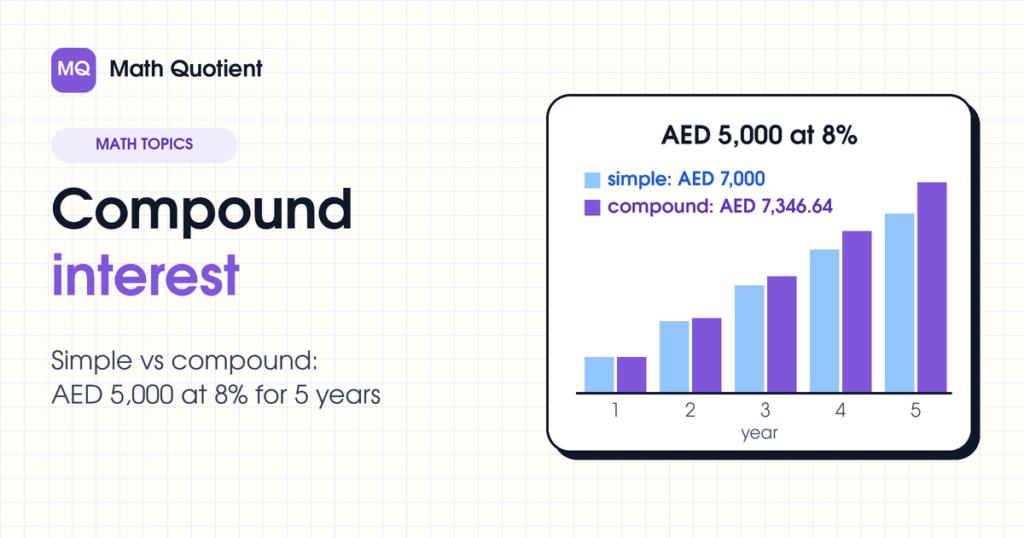
AED 5,000 at 8% a year (made-up numbers). Simple adds AED 400 each year. Compound adds 8% of the new total.
| Year | Simple (AED) | Compound (AED) | Gap (AED) |
|---|---|---|---|
| 1 | 5,400 | 5,400.00 | 0 |
| 2 | 5,800 | 5,832.00 | 32.00 |
| 3 | 6,200 | 6,298.56 | 98.56 |
| 4 | 6,600 | 6,802.44 | 202.44 |
| 5 | 7,000 | 7,346.64 | 346.64 |
They split in year 2, when the first AED 400 starts to earn too. Then the gap grows faster each year.
Working backwards: find the rate or the time
- Rate, simple: AED 2,000 becomes AED 2,300 in 5 years. 300 = 2,000 × r × 5, so r = 3%.
- Rate, compound: AED 4,000 becomes AED 4,840 in 2 years. (1 + r)² = 1.21, so 1 + r = 1.1 and r = 10%.
- Time: When does the compound column pass AED 7,000? It is below after year 4 and above after year 5, so during year 5.
Quick doubling check: 72 ÷ rate. At 8%, that is 9 years (exact: about 9.01).
The same idea on the SAT: A = P(1 + r)t
Yearly compound interest is an exponential function, f(t) = a × bt:
- a is the start value, P.
- b is the growth factor, 1 + r. So b = 1.08 means 8% growth each year.
- b = 0.92 means an 8% drop each year (decay).
Simple interest, A = P + Prt, is a straight line with slope Pr. See exponents for how powers work.
Common interest mistakes
- Using 4 for 4%. 8,000 × 4 × 3 = 96,000. The rate must be 0.04.
- Giving the interest when the question asks for the total. In Example 1, AED 960 is the interest. The total is AED 8,960.
- Using the yearly rate with monthly periods. 8,000 × 1.06²⁴ ≈ 32,391.48. Use 1.005²⁴.
- Rounding each year. Rounding the 8% table to the nearest AED 100 each year ends at 7,300, not 7,346.64.
- Mixing months and years. 18 months is t = 1.5, not 18: AED 480 at 4% on AED 8,000, not AED 5,760.
Check this with the Free BMI Maths Test
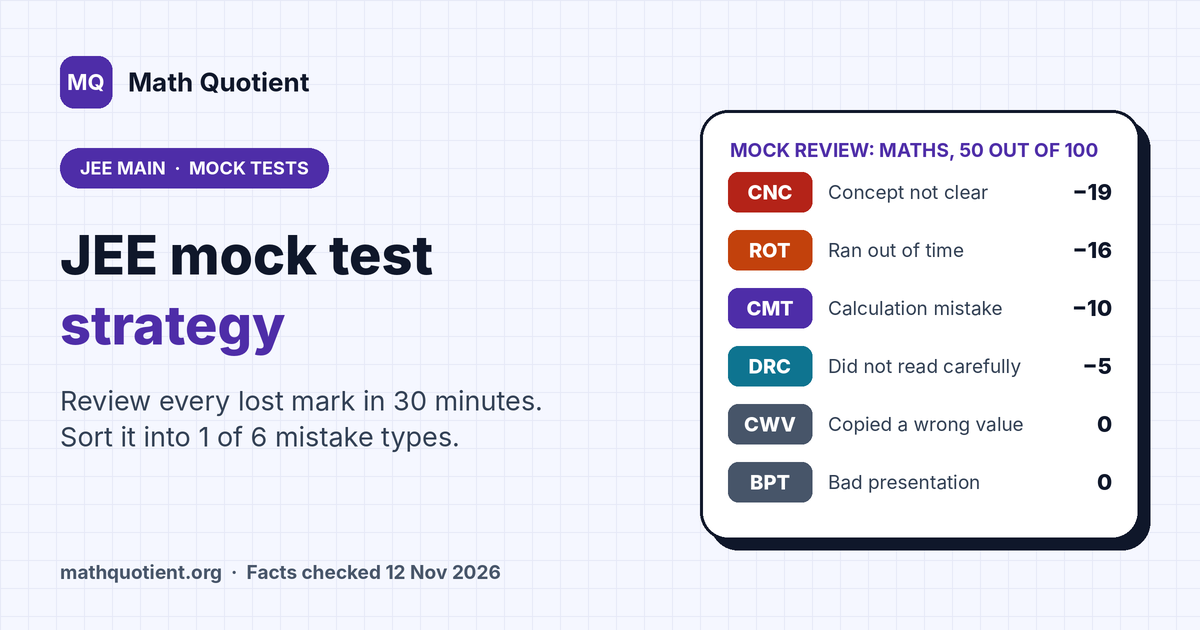
- Writes 4 in place of 0.04 for 4%: CNC, concept not clear.
- Gives the interest when the total was asked: DRC, did not read carefully.
- Uses the yearly rate with monthly periods: CNC, concept not clear.
- Rounds each year of the table: CMT, calculation mistake.
- Puts months where years go: CWV, copied a wrong value.
The Free BMI Maths Test finds which of the 6 mistake types your child makes, and their real maths level. About the Free BMI Maths Test
Test prep corner
Interest questions on the SAT
College Board’s SAT overview lists “Percentages” in Problem-Solving and Data Analysis, and exponential equations in Advanced Math. It does not name compound interest, but money growth uses the same maths. Both questions are SAT-style, written by us.
SAT-style: The value of a savings plan, in AED, is V(t) = 3,500(1.07)t, where t is years. What does 1.07 mean? (A) It grows AED 1.07 a year. (B) It grows 7% a year. (C) It grows 107% a year. (D) The start value is AED 1.07.
(B). The factor is 1 + r, so r = 7%. Trap: (C) reads the whole factor as the rise.
SAT-style: AED 1,500 earns simple interest and is AED 1,770 after 3 years. What is the yearly rate, in percent?
270 = 1,500 × r × 3, so r = 270 ÷ 4,500 = 0.06. Answer: 6. Trap: 270 ÷ 1,500 = 18% covers all 3 years.
More mixed practice: see the SAT-style maths practice questions.
Facts checked on 12 November 2026 on satsuite.collegeboard.org.
Quick check: 5 interest questions
1. Simple interest on AED 600 at 3% a year for 4 years is:
Not quite. That is the total, not the interest.
Yes! 600 × 0.03 × 4 = 72.
Not quite. 3% is 0.03, not 3.
2. AED 1,000 at 10% compounded yearly for 2 years becomes:
Yes! 1,000 × 1.1² = 1,210.
Not quite. Year 2 earns 10% of 1,100.
Not quite. That is after 1 year only.
3. 8% a year, compounded quarterly. What is the rate for each quarter?
Not quite. 8% is for the whole year.
Not quite. Divide by 4, do not multiply.
Yes! 8% ÷ 4 = 2%.
4. Same amount, same yearly rate. After exactly 1 year, compound (added yearly) gives:
Not quite. No interest has been added yet.
Yes! They split from year 2.
Not quite. Compound is never less here.
5. f(t) = 900(0.85)t. What happens each year?
Yes! 1 − 0.85 = 0.15, a 15% drop.
Not quite. 85% is what is left, not what is lost.
Not quite. A factor below 1 means a fall.
Got 2 or fewer right? Book the Free BMI Maths Test to find the cause.
Questions people ask about compound interest
What is the compound interest formula?
A = P(1 + r/n)ⁿᵗ, with r as a decimal and n the times interest is added each year. Interest = A − P.
What is the difference between simple and compound interest?
Simple interest is on the start amount only. Compound interest is also on past interest, so it grows faster.
How do I find the rate from the amount?
Simple: r = I ÷ (Pt). Compound, added yearly: take the t-th root of A ÷ P, then subtract 1.
What does compounded monthly mean?
Interest is added 12 times a year. Use r ÷ 12 for each month and 12t months in all.
Is compound interest on the SAT?
College Board does not name it. But its SAT overview lists percentages and exponential equations, and compound interest uses both.
Keep exploring
Is it 4 or 0.04? Small slips, big gaps.
Book the Free BMI Maths Test to see your child’s real maths level and the cause of each mistake.
Written by Himanshu Jain
B.Tech, IIT Delhi. Founder of Math Quotient.