
To change fractions to decimals fast, look at the bottom number first. It tells you which method to use: make it 100, read a repeat, or rotate a known cycle.
This page gives 6 mental methods for fractions to decimals, sorted by the bottom number. Each one saves time on SAT answer choices or on JEE Main, where no calculator is allowed.
Read the bottom. Pick the method. Check the size.
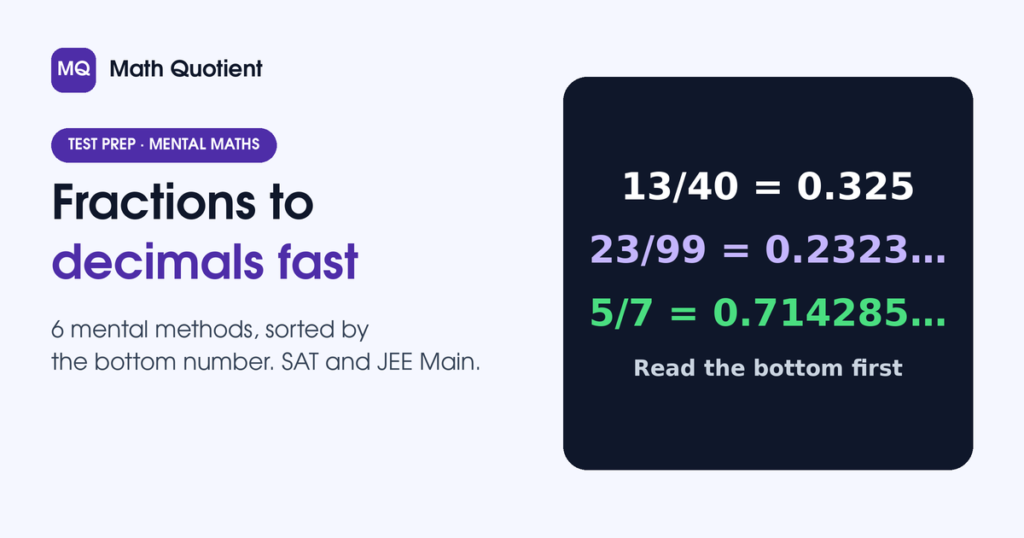
13/40 = 0.325 23/99 = 0.2323… 5/7 = 0.714285…
Quick answer
First, write the fraction in lowest terms.
Bottom made of only 2s and 5s (20, 40, 125): the decimal stops. Scale the bottom to 10, 100 or 1,000.
Bottom 9, 99 or 999: the top repeats. 23/99 = 0.2323…
Bottom 7 or 11: use a known cycle. Bottom 3 × 2s and 5s (6, 12, 15): divide by 3 first.
The eighths (1/8 = 0.125 and so on) are on our mental maths tricks page. This page adds the other bottoms.
Fractions to decimals: which method for which bottom
Find the bottom number of your fraction in the left column. Use the method in that row.
| Bottom (lowest terms) | Method | Example |
|---|---|---|
| Only 2s and 5s: 20, 40, 125 | 1. Make it 10, 100 or 1,000 | 13/40 = 0.325 |
| 9, 99, 999 | 2. Read the repeat | 23/99 = 0.2323… |
| 11 | 3. Times 9, over 99 | 8/11 = 0.7272… |
| 7 | 4. Rotate 142857 | 5/7 = 0.714285… |
| 3 times 2s and 5s: 6, 12, 15, 45 | 5. Divide by 3 first | 11/15 = 0.7333… |
| Anything else: 17, 24, 49 | 6. Use a near, easy bottom | 17/49 ≈ 0.34 |
The 6 mental methods, with examples
1. Make the bottom 10, 100 or 1,000
Multiply the top and the bottom by the same number, so the bottom becomes a power of 10. Then read the decimal.
- 7/20: times 5 gives 35/100 = 0.35.
- 13/40: times 25 gives 325/1,000 = 0.325.
- 9/125: times 8 gives 72/1,000 = 0.072. Keep the zero after the point.
How many decimal places? Write the bottom as 2s and 5s. The bigger power gives the number of places. 40 = 2³ × 5, so 3 places. 16 = 2⁴, so 4 places: 3/16 = 0.1875.
Reduce first. 21/60 looks like it will repeat, because 60 has a 3. But 21/60 = 7/20 = 0.35, and it stops. 7/30 is already in lowest terms, so it repeats: 0.2333…
2. Bottom 9, 99 or 999: read the repeat
One digit over 9 repeats that digit. Two digits over 99 repeat that pair. Three digits over 999 repeat that group.
- 4/9 = 0.444…
- 23/99 = 0.2323…
- 7/99 = 0.0707… Write 7 as 07, so the pair has two digits.
- 37/999 = 0.037037…
3. Bottom 11: times 9, over 99
11 × 9 = 99. So multiply the top by 9 and use method 2.
- 3/11 = 27/99 = 0.2727…
- 8/11 = 72/99 = 0.7272…
Check: the two repeating digits of any k/11 add up to 9 (2 + 7, 7 + 2).
4. Bottom 7: rotate 142857
Every fraction with bottom 7 uses the same six digits, 142857, in a loop. Only the start changes. Find the first digit with a rough sum, then read the loop from there.
- 3/7: 3 ÷ 7 is a bit over 0.4. Start at the 4: 0.428571…
- 5/7: 5 ÷ 7 is just over 0.7. Start at the 7: 0.714285…
- 6/7: 6 ÷ 7 is about 0.86. Start at the 8: 0.857142…
5. Bottom 6, 12, 15 or 45: divide by 3 first
Split the bottom into 3 (or 9) times 2s and 5s. Divide the top by 3 first. Then halve, quarter or divide by 5.
- 5/6: 5 ÷ 3 = 1.666…, then half is 0.8333…
- 7/12: 7 ÷ 3 = 2.333…, then a quarter is 0.58333…
- 11/15: 11 ÷ 3 = 3.666…, then ÷ 5 (times 2, then ÷ 10) is 0.7333…
6. Any other bottom: use a near, easy bottom
Move the bottom to the nearest easy number. This gives an estimate, not an answer. Use it to rule out options.
- 17/49 ≈ 17/50 = 0.34. The true value is 0.3469…
- 13/24 ≈ 13/25 = 0.52. The true value is 0.5416…
- 29/51 ≈ 29/50 = 0.58. The true value is 0.5686…
Which way is the error? If you made the bottom bigger, the true value is bigger than your estimate. If you made the bottom smaller, the true value is smaller.
Top bigger than the bottom? Take out the whole number first. 47/11 = 4 + 3/11 = 4.2727… and 53/6 = 8 + 5/6 = 8.8333…
Common mistakes with fractions to decimals
- Reading 7/99 as 0.77… The repeat must have as many digits as the 9s. It is 0.0707… Type: CNC, concept not clear.
- Not reducing first. 21/60 is 7/20, which stops at 0.35. Type: CNC.
- Scaling only the bottom. 13/40 is not 13/1,000. Multiply the top by 25 too. Type: CMT, calculation mistake.
- Starting the 142857 loop at the wrong digit. 3/7 is not 0.142857… Do the rough sum first. Type: CMT.
- Rounding too early. Use 0.58 for 7/12, multiply by 12, and you get 6.96, not 7. Keep the fraction until the last step. Type: CMT.
- Using an estimate as the final answer. 17/49 is not 0.34. An estimate rules out options. It does not choose between two close ones. Type: DRC, did not read carefully, when the question asks for an exact value.
Free BMI Maths Test
Slips or a gap in the concept?
A repeat read wrong is a concept gap (CNC). A wrong start digit is a slip (CMT). The Free BMI Maths Test sorts every mistake into 6 types and finds your child’s real maths level.
Where fractions to decimals saves time: SAT and JEE Main
| SAT | JEE Main | |
|---|---|---|
| Calculator | Yes: Desmos is built into Bluebook for the whole maths section | No: calculators are on the list of items you may not carry |
| Where it helps | Answer choices in mixed forms, such as 6/11 next to 0.55 | Comparing options, and Section B number answers |
| Answer form | Typed answers: a fraction that does not fit the box is typed as a decimal | Section B answers are rounded off to the nearest integer |
| Main use of the methods | Speed, and a check on what Desmos shows | Speed and accuracy, since every sum is by hand |
SAT: College Board says a calculator is optional, and some maths questions are better solved without one. A 3-second method beats typing into Desmos.
JEE Main: say a Section B working ends at 139/12. Divide by 3 first: 139 ÷ 3 = 46.333…, then a quarter is 11.583… So you enter 12, not 11.
3-minute fractions to decimals drill
Set a 3-minute timer. That is 15 seconds an item. Write the decimal. For a repeat, write the repeating digits twice.
- 9/20
- 21/25
- 7/40
- 11/125
- 5/9
- 41/99
- 2/11
- 4/7
- 1/15
- 13/6
- 7/16
- 22/45
Show the answers
1) 0.45 2) 0.84 3) 0.175 4) 0.088 5) 0.555… 6) 0.4141…
7) 0.1818… 8) 0.571428… 9) 0.0666… 10) 2.1666… 11) 0.4375 12) 0.4888…
11 or 12 right: do the drill twice a week. 8 to 10: redo the method you missed most. 7 or fewer: learn one method a day, in the order of the table above.
Answers checked in Python. The score bands are Math Quotient’s advice.
For UAE families: 5 minutes a day
- Parents: say a fraction out loud. Your child says the decimal and the method number. Ten fractions take about 5 minutes.
- SAT students: before you type a sum into Desmos, say the rough decimal. If Desmos shows something far from it, check what you typed.
- JEE Main students: practise with no calculator at all, as on the day. Write each Section B answer as a decimal first, then round.
What to do now
Learn the “only 2s and 5s” rule. Test it on 5 fractions from your last practice set.
Write 142857 on a card. Say 2/7 to 6/7 from it until each takes 3 seconds.
Do the 3-minute drill. Note the method you missed most.
In your next practice set, estimate every fraction answer before you work it out in full.
Two worked questions: one SAT-style, one JEE-style
SAT-style question
Which of the following values is between 0.54 and 0.55?
- 6/11
- 5/9
- 7/13
- 11/20
Show the answer
Answer: A, 6/11. Method 3: 6/11 = 54/99 = 0.5454…, which is between 0.54 and 0.55.
The traps: D is 55/100 = 0.55 exactly. It is not between. Type: DRC. B is 0.555…, a bit too big. C is about 0.538, a bit too small. Choosing either from a rough guess is CMT.
JEE-style question
Find 100 × (5/7 − 3/11). Give the answer to the nearest integer.
Show the answer
Answer: 44. Method 4: 5/7 = 0.714285… Method 3: 3/11 = 0.2727… The difference is about 0.4416, and 100 times that is 44.16. The nearest integer is 44.
Exact check: 5/7 − 3/11 = (55 − 21)/77 = 34/77 = 0.4415…, so 100 times it is 44.15… It fits.
The trap: using 0.71 and 0.27 gives 44 here, but early rounding can move a number answer by 1. Type: CMT.
Practice questions in the style of each test, written by Math Quotient. They are not real past questions. Answers checked in Python.
Questions people ask about fractions to decimals
How do you change fractions to decimals in your head?
Look at the bottom number in lowest terms. Make it 10, 100 or 1,000 if it is made of 2s and 5s. Read the repeat for 9, 99 or 999. Use a known cycle for 7 and 11.
Which fractions give a decimal that stops?
A fraction in lowest terms stops only when its bottom has no prime factor other than 2 and 5. So 7/20 stops at 0.35, but 7/30 repeats as 0.2333…
How do I remember the sevenths?
Learn one loop: 142857. Every fraction with bottom 7 uses it. Find the first digit with a rough sum, then read on. 3/7 starts at 4: 0.428571…
Can I use a calculator to change fractions to decimals on the SAT?
Yes. College Board allows a calculator on the whole maths section, and Bluebook has Desmos built in. The methods here are a speed tool and a check.
Is a calculator allowed in JEE Main?
No. The JEE Main 2027 bulletin lists calculators among the items you may not carry. Section B answers are rounded off to the nearest integer, so you need the decimal by hand.
Keep exploring
Slow on fractions, or wrong on them?
The Free BMI Maths Test finds your child’s real maths level and the reason for each mistake.
Sources
Facts checked on 14 November 2026. Rules can change.
- College Board: calculator policy (calculator optional, Desmos built into Bluebook)
- College Board: Bluebook test directions (a fraction that does not fit is entered as a decimal)
- NTA: JEE Main 2027 Information Bulletin (Section B rounded off to the nearest integer; calculators not allowed)