
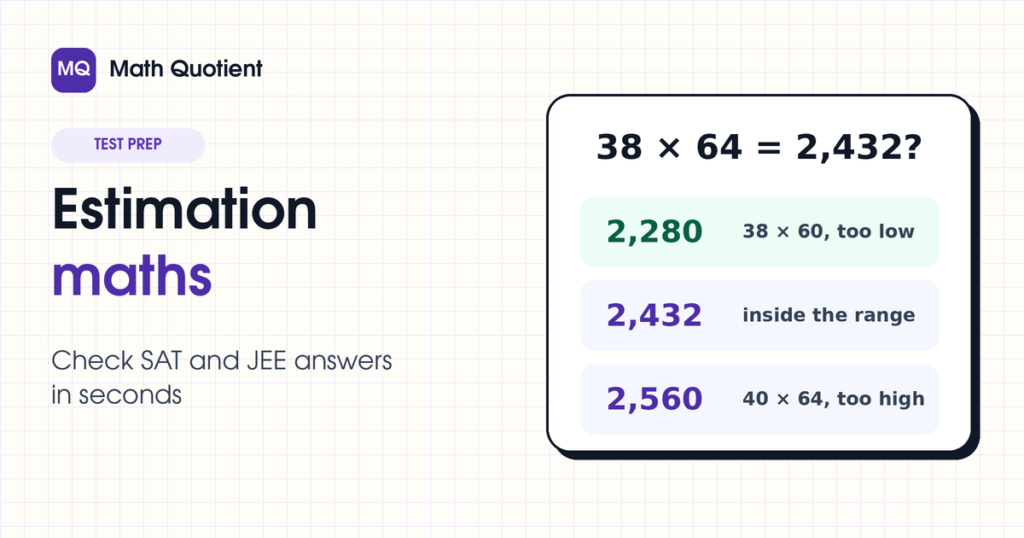
Estimation maths means finding a rough answer fast, then using it to check the exact answer. A good test estimate tells you two things: about how big the answer is, and whether your rough answer is too high or too low. Below: six checks past simple rounding, a rule for when an estimate is enough, and a 12-item drill.
38 × 64 = 2,432?
Quick answer
Round, then ask “over or under?” The direction tells you which options to drop.
Use a range when options are close. A low and a high estimate trap the answer.
For algebra, plug in x = 2. Only the right option matches.
Estimation maths: which check fits which question
The basic step, rounding each number to one easy figure, is on our mental maths tricks for the SAT and JEE page. The six checks below start where that page stops.
| Check | Use it for |
|---|---|
| 1. Over or under | Dropping options on one side |
| 2. Low and high range | Options that are close together |
| 3. Divide by a small decimal | ÷ 0.5, ÷ 0.25, ÷ 0.2 |
| 4. Roots and π | √ and π answers given as decimals |
| 5. Mean from a base | Averages of close numbers |
| 6. Plug in a number | Algebra options |
The six estimation checks, with worked numbers
The symbol ≈ means “is about”.
Check 1: know if your estimate is over or under
These rules give the direction of your estimate.
| Working | Overestimate when you | Underestimate when you |
|---|---|---|
| a × b | round both numbers up | round both numbers down |
| a ÷ b | round a up or b down | round a down or b up |
| a − b | round a up or b down | round a down or b up |
- 6.8 × 3.7: both go up, to 7 × 4 = 28. So the exact answer is under 28. It is 25.16.
- 247 ÷ 5.3: 250 ÷ 5 = 50. The top went up and the bottom went down. Both push the estimate up, so the answer is under 50. It is 46.60.
If one number goes up and the other goes down in a product, the direction is not clear. Use Check 2 then.
Check 2: trap the answer between a low and a high estimate
Make one estimate that is surely too low and one that is surely too high.
38 × 64: round only the 64 down: 38 × 60 = 2,280, too low. Round only the 38 up: 40 × 64 = 2,560, too high. Options of 1,932, 2,432, 2,732 and 3,432 leave only 2,432 inside the range. That is the exact answer.
Check 3: divide by a small decimal
Dividing by a number less than 1 makes the answer bigger: 120 ÷ 0.2 = 600. Learn three swaps: ÷ 0.5 is × 2, ÷ 0.25 is × 4 and ÷ 0.2 is × 5.
- 37.2 ÷ 0.48: use ÷ 0.5, so 37.2 × 2 = 74.4. You divided by a bigger number, so this is an underestimate. The exact answer is 77.5.
- 15.3 ÷ 0.26: use ÷ 0.25, so 15.3 × 4 = 61.2. You divided by a smaller number, so this is an overestimate. The exact answer is 58.85.
Check 4: square roots that are not whole, and answers with π
Find the nearest square below the number, a². The gap to the number is d. Then √(a² + d) ≈ a + d ÷ 2a. This estimate is always a little too big.
- √40: 36 = 6², so a = 6 and d = 4. 6 + 4/12 ≈ 6.33. The exact root is 6.32.
- √130: 121 = 11², so d = 9. 11 + 9/22 ≈ 11.41. The exact root is 11.40.
For whole-number roots, see our page on squaring numbers in your head.
π answers: use π ≈ 3, then add 5%. 36π ≈ 108 + 5.4 = 113.4. The exact value is 113.10. π ÷ 3 = 1.047, so adding 5% gives a small overestimate.
Check 5: the mean from a base number
Pick a round base near the middle. Add the gaps from it, divide by the count, and add the result to the base.
Scores 68, 73, 71, 66 and 77: use base 70. The gaps are −2, +3, +1, −4 and +7. They add to 5. 5 ÷ 5 = 1, so the mean is 70 + 1 = 71. Our mean, median and mode page explains the mean itself.
Check 6: plug in a number to check algebra
Put a small number into the question and into each option. Use x = 2 or x = 3, not 0 or 1: they often make wrong options look right.
Which is equal to (2x + 3)² − (2x − 3)²? (A) 0 (B) 18 (C) 24x (D) 8x²
At x = 2, the question gives 7² − 1² = 49 − 1 = 48. Option C gives 24 × 2 = 48. Option D gives 32. Only C matches. At x = 0, both A and C give 0, so x = 0 cannot tell them apart.
When an estimate is enough, and when it is not
Look at the two options nearest to your estimate. This is our working rule, not an official one.
- The options are far apart. If those two options differ by more than about 10% of your estimate, the estimate can choose. In Check 2, 2,432 and 2,732 differ by 300, which is more than 10% of 2,400.
- The options are close. If they differ by less than about 10%, work it out exactly. Use the estimate only to drop the far options.
- The question wants a typed number. An estimate is a check, not the answer. In JEE Main Section B and in SAT typed answers, you type the worked value, not an estimate.
Free BMI Maths Test
Answers far off, but no idea why? Find the cause.
A wrong direction is often CNC, concept not clear. A slip in the exact sum is CMT, calculation mistake. The Free BMI Maths Test sorts each mistake into one of 6 types and finds your child’s real maths level.
A 6-minute drill: 12 estimates
Set a timer for 6 minutes. For items 1 to 10, write an estimate and say “over” or “under”.
| Set | Estimate these |
|---|---|
| A. Over or under | 1) 7.2 × 4.1 · 2) 9.6 × 5.8 · 3) 412 ÷ 7.9 · 4) 1,207 − 396 |
| B. Small decimals | 5) 24.6 ÷ 0.51 · 6) 9.3 ÷ 0.198 · 7) 3.9 ÷ 0.26 |
| C. Roots and π | 8) √55 · 9) √87 · 10) 25π |
| D. Base and plug in | 11) Mean of 94, 88, 97, 91, 95 · 12) Is (x − 4)² equal to x² − 16? |
Show the 12 answers
A: 1) 28, under (exact 29.52) · 2) 60, over (55.68) · 3) 50, under (52.15) · 4) 800, under (811)
B: 5) 49.2, over (48.24) · 6) 46.5, under (46.97) · 7) 15.6, over (15)
C: 8) 7.43, over (7.42) · 9) 9.33, over (9.327) · 10) 78.75, over (78.54)
D: 11) base 90, gaps add to 15, so 93 · 12) No. At x = 3, (x − 4)² = 1 but x² − 16 = −7.
Scoring (an MQ guide only): 10 or more right, with the right direction? Use the checks in timed papers. Under 8? Read the Check 1 table again.
For UAE families: estimation on the SAT and in JEE Main
SAT. Bluebook has a Desmos calculator for the whole maths section, so an estimate checks what you typed. College Board also says some maths questions are better done without the calculator.
JEE Main. NTA bars calculators and log tables. Paper 1 has 25 maths questions: 20 multiple-choice and 5 number answers. A wrong answer costs 1 mark in both sections. So a check that drops two options before you guess is worth real marks. Our JEE Main maths marking scheme page explains the +4 and −1.
What to do now
- Students: after each practice question, write the estimate next to your answer.
- Parents: time the drill twice a week. Note which set has the most wrong directions.
- Both: for a timed mixed check, try our mental maths speed test.
Two worked questions: one SAT-style, one JEE-style
We wrote these questions. They are not from real papers.
SAT-style: A circle has an area of 50 square units. Which is closest to its radius? (A) 2.0 (B) 4.0 (C) 7.1 (D) 15.9
Estimate: r² = 50 ÷ π. With π ≈ 3, r² ≈ 16.7, so r is a little over 4. Using 3 for π made r² too big, so the true r is a little under 4.08.
Decide: the options are far apart, so the estimate is enough. The answer is (B) 4.0. The exact radius is 3.99.
Traps: (C) leaves out π. (D) has no square root. (A) is half the radius.
JEE-style: The value of √99.8, to two decimal places, is (A) 9.95 (B) 9.98 (C) 9.99 (D) 10.01
Estimate from the square above: 99.8 = 10² − 0.2. So √99.8 ≈ 10 − 0.2 ÷ 20 = 9.99. This is a tiny overestimate.
Decide: 99.8 is under 100, so (D) goes. The exact value is 9.98999…, which rounds to (C) 9.99. (B) is the trap: it cuts off the digits instead of rounding.
Questions people ask about estimation maths
What is estimation in maths?
Estimation is finding an answer that is close enough, fast. You round the numbers to easy ones, work with them, and use the result to check or choose an exact answer.
How do I know if my estimate is an overestimate?
Look at which way you rounded. In a product, rounding both numbers up gives an overestimate. In a division, rounding the top up or the bottom down gives an overestimate.
Can estimation replace the full working?
Only when the options are far apart. If the two nearest options differ by less than about 10%, work it out. For typed answers, give the worked value.
Which number should I plug in to check algebra?
Use 2 or 3. The numbers 0 and 1 hide mistakes, because many different expressions give the same value there.
Answers that are far off, but no idea why?
The Free BMI Maths Test shows whether a wrong answer comes from a misread, a calculation slip or a concept gap, and finds your child’s real maths level.
Sources
- NTA, JEE (Main) 2027 Information Bulletin: section 8.13 lists calculators and log tables as barred items; Paper 1 maths has 20 multiple-choice and 5 number-answer questions, +4 for a right answer and −1 for a wrong one.
- College Board, SAT calculator policy: Desmos is built into Bluebook, and some maths questions are better done without a calculator.
Facts checked on 14 November 2026. We wrote the checks, the 10% rule, the drill and both questions. Every number was verified in Python.