
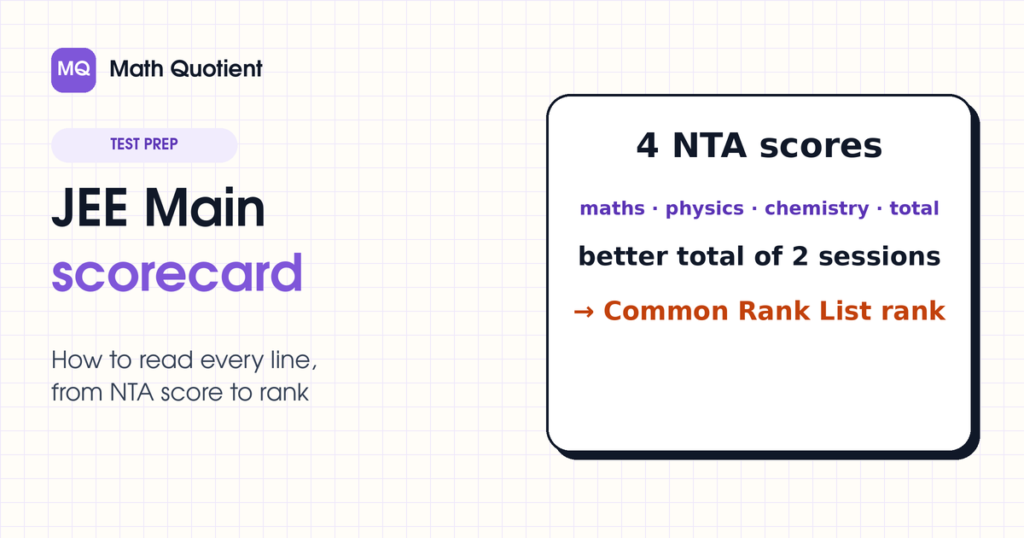
Your JEE Main scorecard shows NTA scores, not marks: one each for maths, physics and chemistry, and one for the total. A Session 1 card has no rank. The final card after Session 2 adds your rank in the Common Rank List and your category rank. This page reads the card line by line, shows why the total is not the average of the three subjects, and says who uses which line.
NTA scores → better total → rank
2 sessions → 1 better total → rank
Quick answer
The four numbers are percentiles, worked out among the students in your shift. 98 does not mean 98% of the marks.
The total ranks your total marks. It is not the mean of the three subject scores.
The rank comes once, after Session 2, from the better of your two totals.
Save the PDF. NTA does not post the card, and the website will not have it after 31 July 2027.
How to read your JEE Main scorecard, line by line
Read the top half for errors and the bottom half for meaning. NTA’s bulletin names the main parts of the card. It does not list every field, so check the rest against your confirmation page.
| Line on the card | What it means | What to check |
|---|---|---|
| Name | Taken from your 10th-standard certificate or mark sheet | Spelling, word for word |
| Application Number | The same number for both sessions | Matches your confirmation page |
| Category and other form details | Copied from your form | Each one, against the confirmation page |
| Mathematics NTA score | Your percentile in maths, in your shift | Compare it with physics and chemistry |
| Physics and chemistry NTA scores | The same idea, for each subject | Which subject is lowest |
| Total NTA score | Your percentile for total marks, in your shift | This number decides the rank |
| Rank (final card only) | Common Rank List rank and category rank | Shown only after Session 2 |
NTA works each score to 7 decimal places, so a card can show a score like 97.4512063. The long tail keeps ties rare. The score is a percentile, not a percentage: it says what share of your shift scored the same as you or less. For more on how shifts change this, see our page on JEE Main percentile vs rank.
Why the total NTA score is not the average of the subjects
The bulletin says the total percentile is not an aggregate or average of the subject percentiles. NTA ranks your total marks on their own. So a student who is top in one subject can have a low total.
Worked example: a shift of 5 made-up students
Real shifts have thousands of students. Five show the idea. Percentile = 100 × (students in the shift with the same marks or fewer) ÷ (students in the shift).
| Student | Maths | Physics | Chemistry | Total |
|---|---|---|---|---|
| A | 80 | 40 | 50 | 170 |
| B | 60 | 70 | 60 | 190 |
| C | 40 | 60 | 80 | 180 |
| D | 70 | 50 | 40 | 160 |
| E | 50 | 80 | 70 | 200 |
Student A, maths: all 5 have 80 or fewer, so 100 × 5 ÷ 5 = 100.
Physics: only A has 40 or fewer: 100 × 1 ÷ 5 = 20. Chemistry: A and D have 50 or fewer: 40.
The mean of 100, 20 and 40 is 53.33. But only A and D have totals of 170 or fewer, so A’s total is 40.
Student E has a maths score of only 40, yet the top total, 100. So read the total for your standing, and the subject lines for where the marks went.
Free BMI Maths Test
Is the maths line holding the total back?
The scorecard shows where you stand, not why. The Free BMI Maths Test finds your child’s real maths level and the reason for each mistake, sorted into 6 types.
Session 1 card vs the final card after Session 2
| Session 1 card | Final card, after Session 2 | |
|---|---|---|
| NTA scores | Maths, physics, chemistry and total, for that session | NTA uses the better of your two totals |
| Best of two | Not yet | Better total only, not the best subject from each session |
| Rank | None | Common Rank List rank and category rank |
| Copy by email | Not stated in the bulletin | The final NTA score is sent to your registered email |
NTA does not mix sessions subject by subject. If your maths was better in January but your total was better in April, the April total counts. The final result also carries a status for JEE Advanced. JEE Advanced has its own rules; see the official JEE Advanced site.
Session 1 runs from 20 to 28 January 2027 and Session 2 from 2 to 7 April 2027. NTA has not published the result dates. For the steps on result day, see our JEE Main Session 1 result page.
Who uses which line on the card
| Who | Uses | Source |
|---|---|---|
| JoSAA and CSAB seat allocation | The Common Rank List rank | JEE (Main) 2027 bulletin, 11.3.2 and 11.6 |
| Institutes outside the central process | Their own ranking, made from the JEE Main result | Bulletin, 11.3.2 |
| Other central or state bodies | May use the scores or merit list | Bulletin, 11.5 |
| DASA, for students abroad | The Common Rank List rank, as it is | DASA 2026 brochure |
NTA runs the test. It does not give admission, and it does not answer admission queries.
For UAE families: DASA and the Gulf quota
DASA (Direct Admission of Students Abroad) is the route that many families abroad look at. The DASA 2026 brochure says three things that touch the scorecard:
- You need a valid JEE Main scorecard and rank for Paper 1.
- Seats go by the JEE Main Common Rank List, used as it is, with no tie-break of its own.
- You sign in with your JEE Main Application Number and password. A share of seats, called CIWG, is for students whose parent works, or has worked, in a Gulf country, the UAE included.
These are the 2026 rules. The DASA 2027 brochure is not out yet, so check it when it comes.
Keep your scorecard safe, and fix errors in time
- Download it yourself from jeemain.nta.nic.in. NTA does not send scorecards by post.
- Save it in two places and print it. The bulletin says the scorecard will not be on the website after 31 July 2027.
- Check your email for the copy of the final NTA score.
- Report a wrong detail within 30 days of the result, through NTA’s contact routes on jeemain.nta.nic.in.
- Do not ask for re-marking. The bulletin says there is no re-checking of the result. The answer key window is the only time to challenge a question.
To turn your own answers into raw marks before the card arrives, use the +4 and −1 rules on our JEE Main maths marking scheme page.
Questions people ask about the JEE Main scorecard
What does the JEE Main scorecard show?
NTA scores for maths, physics, chemistry and the total, with your name and Application Number. The final card after Session 2 also shows your Common Rank List rank and category rank.
Is the NTA score the same as my marks?
No. It is a percentile among the students in your shift, worked to 7 decimal places. Your raw marks out of 300 are not the number on the card.
Why is my total lower than the average of my subjects?
The total ranks your total marks on their own. It is not an average of the subject scores, so it can be higher or lower than their mean.
Does Session 1 give a rank?
No. NTA makes the Common Rank List only after Session 2, from the better of your two total NTA scores.
How long can I download the scorecard?
The bulletin says it will not be on the website after 31 July 2027. Save the PDF and print a copy as soon as it comes.
Want the maths line to rise in April?
The Free BMI Maths Test finds your child’s real maths level and the reason for each mistake.
Sources
- NTA, JEE (Main) 2027 Information Bulletin: 8.15 (keep the scorecard; not on the site after 31 July 2027), 11.3 and 11.3.1 (NTA scores, name as on the 10th-standard certificate, best total of two sessions, rank list), 11.3.2 (no posting, email copy, CRL for CSAB, NTA not an admission body), 11.4 (no re-checking), 11.5 and 11.6 (other users, JoSAA and CSAB), Appendix IV (percentile formula, 7 decimal places, total not an average), 12.3 (grievances within 30 days); test days.
- DASA 2026 Information Brochure (hosted by NIT Mizoram): Clause 4 (valid JEE Main scorecard and rank), Clauses 5 to 7 (CIWG, Gulf countries), Clause 9 (sign in with JEE Main Application Number and password), Clause 37 (seats by CRL, no tie-break).
Facts checked on 14 November 2026. NTA gives times in India time; UAE time is 1 hour 30 minutes behind. The 5-student example is made up and was checked in Python.