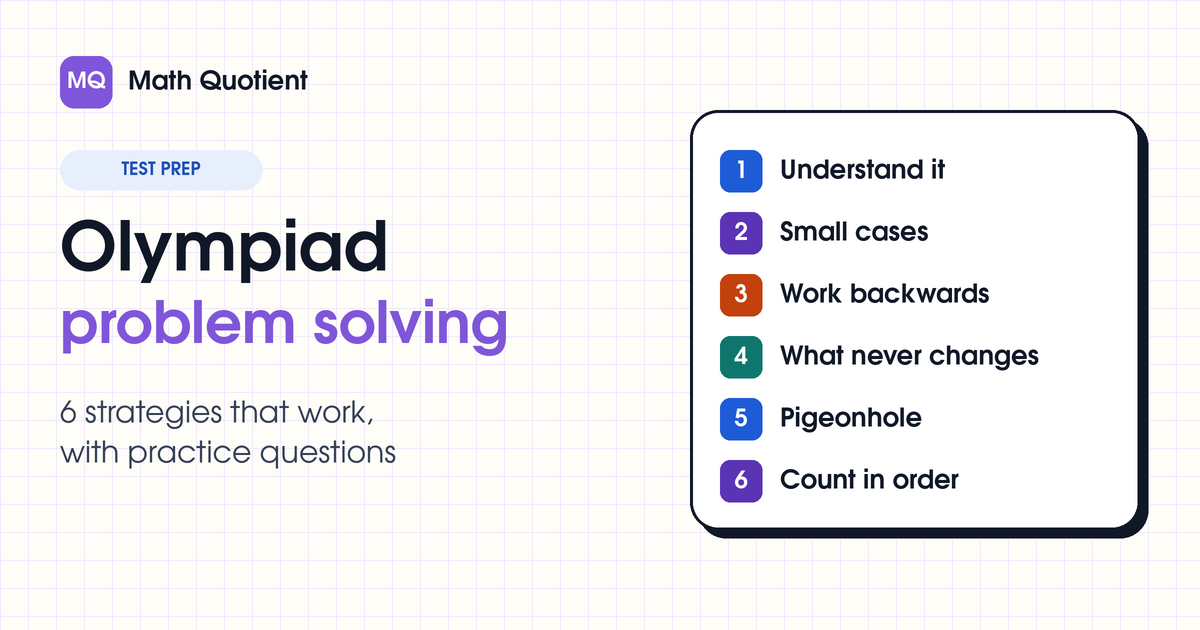
You read an olympiad problem and have no idea where to start. That is normal. In this guide you will learn 6 strategies for olympiad problem solving, how to choose one when you are stuck, and how to practise them every week.
Stuck is where thinking starts.
6 strategies · 1 problem a day
What is olympiad problem solving?
Olympiad problem solving means finding a way into a problem you have never seen before, using maths you already know. Most olympiad problems do not need advanced facts. They need a clever first step.
Strong solvers are not faster at sums. They have a small set of strategies, and they try them one by one. You can learn these strategies, like you learn a new sport move.
In one line
When you are stuck, do not wait for an idea. Pick a strategy and try it.
Olympiad maths: key facts about the IMO
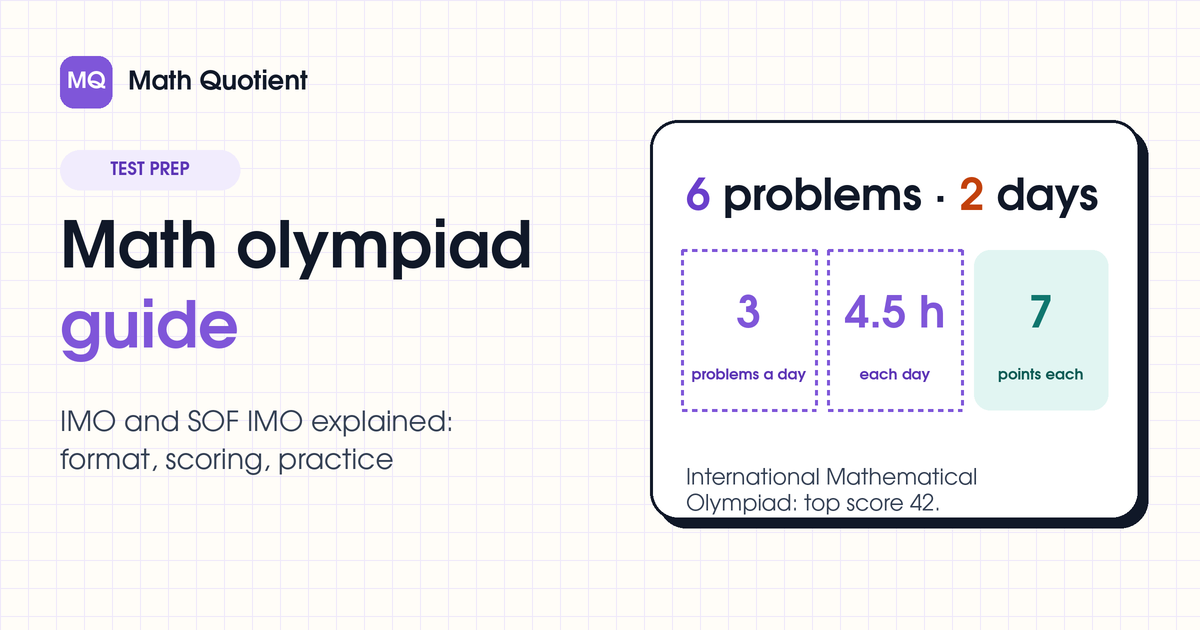
The International Mathematical Olympiad (IMO) is the world’s top maths olympiad for school students. Its format shows why strategy matters.
Problems
3 on each of 2 days.
Each day
For only 3 problems.
Points each
42 points is the top score.
Calculators
Not allowed. Full proofs are needed.
That is 90 minutes for each problem. The time goes on thinking, not on calculating.
Facts checked on 1 November 2026 on the official IMO website, imo-official.org. Rules can change, so always check the official site of your olympiad.
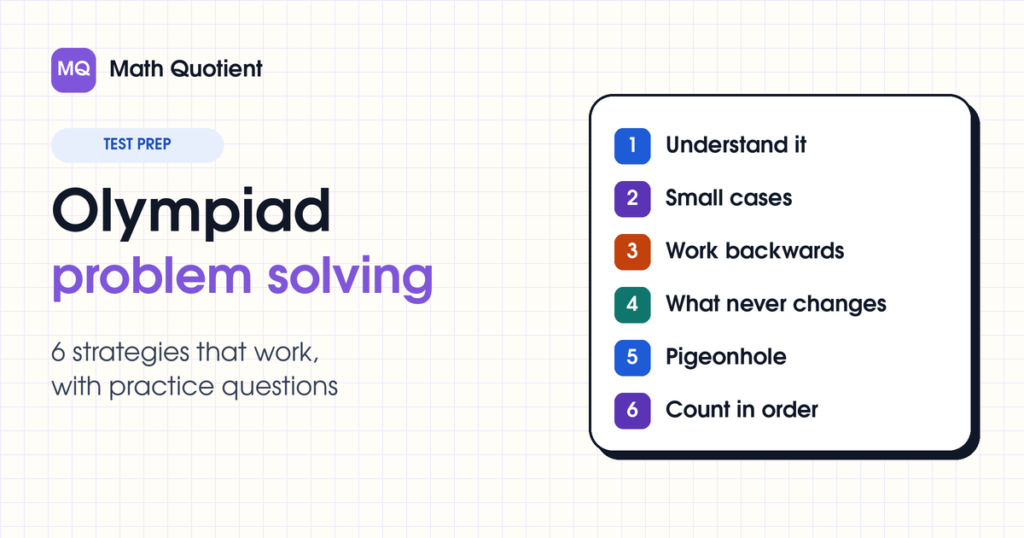
6 olympiad problem solving strategies that work
Understand the problem first. Read it twice. Draw a picture or a table. Write down what you know and what you must find. Many “impossible” problems become clear here.
Try small cases. Test the problem with 1, 2, 3 and 4. Look for a pattern. For example, 1 = 1, 1 + 3 = 4, 1 + 3 + 5 = 9, 1 + 3 + 5 + 7 = 16. These are square numbers.
Work backwards. When you know the end, start there. Undo each step in the opposite order: multiply becomes divide, add becomes take away.
Look for something that never changes. Some problems change numbers again and again. Find what stays the same, such as odd or even. Mathematicians call this an invariant.
Use the pigeonhole principle. If 13 people are in a room, two of them must have a birthday in the same month. There are only 12 months, so 13 people cannot all be in different ones.
Count in an organised way. Make a list in order, so you miss nothing and count nothing twice. Which 2-digit numbers have digits that add up to 5? In order: 14, 23, 32, 41, 50. That is 5 numbers.
Watch out!
A pattern from small cases is a guess, not a proof. 1, 4, 9 and 16 suggest square numbers, but you must still explain why the pattern always works.
Where these strategies help in olympiad maths
The IMO says its problems come from four areas of maths. Each strategy is strong in some areas.
Number theory
Whole numbers, factors and remainders. Small cases and “odd or even” help a lot. Start with our guide to the quotient and remainder.
Combinatorics
Clever counting and arrangements. Organised lists, invariants and the pigeonhole principle all live here.
Algebra
Equations and expressions. Working backwards and small cases help. Strong fraction skills make the steps easier.
Geometry
Shapes, angles and lengths. A good, large, accurate drawing is the first strategy here.
Which strategy when? Clues in the problem
The words in a problem often tell you which strategy to try first. Use this table when you are stuck.
| If the problem says… | Try this first |
|---|---|
| “for every whole number n” or “find a formula” | Try small cases: n = 1, 2, 3, 4 |
| You know the result at the end, but not the start | Work backwards |
| A move is repeated again and again: “can you ever reach…?” | Look for something that never changes, such as odd or even |
| “Show that two of them must…” or more items than groups | Use the pigeonhole principle |
| “How many ways…?” | Count in an organised way: a list, a table or a tree |
| A long story with many numbers | Understand first: draw a picture or a table |
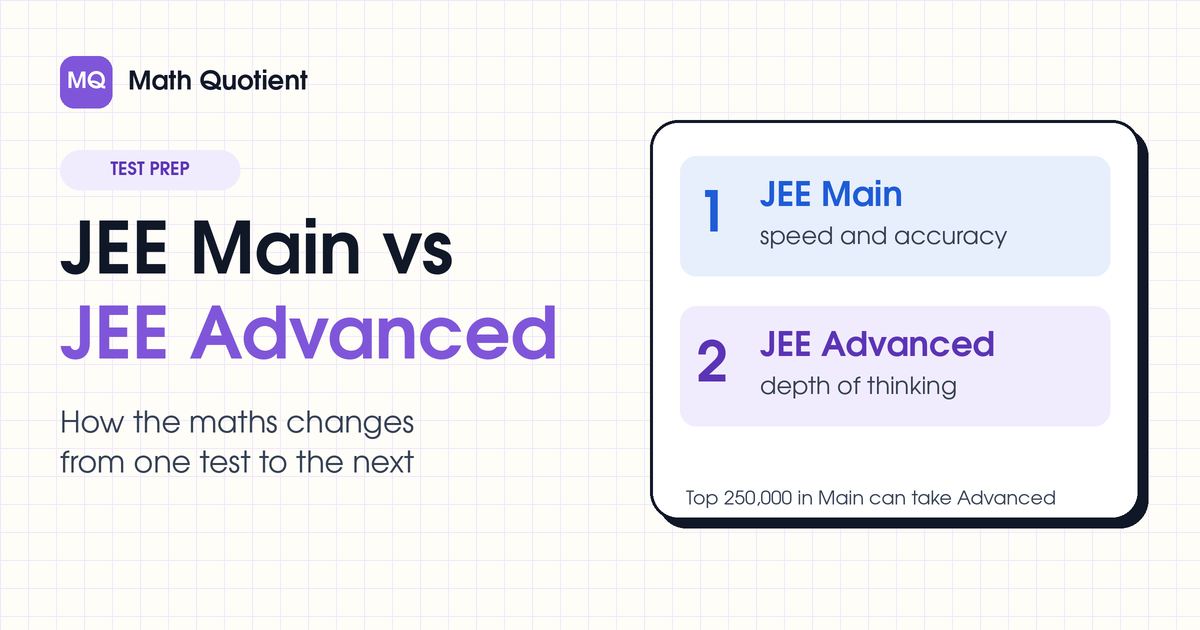
Students in the UAE often meet these strategies first in school olympiads such as the SOF IMO and the IOF qualifier. Read our math olympiad guide to see which one fits you.
Olympiad-style problem solving questions with answers
These are practice questions in the style of school maths olympiads. They are not real past questions. Each one uses one of the 6 strategies. Work each one out first, then tap to check.
1. Small cases: what is 1 + 3 + 5 + … + 39, the sum of the first 20 odd numbers?
The small cases give 1, 4, 9, 16. The sum of the first n odd numbers is n × n. So the answer is 20 × 20 = 400.
2. Work backwards: I think of a number. I double it, add 6, then divide by 4. The answer is 9. What was my number?
Undo each step from the end. 9 × 4 = 36. 36 − 6 = 30. 30 ÷ 2 = 15. Check: 15 × 2 = 30, 30 + 6 = 36, 36 ÷ 4 = 9.
3. Pigeonhole: a drawer has many red, blue and green socks. The room is dark. How many socks must you take to be sure of 3 socks of the same colour?
With bad luck, you can take 2 of each colour with no 3 the same: that is 6 socks. The next sock must make 3 of one colour. So you need 7 socks.
4. Invariant: the numbers 1 to 10 are written on a whiteboard. You rub out any two numbers and write their difference (bigger minus smaller). You repeat this until one number is left. Can it be 0?
Look at the sum. At the start it is 55, which is odd. When you change a and b into a − b, the sum goes down by 2b, an even number. So the sum stays odd every time. The last number is odd, so it can never be 0.
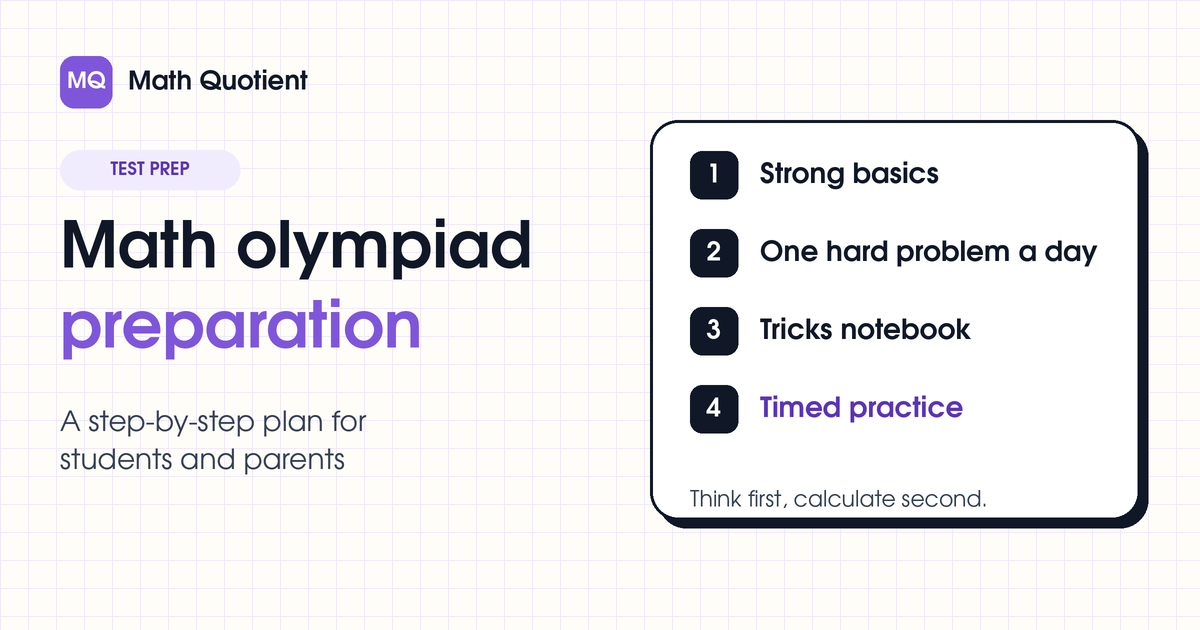
How to practise olympiad problem solving
Two habits turn the strategies into skill.
Name the strategy
After each problem, write one line: “This used small cases” or “This used pigeonhole”. Soon you will see which strategy fits which kind of problem.
Write full solutions
Explain every step in sentences. At the IMO, each solution gets 0 to 7 points, and partial progress can get partial points. A clear write-up shows your thinking.
Did you know?
The first IMO was held in 1959 in Romania, with 7 countries. Today more than 600 students take part each year. Only a few, and in some years none, solve all six problems.
Questions people ask about olympiad problem solving
What are the best strategies for maths olympiad problems?
Six strategies help most: understand the problem, try small cases, work backwards, look for what never changes, use the pigeonhole principle and count in an organised way.
What should I do when I am stuck on an olympiad problem?
Try a strategy instead of waiting for an idea. Draw a picture, test small numbers, or start from the end. Give the problem real time before you look at a hint.
What topics are in maths olympiad problems?
The IMO says its problems come from algebra, combinatorics, geometry and number theory. Many school olympiads use the same four areas at an easier level.
Is a calculator allowed at the IMO?
No. The IMO does not allow calculators or electronic aids. Solutions must include complete proofs.
How are IMO problems scored?
Each of the 6 problems is worth 7 points, so the top score is 42. Partial progress can get partial points, but full points need a complete and correct argument.
Sources
All facts about the IMO on this page come from the official IMO website. Checked on 1 November 2026.
Keep exploring
Want to know your child’s real maths level?
Start with the free BMI maths check. It finds your child’s real maths level and the reason for each mistake.
Written by Himanshu Jain
B.Tech, IIT Delhi. Founder of Math Quotient.