Your school says “IMO registration is open”. Is that the famous world olympiad, or something else? In this guide you will learn what a math olympiad is, why there are two different “IMOs”, and how the world’s top maths olympiad works.
Hard problems, clever ideas, no calculator.
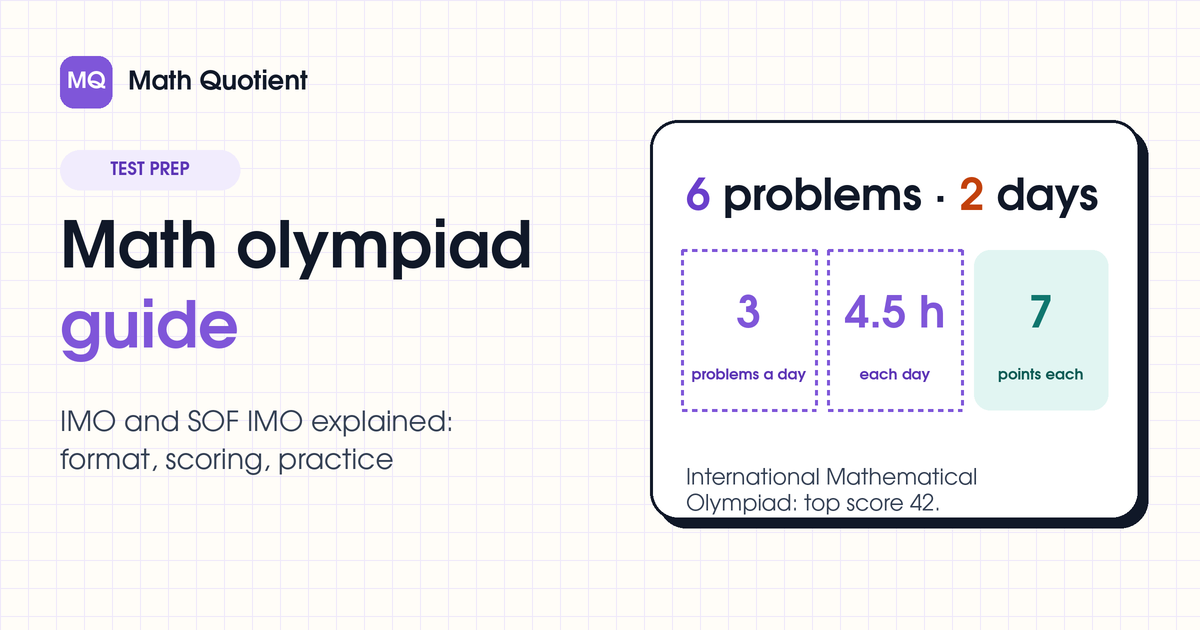
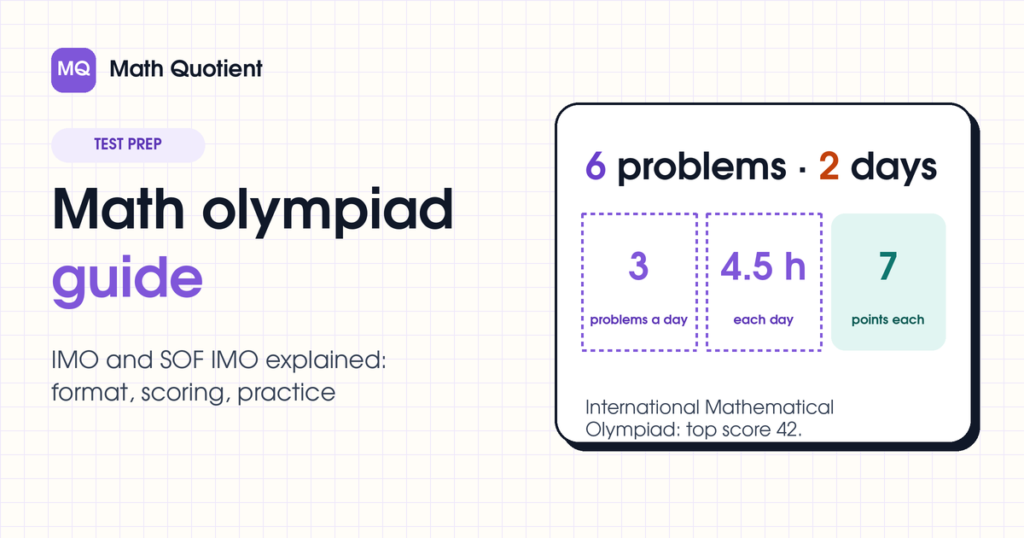
6 problems · 2 days
What is a math olympiad?
A math olympiad is a maths competition with problems that need clever thinking, not just fast calculation. Students meet questions they have never seen before. They must find their own way to the answer.
There are many maths olympiads. Some are for young children and use multiple-choice questions. The hardest ones ask for full written proofs.
In one line
An olympiad tests how you think, not how much you remember.
IMO and SOF IMO: what is the difference?
Two different olympiads use the short name “IMO”. Parents often mix them up.
- International Mathematical Olympiad (IMO): the world championship of school maths. It started in 1959 in Romania. Each country sends a team of up to six students. They must be under 20 and not yet at university.
- SOF International Mathematics Olympiad (SOF IMO): a yearly olympiad run by the Science Olympiad Foundation, which is based in India. Students take part through their school. Level 1 is a 60-minute multiple-choice paper at school. The top scorers go on to Level 2.
So the SOF IMO is a school-based olympiad that many children can try. The International Mathematical Olympiad is a small, very hard competition for each country’s best few students.
Which maths olympiads can students in the UAE take?
Here are three olympiads side by side. Each one is for a different student and needs a different kind of preparation.
SOF IMO
Run by: the Science Olympiad Foundation (India).
Who: most school ages.
Format: a 60-minute multiple-choice paper at school. The top 5% at each level can go on to Level 2.
How to enter: only through your school. Ask the school if it takes part.
2026–27 Level 1 dates: 23 October, 26 November and 10 December 2026.
IOF Mathematics Olympiad Qualifier
Run by: the International Olympiad Foundation, the UAE contact for the International Mathematical Olympiad.
Who: most school ages, with test centres in all seven emirates.
Format: Round 1 is 30 multiple-choice questions (September to October). Round 2 is 45 questions for older students (mid-November to mid-December).
How to enter: online, at the level for your own school year.
International Mathematical Olympiad
Run by: the IMO, with a different host country each year.
Who: a national team of up to six students.
Format: 6 problems with full written proofs, over 2 days.
How to enter: through your country’s selection. In the UAE, the best IOF qualifier students go to national team training, and the best six form the team.
Next: IMO 2027 in Budapest, Hungary, 16 to 26 July 2027.
Which one first?
For most children, a school olympiad such as the SOF IMO or IOF Round 1 is the right start. These use multiple-choice questions. The road to the IMO team needs proof writing, which takes years of practice. See our step-by-step olympiad preparation plan.
International Mathematical Olympiad: key facts
These facts are about the world olympiad, the International Mathematical Olympiad.
First IMO
Held in Romania, with 7 countries.
Team size
Up to six students from each country.
Top score
6 problems, up to 7 points each.
Countries
More than 120 countries and regions in 2026.
Facts checked on 2 November 2026 on imo-official.org, sofworld.org and olympiads.org. Check the official websites for updates.
How the International Mathematical Olympiad works
Each country chooses its own team of up to six students. They must be under 20 and not at university.
The competition has two days in a row. Each day, students get 4.5 hours to solve 3 problems. Calculators are not allowed.
Each problem is worth 0 to 7 points, so the top score is 42. Up to half of the students win a medal. Gold, silver and bronze medals are given in a ratio of about 1 : 2 : 3.
Watch out!
At the International Mathematical Olympiad, a final answer alone is not enough. Every solution must be a full written proof that explains why the answer is true.
The maths in a math olympiad
The International Mathematical Olympiad takes its problems from four areas. Younger olympiads use the same ideas in simpler forms.
Number theory
Whole numbers, primes, divisibility and remainders. It grows from ideas like the quotient and remainder.
Algebra
Equations, inequalities and patterns. You often show that something is true for every number, not just one.
Geometry
Triangles, circles and angles. You prove why a shape has a property, not only measure it.
Combinatorics
Clever counting and arranging. For example: in how many ways can 8 people shake hands?
Olympiad-style practice questions with answers
These are practice questions in the style of school maths olympiads. They are not real past questions. Work each one out first, then tap to check.
1. What is the next number? 2, 6, 12, 20, 30, …
The gaps are 4, 6, 8, 10, so the next gap is 12. The answer is 42. (Each number is n × (n + 1): 6 × 7 = 42.)
2. How many two-digit numbers can be divided exactly by 7?
The smallest is 14 (7 × 2) and the largest is 98 (7 × 14). From 2 to 14 there are 13 numbers.
3. Three whole numbers in a row add up to 72. What is the largest?
The middle number is 72 ÷ 3 = 24. The numbers are 23, 24 and 25, so the largest is 25.
4. What is the last digit of 72026?
The last digits of 7, 7², 7³, 7⁴ are 7, 9, 3, 1, and then the pattern repeats every 4. 2026 ÷ 4 = 506 remainder 2, so the last digit is the 2nd in the pattern: 9.
How to start with math olympiads
Olympiad skill grows slowly, with steady practice.
Start with puzzles
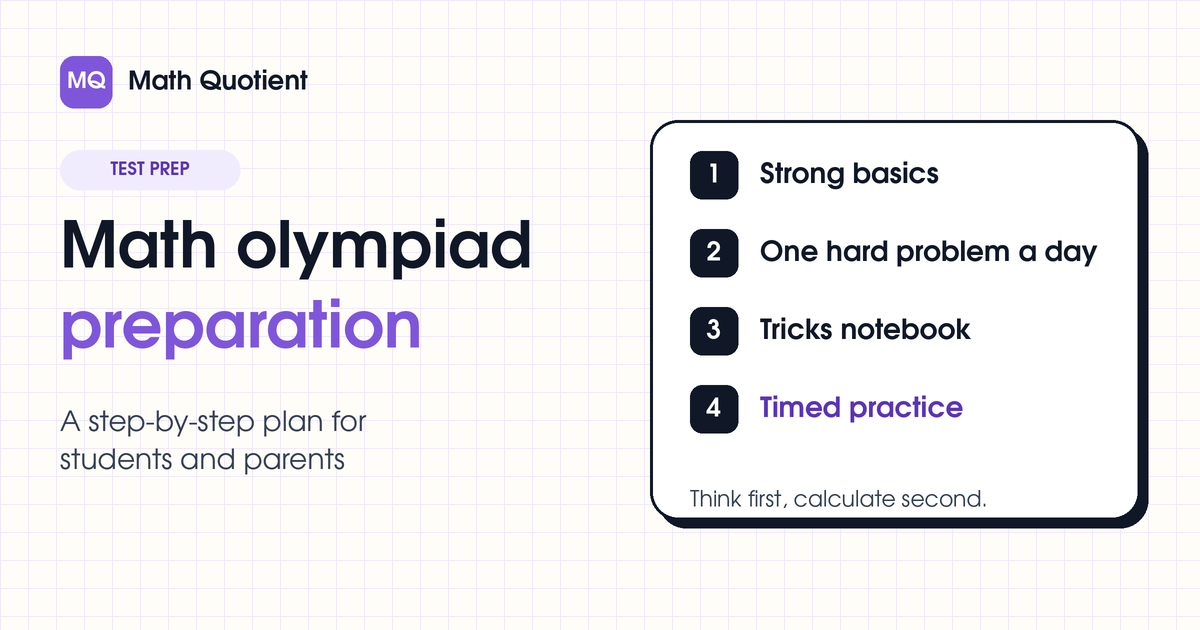
Try one hard problem a day. Stay with it for 20 minutes before you look at a hint.
Write full solutions
Explain each step in words, as if to a friend. This is the skill the top olympiads reward.
Did you know?
The UAE first took part in the International Mathematical Olympiad in 2008. The 2026 olympiad was in Shanghai, China, and the 2027 olympiad will be in Budapest, Hungary. Saudi Arabia will host in 2028.
Questions people ask about the math olympiad
What is the math olympiad?
A math olympiad is a maths competition with problems that need clever thinking, not just fast calculation. The best known is the International Mathematical Olympiad.
What is the difference between IMO and SOF IMO?
The International Mathematical Olympiad is the world championship for each country’s top six students. The SOF International Mathematics Olympiad is a school-based olympiad run by the Science Olympiad Foundation.
Which maths olympiads can students in the UAE take?
The SOF IMO is open to schools outside India, and you enter only through your school, so ask your school if it takes part. The IOF Mathematics Olympiad Qualifier has centres in all seven emirates, and you register online. Its best students can go on to the UAE team for the International Mathematical Olympiad.
Who can take part in the International Mathematical Olympiad?
Students under 20 who are not yet at university. Each country chooses a team of up to six students.
How is the International Mathematical Olympiad scored?
There are 6 problems, each worth 0 to 7 points, so the top score is 42. Up to half of the students win a medal.
Can I use a calculator in a math olympiad?
Not at the International Mathematical Olympiad. Most olympiad problems need clever ideas, not long calculations.
Keep exploring
Want to know your child’s real maths level?
Start with the free BMI maths check. It finds your child’s real maths level and the reason for each mistake.
Written by Himanshu Jain
B.Tech, IIT Delhi. Founder of Math Quotient.