
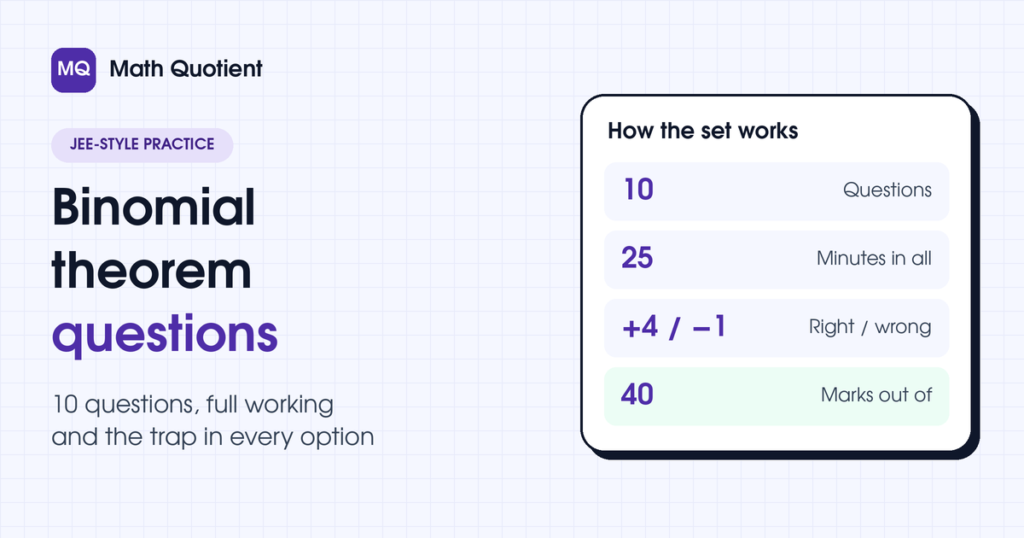
This set has 10 binomial theorem questions written in the JEE Main format, each solved line by line. Most turn on the general term: write it, set the power of x, solve for r. Every wrong option comes with its trap. Math Quotient wrote all 10; none is a past paper.
Tᵣ₊₁ = ⁿCᵣ aⁿ⁻ʳ bʳ
Inside these binomial theorem questions
Unit 5 of the 2027 JEE Main maths list from NTA is “Binomial Theorem and its Simple Applications”. It covers a positive whole-number power, the general term, the middle term and simple uses.
General and middle term
Questions 1, 2, 3 and 8.
Coefficients
Questions 4, 5, 9 and 10.
Simple applications
Questions 6 and 7.
Type-in answers: questions 9 and 10, as in Section B.
Rules and timing
Allow 25 minutes in all. Each card shows its share.
General term first. Copy each bracket’s sign and number into it. A lost minus or a lost power of 2 costs most marks here.
Pen and paper only. Calculators are barred at the centre.
Score with NTA’s rule: +4 for a right answer, −1 for a wrong one, 0 for a blank. Our JEE Main marking scheme page explains it.
Trap codes (Free BMI Maths Test): CNC = concept not clear, DRC = did not read carefully, CWV = copied a wrong value, CMT = calculation mistake, ROT = ran out of time.
Set A: general term, middle term, coefficients
Question 1
What is the coefficient of x⁴ in the expansion of (x² + 2/x)⁸?
- 70
- 448
- 1120
- 1792
Answer to question 1
Correct: C, 1120. Tᵣ₊₁ = ⁸Cᵣ (x²)⁸⁻ʳ (2/x)ʳ = ⁸Cᵣ 2ʳ x¹⁶⁻³ʳ. Set 16 − 3r = 4, so r = 4. Coefficient: 70 × 16 = 1120.
Fast check: with power 2 the rule gives x⁴, x and x⁻². By hand, (x² + 2/x)² = x⁴ + 4x + 4/x². It matches.
Traps: A forgets the 2⁴ (CNC). B uses r = 3, the x⁷ term (CMT). D uses r = 5, the x term (CMT).
Question 2
What is the term independent of x in (x − 3/x²)⁹?
- 2268
- −2268
- 252
- −84
Answer to question 2
Correct: B, −2268. Tᵣ₊₁ = ⁹Cᵣ x⁹⁻ʳ (−3)ʳ x⁻²ʳ = ⁹Cᵣ (−3)ʳ x⁹⁻³ʳ. Set 9 − 3r = 0, so r = 3. Term: 84 × (−27) = −2268.
Fast check: r is odd, so the term must be negative. That rules out A and C at once.
Traps: A drops the minus (CMT). C uses 3, not 3³ (CMT). D drops the 3 and keeps only the sign (CWV).
Question 3
What is the middle term in the expansion of (x + 1/(2x))¹⁰?
- 252
- 63/4
- 63/8
- 105/8
Answer to question 3
Correct: C, 63/8. Power 10 gives 11 terms, so the middle is term 6 and r = 5. T₆ = ¹⁰C₅ x⁵ (1/(2x))⁵ = 252 ÷ 32 = 63/8. The x’s cancel.
Fast check: an even power has one middle term; an odd power has two.
Traps: A forgets the 1/2 inside the bracket (CNC). B uses 2⁴, not 2⁵ (CMT). D is term 5, with r = 4 (DRC).
Question 4
The sum of all the coefficients in the expansion of (1 + x)ⁿ is 4096. What is the greatest coefficient?
- 792
- 924
- 1716
- 2048
Answer to question 4
Correct: B, 924. Put x = 1: the sum of the coefficients is 2ⁿ = 4096, so n = 12. The middle coefficient is the greatest: ¹²C₆ = 924.
Fast check: for (1 + x)⁴ the row is 1, 4, 6, 4, 1. The middle, 6, is the top one.
Traps: A is ¹²C₅, one step off the middle (CMT). C uses n = 13 (CMT). D is half the sum, not a coefficient (CNC).
Question 5
Three terms in a row in the expansion of (1 + x)ⁿ have coefficients in the ratio 1 : 5 : 20. What is n?
- 5
- 24
- 29
- 30
Answer to question 5
Correct: C, 29. Use ⁿCᵣ ÷ ⁿCᵣ₋₁ = (n − r + 1) ÷ r. First ratio: (n − r + 1) ÷ r = 5, so n = 6r − 1. Second ratio is 20 ÷ 5 = 4: (n − r) ÷ (r + 1) = 4, so n = 5r + 4. Then r = 5 and n = 29.
Fast check: ²⁹C₄, ²⁹C₅, ²⁹C₆ are 23751, 118755, 475020. That is 1 : 5 : 20.
Traps: A gives r, not n (DRC). B is n − r (CMT). D uses (n − r) ÷ r for the ratio, one off (CNC).
Free BMI Maths Test
Right term, wrong number? Find out why.
A lost minus sign and a wrong r need different fixes. The Free BMI Maths Test sorts each mistake into one of 6 types and shows your child’s real maths level.
Set B: remainders, surds and sums
Question 6
What is the remainder when 7¹⁰³ is divided by 25?
- 7
- 18
- 24
- 43
Answer to question 6
Correct: B, 18. 7² = 49 = 50 − 1. So 7¹⁰³ = 7 × 49⁵¹ = 7 × (50 − 1)⁵¹. Every term of the expansion except the last has a factor 50. The last term is (−1)⁵¹ = −1. So 7¹⁰³ leaves the same remainder as −7, which is 25 − 7 = 18.
Fast check: 7⁴ = 2401 leaves 1, so 7¹⁰³ = (7⁴)²⁵ × 7³ leaves the same as 343, which is 18.
Traps: A drops the minus from (−1)⁵¹ (CMT). C forgets the extra 7 (DRC). D is the remainder on division by 100 (DRC).
Question 7
What is the value of (√3 + 1)⁴ + (√3 − 1)⁴?
- 28
- 56
- 32√3
- 28 + 16√3
Answer to question 7
Correct: B, 56. Add the two expansions. The odd terms cancel and the even terms double: 2[(√3)⁴ + 6(√3)² + 1] = 2[9 + 18 + 1] = 56.
Traps: A forgets to double (CMT). C is the difference, not the sum (DRC). D expands only the first bracket (DRC).
Question 8
What is the coefficient of x³ in (1 + 2x)(1 − x)⁷?
- −35
- −77
- 7
- −14
Answer to question 8
Correct: C, 7. x³ comes two ways: 1 × (the x³ term) and 2x × (the x² term). In (1 − x)⁷ those coefficients are −35 and +21. So −35 + 2 × 21 = 7.
Traps: A forgets the 2x part (CNC). B gives the x² coefficient a minus (CMT). D drops the 2 in 2x (CWV).
Question 9
Find the value of ¹⁰C₁ + ¹⁰C₃ + ¹⁰C₅ + ¹⁰C₇ + ¹⁰C₉.
Answer to question 9
Correct: 512. Put x = 1 in (1 + x)¹⁰: all coefficients add to 1024. Put x = −1: the even ones minus the odd ones is 0. So the odd ones are half of 1024, which is 512 = 2⁹.
Fast check: for power 4, ⁴C₁ + ⁴C₃ = 4 + 4 = 8 = 2³.
Trap: 1024 adds every coefficient (DRC). Adding the five terms one by one costs time (ROT).
Question 10
In the expansion of (2 + x)ⁿ, the coefficients of x³ and x⁴ are equal. Find n.
Answer to question 10
Correct: 11. The coefficient of xʳ is ⁿCᵣ 2ⁿ⁻ʳ. Set ⁿC₃ 2ⁿ⁻³ = ⁿC₄ 2ⁿ⁻⁴. Divide: 2 = ⁿC₄ ÷ ⁿC₃ = (n − 3) ÷ 4. So n − 3 = 8 and n = 11.
Fast check: ¹¹C₃ × 2⁸ = 165 × 256 = 42240, and ¹¹C₄ × 2⁷ = 330 × 128 = 42240.
Trap: putting the power of 2 on x’s side gives n = 5 (CNC).
Marks out of 40: what next
| Your marks | Meaning | Next step |
|---|---|---|
| 32+ within the time | The general term is second nature. | Add Unit 5 to mixed timed papers. |
| 20 to 31, or slow | Signs, powers or pace let you down. | Rework each miss with Tᵣ₊₁ written in full. |
| Below 20 | The base idea needs work. | Take the Free BMI Maths Test to see why. |
Many CMT codes? Circle each minus and each number in the brackets first. Many CNC codes? Relearn what r counts.
Losing marks to one minus sign?
The Free BMI Maths Test finds where your child’s maths really stands and why each wrong answer happened.
Binomial theorem in JEE Main: FAQ
How many binomial questions are in a JEE Main paper?
NTA does not say how many come from each unit. The maths part has 25 questions in all: 20 with options and 5 with typed answers.
Which formula matters most?
The general term, Tᵣ₊₁ = ⁿCᵣ aⁿ⁻ʳ bʳ. Questions 1, 2, 3, 8 and 10 all start from it.
What if a number answer is not a whole number?
NTA’s 2027 bulletin says a Section B answer is rounded off to the nearest whole number. Both number answers in this set are whole numbers.
Are these past JEE Main questions?
No. All 10 are new questions written by Math Quotient in the same format.
Sources
Facts checked on 14 November 2026. We worked each answer and each trap option again in Python.
- NTA bulletin for JEE (Main) 2027: question count, marking, rounding of typed answers, calculator ban.
- NTA topic list for JEE (Main) 2027 Paper 1: Unit 5.