Here are 10 permutation and combination questions in JEE Main style, with full solutions. Every solution starts with one test: does order matter? Then it names the trap behind each wrong option. These are our own JEE-style questions, not copies of past papers.
Pick 2 of A, B, C
Permutation and combination questions in this set
NTA’s JEE Main 2027 maths topic list has a unit for this: Unit 4, “Permutations and Combinations”. It names the counting principle, P(n, r), C(n, r) and simple uses.
Order matters
Questions 1, 2, 4, 5 and 8.
Order does not
Questions 3, 6, 7, 9 and 10.
Questions 9 and 10 need a whole number, like Section B of the paper.
The rules for this set
Give yourself 25 minutes for all 10. Each card has a pace target.
Ask “does order matter?” first. Swap two items in your answer. If the result is a new outcome, order matters.
Work by hand. NTA lists calculators as banned items.
Score it the NTA way: +4 right, −1 wrong, 0 skipped. Our JEE Main marking scheme guide has the details.
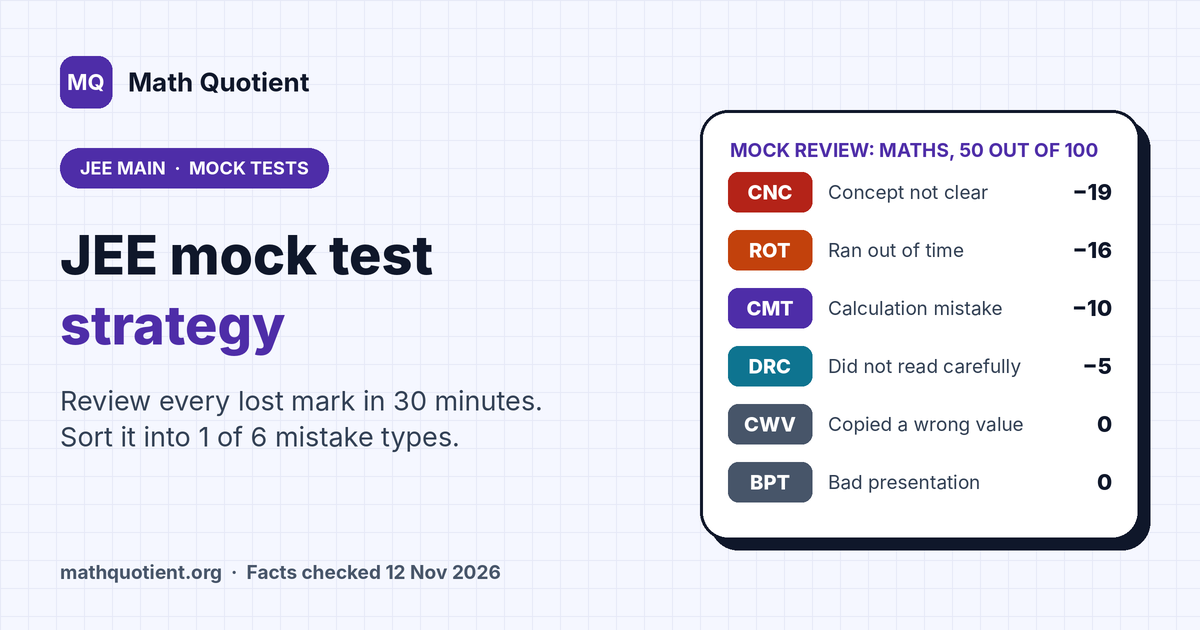
Trap codes come from the Free BMI Maths Test. CNC: concept not clear. DRC: did not read carefully. CMT: calculation mistake. ROT: ran out of time.
Part 1: JEE-style counting questions 1 to 5
Question 1
How many different arrangements can be made from all the letters of SHARJAH?
- 5040
- 2520
- 1260
- 630
Solution to question 1
Order matters? Yes: a new order is a new string.
Correct: C, 1260. 7 letters, with A twice and H twice. 7! ÷ (2! × 2!) = 5040 ÷ 4 = 1260.
Why the others tempt: A ignores the repeats (CNC). B divides by only one 2! (CNC). D divides by a third 2! that is not there (CMT).
Question 2
Six friends sit in a row of 6 chairs. Two of them, Rami and Zara, must not sit side by side. In how many ways can they sit?
- 720
- 600
- 480
- 240
Solution to question 2
Order matters? Yes. Each chair is a different place.
Correct: C, 480. All seatings: 6! = 720. Together: glue the pair into one block, 5! × 2 = 240. Apart: 720 − 240 = 480.
Why the others tempt: A ignores the rule (DRC). B forgets the pair can swap and takes away only 120 (CNC). D is the “together” count (DRC).
Question 3
A team of 4 is picked from 5 boys and 4 girls. It must have at least one girl. How many teams are possible?
- 224
- 126
- 121
- 40
Solution to question 3
Order matters? No. A team is the same team in any order.
Correct: C, 121. Count all teams, then take away the teams with no girl. ⁹C₄ − ⁵C₄ = 126 − 5 = 121.
Why the others tempt: A picks one girl, then any 3 others, so teams with 2 or more girls repeat (CNC). B ignores the rule (DRC). D counts exactly one girl (DRC).
Question 4
Seven people sit at a round table. Two of them must sit side by side. Rotations count as the same seating. How many seatings are there?
- 1440
- 720
- 240
- 120
Solution to question 4
Order matters? Yes, but only who sits next to whom.
Correct: C, 240. Glue the pair: now 6 units sit in a circle, which gives (6 − 1)! = 120. The pair can swap: 2 × 120 = 240.
Why the others tempt: A treats the circle as a row, 6! × 2 (CNC). B ignores the pair rule: (7 − 1)! = 720 (DRC). D forgets the swap (CNC).
Question 5
How many 4-digit even numbers can be made from the digits 0, 1, 2, 3, 4 and 5, with no digit used twice?
- 300
- 180
- 156
- 96
Solution to question 5
Order matters? Yes. 1024 and 4012 are different numbers.
Correct: C, 156. Split by the last digit. Ends in 0: 5 × 4 × 3 = 60. Ends in 2 or 4: the first digit cannot be 0 or the last digit, so 2 × 4 × 4 × 3 = 96. Total 156.
Why the others tempt: A counts odd numbers too (DRC). B lets 0 come first (CNC). D drops numbers ending in 0 (CNC).
Free BMI Maths Test
Counted twice? Find out why.
Overcounting comes from a weak idea or a skipped word. The Free BMI Maths Test tells you which. It finds your child’s real maths level and puts every mistake into one of 6 types.
Part 2: JEE-style counting questions 6 to 10
Question 6
There are 12 points in a plane. Exactly 6 of them lie on one straight line. No other 3 points are in a line. How many triangles have their corners at these points?
- 1320
- 220
- 205
- 200
Solution to question 6
Order matters? No. Corners P, Q, R make the same triangle as R, Q, P.
Correct: D, 200. Any 3 points: ¹²C₃ = 220. Three points on the line make no triangle: ⁶C₃ = 20 of them. 220 − 20 = 200.
Why the others tempt: A uses ¹²P₃, so each triangle counts 6 times (CNC). B forgets the line (DRC). C takes away ⁶C₂ (CMT).
Question 7
A group of 5 is chosen from 10 people. Two of them, Omar and Leila, refuse to be in the group together. How many groups are possible?
- 252
- 196
- 140
- 56
Solution to question 7
Order matters? No. It is a group.
Correct: B, 196. All groups: ¹⁰C₅ = 252. Groups with both: fill the other 3 places from 8, so ⁸C₃ = 56. 252 − 56 = 196.
Why the others tempt: A ignores the rule (DRC). C counts “exactly one of the two”, 2 × ⁸C₄, and forgets groups with neither (CNC). D is the “both” count (DRC).
Question 8
The letters of DUBAI are arranged so that no two vowels are next to each other. How many arrangements are there?
- 120
- 84
- 36
- 12
Solution to question 8
Order matters? Yes. These are arrangements of letters.
Correct: D, 12. Place the consonants D and B first: 2! = 2 ways. They make 3 gaps: _ D _ B _. Put one vowel (U, A, I) in each gap: 3! = 6 ways. 2 × 6 = 12.
Check: the vowels can only sit in places 1, 3 and 5, so 3! × 2! = 12.
Why the others tempt: B is “not all three together”, 120 − 36 (DRC). C is “all together” (DRC). A ignores the rule (DRC).
Question 9
Three different numbers are chosen from 1 to 15. In how many ways can their sum be even?
Solution to question 9
Order matters? No. Only which three numbers you take.
Correct: 231. From 1 to 15 there are 8 odd and 7 even numbers. An even sum needs 0 or 2 odd numbers. Three even: ⁷C₃ = 35. Two odd and one even: ⁸C₂ × 7 = 28 × 7 = 196. Total 35 + 196 = 231.
Trap: half of ¹⁵C₃ = 455 is 227.5, not a count. The split is not equal (CNC).
Question 10
8 identical sweets are shared among 3 children. Each child gets at least 1 sweet. In how many ways can this be done?
Solution to question 10
Order matters? Only how many sweets each child gets.
Correct: 21. Line up the sweets. Put 2 dividers in 2 of the 7 gaps between them: ⁷C₂ = 21.
Trap: ¹⁰C₂ = 45 lets a child get 0 sweets (DRC).
Your marks out of 40
+4 for each correct answer, −1 for each wrong one, 0 if skipped.
| Marks | What it shows | Do this |
|---|---|---|
| 32 or more, within 25 minutes | You pick nPr or nCr well. | Add counting to your timed sets. |
| 20 to 31, or past 25 minutes | Restrictions or slow listing cost you. | Redo the misses, order test first. |
| Under 20 | The base idea of counting is shaky. | Book the Free BMI Maths Test to find the cause. |
Mostly DRC codes? Underline “at least”, “not together” and “no two” before you start. Mostly CNC? Go back to the order test.
Practise next
Still mixing up nPr and nCr?
The Free BMI Maths Test finds where your child’s maths really stands and why each wrong answer happened.
Common questions about permutations and combinations
How do I know if a question is a permutation or a combination?
Swap two items in one answer. If you get a new outcome, such as a new seating or a new number, it is a permutation. If nothing changes, as with a team or a group, it is a combination.
How many P and C questions come in JEE Main?
NTA does not give a number for each unit. It is Unit 4 of the 14 maths units.
How do I check my answer fast?
Shrink the question and list every case, as with 2 of 3 letters at the top of this page. If the formula matches the small case, trust it.
Are these real JEE Main questions?
No. Math Quotient wrote them in the JEE Main format. NTA’s own sample test is on nta.ac.in.
Sources
Facts checked on 12 November 2026. Answers and wrong options checked in Python by formula and by listing every case.
- NTA, JEE (Main) 2027 Information Bulletin: question format, +4 / −1 marking, banned items.
- NTA, JEE (Main) 2027 Paper 1 topic list: maths Unit 4.
Author: Himanshu Jain
IIT Delhi B.Tech, and the founder of Math Quotient.