
Here are 10 SAT trigonometry questions on right triangles, with full working. Special triangles, angles that add to 90°, similar triangles, heights and trapezoids. We wrote them in the SAT style; they are not past test items.
3 checks · 10 questions
What these SAT trigonometry questions cover
SAT Geometry and Trigonometry gives 5 to 7 of the 44 maths questions, across four skills. This set covers one: right triangles and trigonometry.
College Board’s framework says this skill asks you to solve problems with the Pythagorean theorem, right triangle and unit circle trigonometry, and special right triangles. This set stays with triangles. Questions 3, 5 and 10 need a typed answer.
Parents: the PSAT 8/9 does not test trigonometry. The PSAT/NMSQT, PSAT 10 and SAT do.
Four checks before any SAT trig question
| Check | What to do | Why it matters |
|---|---|---|
| 1. Which angle? | Circle the named angle. Label the sides from it. | Opposite and adjacent swap with the angle. |
| 2. Which ratio? | sin = opp ÷ hyp, cos = adj ÷ hyp, tan = opp ÷ adj. | The Bluebook sheet does not give these. |
| 3. A special angle? | 30°, 45° or 60°: use x, x√3, 2x or s, s, s√2. | Exact answers often have √2 or √3. |
| 4. Degrees on? | In Desmos, type sin(30). It must show 0.5. | If not, switch to degrees in the settings. |
Time yourself: 16 minutes is near SAT pace. Sketch every triangle.
SAT trigonometry questions: ratios and special triangles
Question 1
A square courtyard has a straight path along one diagonal. The path is 60 m long. What is the area of the courtyard, in square metres?
- 900
- 1,800
- 3,600
- 7,200
Show answer
Answer: B, 1,800. A diagonal cuts the square into two 45°-45°-90° triangles. The diagonal is s√2, so s = 60 ÷ √2 = 30√2. Area: s² = 900 × 2 = 1,800.
Traps: A halves the diagonal. C uses the diagonal as the side. D multiplies by √2. BMI type: CNC, concept not clear.
Question 2
In triangle PQR, angle Q is 90°, angle P is 60° and PR = 14. What is the length of QR?
- 7
- 7√2
- 7√3
- 14√3
Show answer
Answer: C, 7√3. PR is the hypotenuse, so 2x = 14 and x = 7. QR is opposite the 60° angle, so QR = x√3 = 7√3.
Traps: A is PQ, the side opposite 30°. BMI type: DRC, did not read carefully. D multiplies the hypotenuse by √3. BMI type: CNC.
Question 3
The acute angles of a right triangle are (3k + 10)° and (2k + 20)°, and sin(3k + 10)° = cos(2k + 20)°. What is the value of k?
Show answer
Answer: 12. The sine of one acute angle equals the cosine of the other, because they add to 90°. So 3k + 10 + 2k + 20 = 90. Then 5k = 60 and k = 12. The angles are 46° and 44°.
Traps: setting the two angles equal gives k = 10. BMI type: CNC.
Question 4
In triangle XYZ, angle Z is 90°, XZ = 33 and YZ = 56. What is sin X?
- 33/65
- 56/65
- 33/56
- 56/33
Show answer
Answer: B, 56/65. XY² = 33² + 56² = 4,225, so XY = 65. From angle X, the opposite side is YZ = 56. So sin X = 56/65.
Traps: A is cos X, and D is tan X. BMI type: DRC. C is tan Y, with the sides upside down. BMI type: CNC.
Question 5
Right triangles ABC and DEF are similar. Angles C and F are right angles, and angle A matches angle D. cos A = 12/37 and DF = 24. What is the length of EF?
Show answer
Answer: 70. Similar triangles have equal angles, so cos D = DF ÷ DE = 12/37. Then DE = 24 × 37 ÷ 12 = 74. EF² = 74² − 24² = 5,476 − 576 = 4,900, so EF = 70.
Traps: 35 forgets the scale, and 74 is the hypotenuse. BMI type: DRC.
Free BMI Maths Test
Picked cos when the question said sin? Find out why.
Mixing up opposite and adjacent is a concept gap. Answering for the wrong angle is a misread. The Free BMI Maths Test tells these apart across 6 mistake types, and shows your child’s real maths level.
SAT trigonometry questions: heights, angles and shapes
Question 6
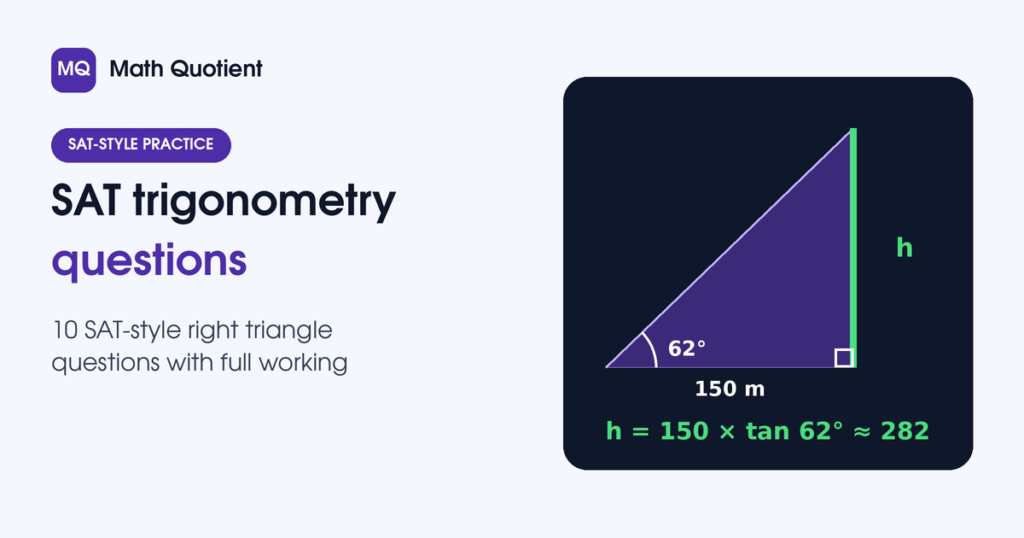
A student stands on level ground 150 m from the foot of a tower. The angle of elevation from the ground to the top of the tower is 62°. To the nearest metre, how tall is the tower?
- 70
- 132
- 282
- 320
Show answer
Answer: C, 282. The height is opposite 62°, and 150 m is adjacent. So height = 150 × tan 62° ≈ 150 × 1.881 ≈ 282.
Traps: A uses cos and B uses sin. BMI type: CNC. D is the straight-line distance to the top, not the height. BMI type: DRC.
Question 7
A vertical pole 3.2 m tall casts a shadow 4.5 m long on level ground. To the nearest degree, what is the angle between the ground and the line from the tip of the shadow to the top of the pole?
- 0.62
- 35
- 45
- 55
Show answer
Answer: B, 35. From the tip of the shadow, the pole is opposite and the shadow is adjacent. tan θ = 3.2 ÷ 4.5, so θ = tan⁻¹(0.711) ≈ 35.4°, which is 35°.
Traps: A is the angle in radians. D is the angle at the top of the pole. BMI type: DRC. C uses sin⁻¹ or cos⁻¹ on these sides. BMI type: CNC.
Question 8
A triangle has two sides of 10 cm, and the two angles at its base are each 30°. What is the area of the triangle, in square centimetres?
- 25
- 25√3
- 50
- 50√3
Show answer
Answer: B, 25√3. Drop a line from the top to the middle of the base. The height is 10 × sin 30° = 5. Half the base is 10 × cos 30° = 5√3, so the base is 10√3. Area = ½ × 10√3 × 5 = 25√3 ≈ 43.3.
Traps: D forgets the ½. BMI type: CMT, calculation mistake. A takes the base as 10, and C takes the top angle as 90° (it is 120°). BMI type: CNC.
Question 9
In trapezoid ABCD, side AB is parallel to side DC. AB = 10 and the height of the trapezoid is 6. Angle D is 45° and angle C is 60°. What is the length of DC?
- 16 + 2√3
- 16 + 3√3
- 16 + 6√3
- 22
Show answer
Answer: A, 16 + 2√3. Drop the height from A and from B. The middle part of DC is 10. At D (45°), the left part equals the height: 6. At C (60°), tan 60° = 6 ÷ part, so the part is 6 ÷ √3 = 2√3. DC = 10 + 6 + 2√3 ≈ 19.46.
Traps: C multiplies by tan 60°, and B uses 6 × sin 60°. BMI type: CNC. D treats 60° like 45°. BMI type: DRC.
Question 10
In the xy-plane, O is the origin and P is the point (28, 45). Angle θ is between the positive x-axis and the line OP. What is the value of cos θ?
Show answer
Answer: 28/53. OP² = 28² + 45² = 2,809, so OP = 53. The side next to θ is 28, so cos θ = 28/53.
Traps: 45/53 is sin θ, and 45/28 is tan θ. BMI type: DRC. 28/45 skips the hypotenuse. BMI type: CNC.
Score yourself
| Score | What it shows | Do this |
|---|---|---|
| 9 or 10 | Ratios and special triangles are secure. | Move to Hard “Right triangles and trigonometry” items in the Student Question Bank. |
| 7 or 8 | A label or a ratio slips. | Redraw each miss and write O, A and H on it. |
| 0 to 6 | A basic gap. | Book the Free BMI Maths Test to find it. |
Most misses here are the wrong angle (DRC) or the wrong ratio (CNC). Fix the one you have more of first.
Practise next
For official questions, filter College Board’s Student Question Bank by the Geometry and Trigonometry domain and the “Right triangles and trigonometry” skill.
Same trig slip, every time?
The Free BMI Maths Test finds your child’s real maths level and the reason for each mistake.
FAQ: SAT trigonometry questions
Does the SAT give sin, cos and tan on the reference sheet?
No. The sheet gives Pythagoras and the 30°-60°-90° and 45°-45°-90° triangles. Learn SOH CAH TOA yourself.
How many trigonometry questions are on the SAT?
College Board does not give a number for trigonometry alone. The whole Geometry and Trigonometry domain has 5 to 7 of the 44 maths questions.
Is the sine rule or the cosine rule on the SAT?
College Board’s skill list does not name them. It names right triangle and unit circle trigonometry.
Sources
Facts checked on 14 November 2026. All 10 answers and every wrong option were worked out again in Python.