
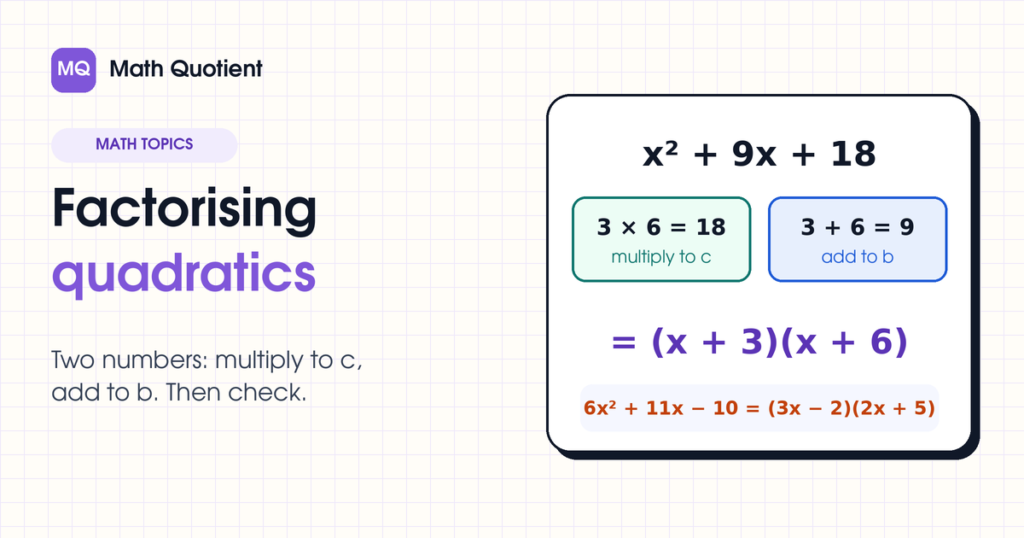
Factorising quadratics means writing an expression like x² + 9x + 18 as two brackets multiplied together: (x + 3)(x + 6). You look for two numbers that multiply to the number term and add to the x number.
Multiply to c. Add to b.
x² + 9x + 18 = (x + 3)(x + 6)
Hello, curious mind!
What does factorising a quadratic mean?
A quadratic expression is ax² + bx + c, with a not 0. Factorising is the reverse of expanding brackets.
It also solves equations: (x + 3)(x + 6) = 0 gives x = −3 or x = −6. Always expand back to check.
Step 0: take out a common factor first
Look for a number or letter in every term: 2x² − 72 = 2(x² − 36).
How to factorise quadratics when a = 1: the sign rules
For x² + bx + c, find p and q with p × q = c and p + q = b. The answer is (x + p)(x + q). The signs of b and c fix the signs of p and q.
| Expression | Sign of c, b | Numbers | Factors |
|---|---|---|---|
| x² + 9x + 18 | +, + | 3 and 6 | (x + 3)(x + 6) |
| x² − 9x + 18 | +, − | −3 and −6 | (x − 3)(x − 6) |
| x² + 3x − 18 | −, + | 6 and −3 | (x + 6)(x − 3) |
| x² − 3x − 18 | −, − | −6 and 3 | (x − 6)(x + 3) |
c positive: both numbers have the sign of b. c negative: one plus, one minus, and the bigger one takes the sign of b.
List the factor pairs of c in order and stop at the pair that gives b.
Factorising when a is not 1: split the middle term
Guessing brackets is slow here. Splitting the middle term always works if the expression factorises.
Example: factorise 6x² + 11x − 10
Multiply a and c: 6 × (−10) = −60.
Find two numbers that multiply to −60 and add to 11: 15 and −4.
Split 11x into 15x − 4x: 6x² + 15x − 4x − 10.
Factorise each pair: 3x(2x + 5) − 2(2x + 5). The same bracket must appear twice.
Take out that bracket: (3x − 2)(2x + 5).
Check with x = 10: 600 + 110 − 10 = 700, and 28 × 25 = 700.
Special forms you can spot at once
Difference of two squares
a² − b² = (a − b)(a + b). There is no x term.
49x² − 25 = (7x)² − 5² = (7x − 5)(7x + 5).
Perfect squares
9x² − 24x + 16: 9x² = (3x)², 16 = 4², and the middle is 2 × 3x × 4 = 24x. So it is (3x − 4)².
A negative x² number
Take out −1: −x² + 4x + 21 = −(x² − 4x − 21) = −(x − 7)(x + 3).
A quadratic in disguise
Treat x² as one block. x⁴ − 13x² + 36 = (x² − 4)(x² − 9) = (x − 2)(x + 2)(x − 3)(x + 3).
Does it factorise? The 10-second test
Work out b² − 4ac. With whole-number a, b and c, it factorises with whole numbers only when this is a square number.
| Expression | b² − 4ac | Result |
|---|---|---|
| 4x² + 7x + 3 | 49 − 48 = 1 | Square: (4x + 3)(x + 1) |
| 4x² + 7x + 2 | 49 − 32 = 17 | Not square: stop hunting |
If not, use the quadratic formula or completing the square instead.
Common mistakes when factorising quadratics
- Swapping the signs. (x − 3)(x + 6) expands to x² + 3x − 18, not x² − 3x − 18.
- Copying a sign wrongly. Writing −10 as +10 gives ac = 60, and no pair adds to 11.
- A sign slip in grouping. Writing + 2(2x + 5) for − 2(2x + 5) gives (3x + 2)(2x + 5), which is wrong.
- Stopping too soon. (2x − 12)(x + 6) equals 2x² − 72, but the full answer is 2(x − 6)(x + 6).
- Factorising a sum of squares. x² + 25 is not (x + 5)(x − 5). That gives x² − 25.
Check this with the Free BMI Maths Test
- Swaps the signs, or factorises x² + 25: CNC, concept not clear.
- Copies −10 as +10: CWV, copied a wrong value.
- Loses the minus in front of the second pair: CMT, calculation mistake.
- Leaves a common factor inside a bracket: BPT, bad presentation.
Which of these does your child make most? The Free BMI Maths Test sorts each mistake into one of 6 types and finds their real maths level. About the Free BMI Maths Test
Test prep corner
Factorising in SAT and JEE Main maths
SAT Advanced Math lists “Equivalent expressions” (College Board). JEE Main 2027 maths Unit 2 names quadratic equations (NTA). Both questions below were written by Math Quotient in the style of each test. They are not real past questions.
SAT-style: Which of these is a factor of 3x² − 7x − 20? (A) x + 4 (B) 3x + 5 (C) 3x − 5 (D) x + 5
ac = −60, and −12 + 5 = −7. So 3x² − 12x + 5x − 20 = (3x + 5)(x − 4). Answer (B). Trap: (A) flips the sign of x − 4.
JEE-style, number answer: x² + px + 12 = (x + m)(x + n), where m and n are integers. How many different integer values can p take?
mn = 12 and p = m + n. The pairs 1, 12; 2, 6; 3, 4 give p = 13, 8, 7, and the negative pairs give −13, −8, −7. Answer: 6. Trap: forgetting the negative pairs gives 3.
More: our SAT-style quadratic questions or the JEE-style quadratic equations questions, with full working.
Facts checked on 14 November 2026 on satsuite.collegeboard.org and jeemain.nta.nic.in.
Quick check: 5 factorising questions
1. Factorise x² + 11x + 24.
Not quite. 4 + 6 = 10.
Yes! 3 × 8 = 24 and 3 + 8 = 11.
Not quite. 2 + 12 = 14.
2. Factorise x² − 64.
Not quite. (x − 8)² has a −16x term.
Not quite. That is x² − 64x.
Yes! A difference of two squares.
3. Factorise 2x² + 7x + 6.
Yes! ac = 12, and 4 + 3 = 7.
Not quite. The x term is 13x.
Not quite. The x term is 8x.
4. Which one does not factorise with whole numbers?
Not quite. (x + 2)(x + 3).
Not quite. (x + 1)(x + 4).
Yes! b² − 4ac = 25 − 32 = −7, not a square.
5. Factorise 5x² − 20x fully.
Not quite. x is still in both terms.
Yes! 5x is in both terms.
Not quite. That is 5x² − 4x.
Got 2 or fewer right? Book the Free BMI Maths Test to find the cause.
Questions people ask about factorising quadratics
Can every quadratic be factorised?
Not with whole numbers. x² + 6x + 2 gives b² − 4ac = 28, not a square.
Does the order of the brackets matter?
No. (x + 6)(x − 3) and (x − 3)(x + 6) are the same.
Is factorising the same as factoring?
Yes. “Factorising” is UK English and “factoring” is US English. SAT questions use the US word.
Keep exploring
Signs keep going wrong in the brackets?
One free test shows where the slips come from: the Free BMI Maths Test finds your child’s real level and the cause of each mistake.