
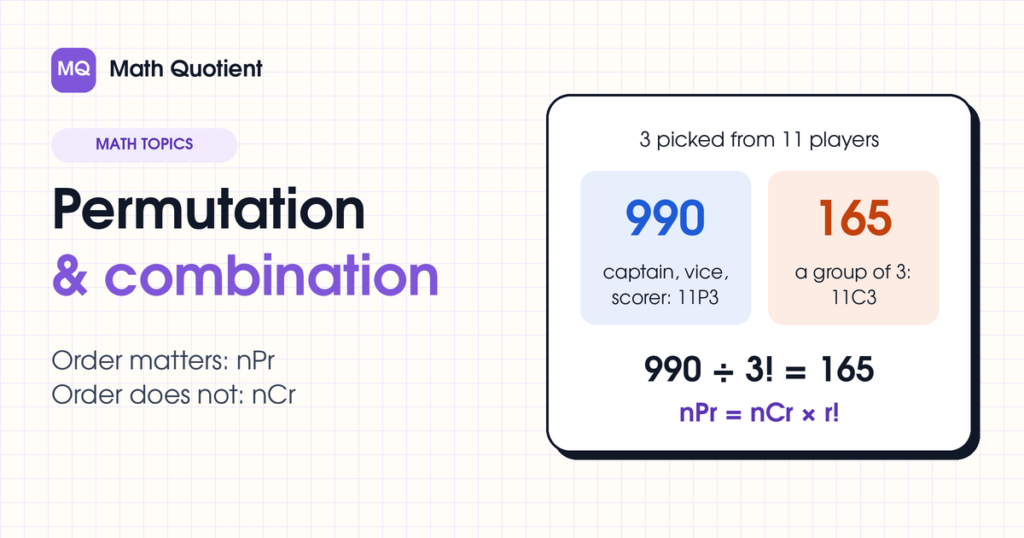
Permutation and combination are two ways to count choices. A permutation counts arrangements, where order matters. A combination counts selections, where order does not.
990 ÷ 3! = 165
Hello, curious mind!
Start with the counting rule
If one choice can be made in a ways and the next in b ways, both together can be made in a × b ways. This is the fundamental counting principle. Every permutation and combination formula grows from it.
A café meal deal has 3 drinks, 4 sandwiches and 2 desserts. You take one of each. That gives 3 × 4 × 2 = 24 meals.
Now line up 4 different books on a shelf. The first place has 4 choices, the next 3, then 2, then 1. That is 4 × 3 × 2 × 1 = 24. We write it as 4! and say “4 factorial”. By agreement, 0! = 1.
Remember this
One choice and then another: multiply.
Permutation and combination formulas
| Permutation | Combination | |
|---|---|---|
| Counts | Arrangements | Selections |
| Order | Matters | Does not matter |
| Formula | ⁿPᵣ = n! ÷ (n − r)! | ⁿCᵣ = n! ÷ (r! (n − r)!) |
| Link | ⁿPᵣ = ⁿCᵣ × r! | |
Here n is how many items you have, and r is how many you pick. Each item is used once.
Example 1: jobs for 3 players (permutation)
A team of 11 needs a captain, a vice-captain and a scorer. One player cannot hold two jobs. How many ways are there?
Captain: 11 choices. Vice-captain: 10 left. Scorer: 9 left.
¹¹P₃ = 11 × 10 × 9 = 990.
Example 2: 3 players to carry the kit (combination)
Now pick any 3 of the 11 to carry the kit. There are no jobs, so a group is just a group.
Each group of 3 was counted 3! = 6 times in Example 1, once for each way to hand out the jobs.
¹¹C₃ = 990 ÷ 6 = 165.
This is why the formulas are linked. Divide by r! to wipe out the order.
Permutation or combination: which one do I use?
Ask one question: do the picked items get different places or jobs?
- Yes, so permutation: seats in a row, digits in a code, first and second prize, letters in a word.
- No, so combination: a team, a hand of cards, toppings on a pizza, questions picked to answer.
Mixed questions use both. Choose 2 of 5 novels and 1 of 4 comics for a trip: ⁵C₂ × ⁴C₁ = 10 × 4 = 40. The two picks happen together, so multiply.
Repeats and short cuts
When an item can be used again
A lock has a 3-digit code, and each digit is 0 to 9. Digits may repeat, so each place has 10 choices: 10 × 10 × 10 = 1,000 codes. If no digit may repeat, it is ¹⁰P₃ = 10 × 9 × 8 = 720. Read the question for this rule first.
When letters repeat
LEVEL has 5 letters, with L twice and E twice. Swapping the two Ls makes no new word. So divide by 2! for the Ls and 2! for the Es: 5! ÷ (2! × 2!) = 120 ÷ 4 = 30.
Choosing r is the same as leaving n − r
ⁿCᵣ = ⁿCₙ₋ᵣ. Picking 18 of 20 is the same as picking the 2 to leave out. So ²⁰C₁₈ = ²⁰C₂ = (20 × 19) ÷ 2 = 190.
Common permutation and combination mistakes
- Using ⁿPᵣ for a group. 990 kit carriers counts each group 6 times. The answer is 165.
- Adding stages that happen together. 10 + 4 = 14 for the novels and comics. Both picks happen, so 10 × 4 = 40.
- Missing a repeat rule. Giving 720 when the lock allows repeats. It should be 1,000.
- Dividing by only one 2!. 120 ÷ 2 = 60 for LEVEL forgets the second pair. The answer is 30.
- Dividing by r, not r!. 990 ÷ 3 = 330 for ¹¹C₃. Divide by 3! = 6.
Check this with the Free BMI Maths Test
- Uses ⁿPᵣ when order does not matter: CNC, concept not clear.
- Adds two stages instead of multiplying: CNC, concept not clear.
- Misses “digits may repeat”: DRC, did not read carefully.
- Divides LEVEL by one 2! only: CMT, calculation mistake.
- Divides by 3 instead of 3!: CMT, calculation mistake.
The Free BMI Maths Test finds which of the 6 mistake types your child makes, and their real maths level. About the Free BMI Maths Test
Test prep corner
Permutation and combination in JEE Main
NTA’s JEE Main 2027 maths topic list has a unit for it: Unit 4, “Permutations and Combinations”. The unit lists the fundamental principle of counting, the meaning of P(n, r) and C(n, r), and simple applications. These are JEE-style questions, not real past questions.
JEE-style: How many diagonals does a polygon with 10 sides have?
Any 2 corners make a line: ¹⁰C₂ = 45. Ten of those lines are sides, not diagonals. 45 − 10 = 35. Trap: ¹⁰P₂ = 90 counts each line twice.
JEE-style: A group of 4 is chosen from 7 people. One of them, the captain, must be in it. How many groups are possible?
Put the captain in first. Choose the other 3 from the 6 left: ⁶C₃ = 20. Trap: ⁷C₄ = 35 ignores the rule.
Ready for harder ones? Try our JEE-style permutation and combination questions, with full working and a +4 / −1 score table.
Facts checked on 14 November 2026 on nta.ac.in (JEE Main 2027 topic list).
Quick check: 5 counting questions
1. 5 runners race. In how many ways can first and second place go?
Not quite. First and second are different places, so order matters.
Yes! ⁵P₂ = 5 × 4 = 20.
Not quite. One runner cannot take both places.
2. How many ways can you choose 2 fruits from 6 kinds for a bowl?
Yes! ⁶C₂ = 30 ÷ 2 = 15.
Not quite. A bowl has no order. Divide by 2!.
Not quite. 6 × 2 is not a counting rule.
3. How many ways can the letters A, B, C and D be arranged?
Not quite. 4 × 4 lets a letter be used twice.
Not quite. Each place has fewer choices than the one before.
Yes! 4! = 4 × 3 × 2 × 1 = 24.
4. What is ⁸C₆?
Not quite. 56 is ⁸P₂. Divide by 2! as well.
Yes! ⁸C₆ = ⁸C₂ = (8 × 7) ÷ 2 = 28.
Not quite. Use ⁸C₂ = (8 × 7) ÷ 2.
5. You have 4 shirts and 3 trousers. How many outfits of one shirt and one pair of trousers?
Not quite. You wear both, so multiply.
Yes! 4 × 3 = 12.
Not quite. That is a power, not a product of choices.
Got 2 or fewer right? Book the Free BMI Maths Test to find the cause.
Questions people ask about permutation and combination
What is the difference between permutation and combination?
A permutation counts arrangements, so order matters. A combination counts selections, so order does not.
What are the permutation and combination formulas?
ⁿPᵣ = n! ÷ (n − r)! and ⁿCᵣ = n! ÷ (r! (n − r)!). They are linked by ⁿPᵣ = ⁿCᵣ × r!.
Why is 0! equal to 1?
There is exactly one way to arrange nothing. It also keeps the formulas working, for example ⁿCₙ = 1.
Is a permutation always bigger than a combination?
It is never smaller. For r of 2 or more, ⁿPᵣ is r! times ⁿCᵣ, so it is bigger.
Does your child mix up ⁿPᵣ and ⁿCᵣ?
The Free BMI Maths Test finds your child’s real maths level and the reason for each mistake.