
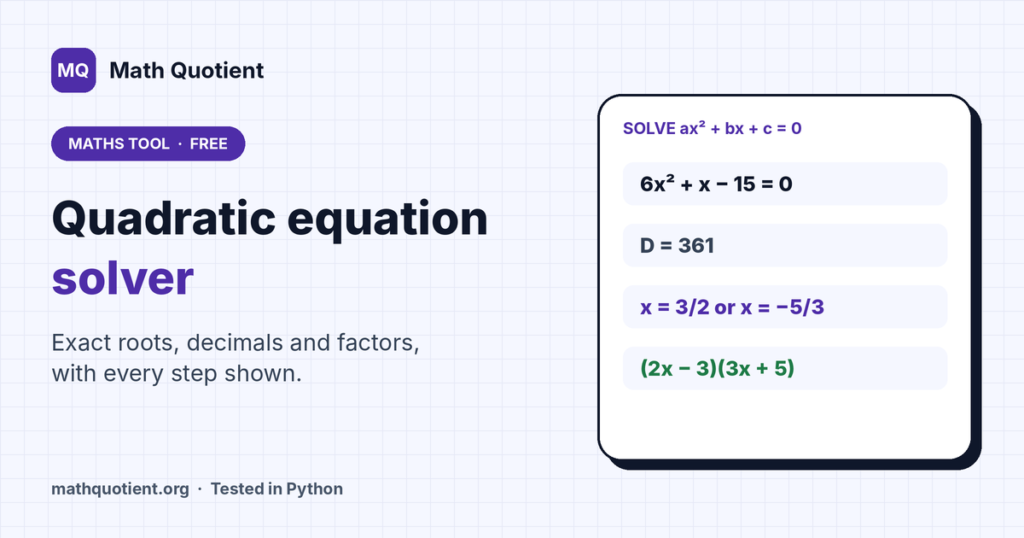
This free quadratic equation solver finds the roots of ax² + bx + c = 0 and shows every step. It gives the exact answer (a fraction or a square root) and the decimals. It also gives the factorised form when there is one, and complex roots when the discriminant is negative.
Check your working. Then learn where it went wrong.
Quadratic equation solver
Pick a mode. Type each number with its sign. Use 0 for a missing term. Fractions such as 3/4 and decimals such as −2.5 are fine.
How the solver works, and its limits
It follows the same order you should use on paper. The working under the answer shows each step with your numbers.
Get 0 on one side. In the "both sides" mode, the solver takes each right-side number away from the matching left-side number. This is the step where most signs go wrong.
Make the numbers whole. If a, b or c is a fraction or a decimal, it multiplies every term by the smallest number that clears them. It then divides out any common factor, and makes a positive. The roots do not change.
Work out the discriminant, b² − 4ac. Its sign tells you what kind of roots to expect, before any square root.
Give the exact roots. It simplifies the square root, for example √48 = 4√3, and cancels common factors. Decimals come after, to 4 decimal places.
Check. For ax² + bx + c = 0, the roots add up to −b/a and multiply to c/a. The solver shows both, so you can test your own answer in seconds.
The limits
Each box takes a number from −10,000 to 10,000, with up to 4 decimal places, or a fraction such as 7/3. The solver does not read a typed equation, so enter the numbers by term. The "two roots" mode takes whole numbers, fractions and decimals, not square roots. If a is 0, the equation is linear, and the solver says so.
What your answer means
The discriminant, D = b² − 4ac, sorts every quadratic into one of four kinds. Here is what the solver shows for each, with the examples it uses.
| D | You get | Example |
|---|---|---|
| A square number | Two roots with no square root. It factorises. | 6x² + x − 15 = 0: D = 361, x = 3/2 or −5/3, (2x − 3)(3x + 5) |
| More than 0, not square | Two roots with a square root. No whole-number factors. | 3x² − 9x + 5 = 0: D = 21, x = (9 ± √21)/6 |
| 0 | One repeated root. The curve touches the x-axis. | 25x² − 30x + 9 = 0: x = 3/5, (5x − 3)² |
| Less than 0 | No real roots. Two complex roots. | x² − 2x + 10 = 0: D = −36, x = 1 ± 3i |
Exact form or decimal?
Use the exact form when a question asks for an exact value, or when the answer choices hold square roots. Use the decimal when a question asks you to round. Do not round in the middle of the working. Take 3x² − 9x + 5 = 0. Round √21 to 4.6 first, and the larger root comes out as 2.2667. The true value is about 2.2638.
Real or complex roots?
For SAT maths, "no real roots" is the answer when D is less than 0. JEE Main maths also uses complex numbers, so a question may ask for the roots in the form p ± qi. The solver gives both.
Common mistakes when you use a solver
A solver does the sums right. The answer is only as good as the numbers you type, and these slips are the usual cause of a "wrong" answer.
- Typing c before every term is on one side. In 4x² − 3x = 7, c is −7, not 7. Use the "both sides" mode if you are not sure.
- Losing a minus sign when you copy b. In x² − 11x + 18 = 0, b is −11. Typed as 11, the roots become −2 and −9, not 2 and 9.
- Leaving out a = 1. In x² + 6x − 7 = 0, a is 1, not 0 or blank.
- Mixing up the order. In 8 − 3x + 2x² = 0, a = 2, b = −3 and c = 8. Read each number by its power of x, not by where it sits.
Free BMI Maths Test
The solver got it right. Why did you not?
- Read c before moving every term to one side: DRC, did not read carefully.
- Copied b as 11 when it was −11: CWV, copied a wrong value.
- Rounded √21 in the middle of the working: CMT, calculation mistake.
- Stopped at "no real roots" when the question wanted complex roots: CNC, concept not clear.
The Free BMI Maths Test finds which of the 6 mistake types your child makes, and their real maths level.
Build an equation from its roots
Questions often go the other way: "Find a quadratic with roots 4 and −2/3." The solver's third mode does this with a short rule.
Add the roots: 4 + (−2/3) = 10/3. Multiply them: 4 × (−2/3) = −8/3.
Write x² − (sum)x + (product) = 0: x² − (10/3)x − 8/3 = 0.
Multiply by 3 to clear the fractions: 3x² − 10x − 8 = 0. Check: (x − 4)(3x + 2) gives the same.
Any multiple, such as 6x² − 20x − 16 = 0, has the same roots. The solver gives the one with the smallest whole numbers.
Learn the method behind the answers
In a test you need the method, not the solver. Start with quadratic equations to choose the fastest way to solve. Then use the quadratic formula page to learn each step of the formula, and completing the square for turning points.
To test yourself, try the SAT-style quadratic questions or the JEE-style quadratic equations questions. Solve each one on paper first, then check it here.
Questions people ask about solving quadratics
How do I solve a quadratic equation with steps?
Get 0 on one side and read a, b and c with their signs. Work out b² − 4ac. Then use x = (−b ± √(b² − 4ac)) ÷ 2a, and simplify. The solver on this page shows each of these steps with your numbers.
Can this solver handle fractions and decimals?
Yes. Type 3/4 or 0.75. The solver multiplies every term by a number that makes them whole first. For example, 0.5x² − 1.5x − 2 = 0 becomes x² − 3x − 4 = 0, with roots 4 and −1.
What does it mean when there are no real roots?
The discriminant is less than 0, so the curve y = ax² + bx + c does not cross the x-axis. There are still two complex roots. For x² − 2x + 10 = 0, they are 1 + 3i and 1 − 3i.
Why is my answer different from the solver's?
Check that you typed b and c with their signs, and that every term was on one side first. Then check if your answer is the same number in another form: (9 ± √21)/6 is the same as 3/2 ± √21/6.
How do I find a quadratic from its roots?
Use x² − (sum of roots)x + (product of roots) = 0, then clear any fractions. Roots 4 and −2/3 give 3x² − 10x − 8 = 0.
Keep exploring
Right with the solver, wrong on paper?
The Free BMI Maths Test finds your child's real maths level and the reason for each mistake.
How we checked it
Maths checked on 14 November 2026. We tested every mode of the solver against the same answers worked in Python, including fractions, decimals, negative numbers, a = 0 and empty boxes.