
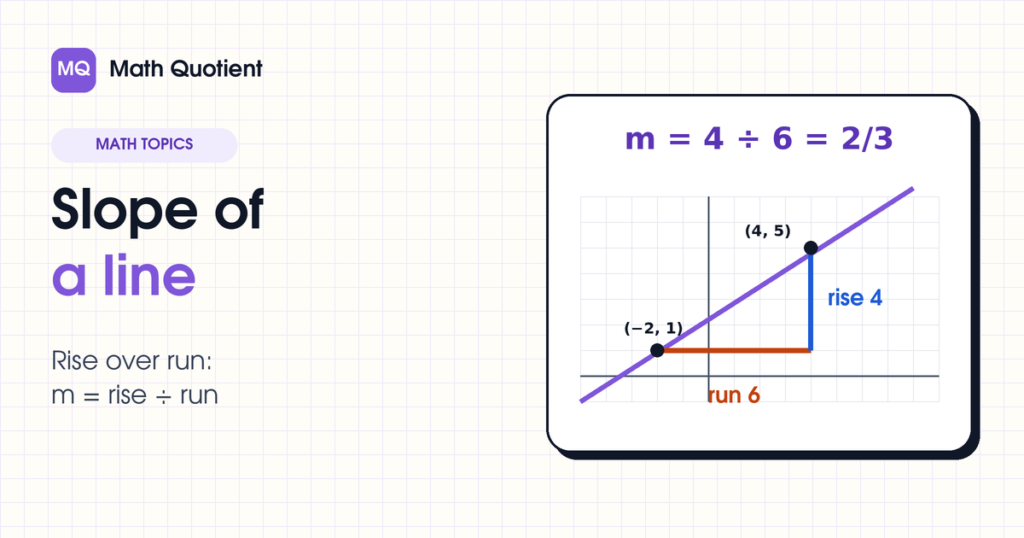
The slope of a line tells you how steep it is and which way it goes. Slope m = rise ÷ run = (y₂ − y₁) ÷ (x₂ − x₁): the change in y for each 1 step to the right.
m = 4 ÷ 6 = 2/3
Hello, curious mind!
What is the slope of a line?
Slope is how much y changes for each 1 step in x. We use the letter m. In the UK it is often called the gradient. A bigger number means a steeper line.
| Slope | The line | Example |
|---|---|---|
| Positive | goes up from left to right | y = 3x + 1 |
| Negative | goes down from left to right | y = −x + 4 |
| Zero | is flat | y = 7 |
| Undefined | stands upright | x = −2 |
Why is an upright line “undefined”? Its run is 0, and you cannot divide by 0. A flat line has a rise of 0, and 0 ÷ run = 0. So zero slope and no slope are different things.
How to find the slope of a line: 3 worked examples
Example 1: from two points
Find the slope through (−3, 4) and (2, −6).
Rise: −6 − 4 = −10. Run: 2 − (−3) = 5.
m = −10 ÷ 5 = −2. The line goes down 2 for each 1 step right.
Start both subtractions with the same point. Swap both and you still get −2.
Example 2: from an equation
Find the slope of 5x − 2y = 8.
Get y alone: −2y = −5x + 8, so y = 2.5x − 4.
In y = mx + c, m is the number in front of x: m = 5/2.
Short cut: for ax + by = c, the slope is −a ÷ b. Here −5 ÷ (−2) = 5/2.
Example 3: slope as a rate (made-up numbers)
A phone shows 84% battery at 2 pm and 63% at 5 pm. It drains at a steady rate.
Slope = (63 − 84) ÷ (5 − 2) = −21 ÷ 3 = −7% per hour.
From 63%, it needs 63 ÷ 7 = 9 more hours. So it runs out at 2 am.
The units of a slope are “y units per x unit”. Say them: it makes the meaning clear.
Parallel and perpendicular lines
- Parallel lines have the same slope. The line through (1, −2) parallel to y = 4x + 3 also has m = 4. Put in the point: −2 = 4 + c, so c = −6 and y = 4x − 6.
- Perpendicular slopes multiply to −1. Flip the fraction and change the sign. 2x + 5y = 10 has m = −2/5, so a line at right angles has m = 5/2.
- Points on one line share a slope. A(−1, 7), B(1, 1) and C(3, −5): AB has slope −6 ÷ 2 = −3 and BC has slope −6 ÷ 2 = −3. Same slope through B, so all three are on one line.
One exception: a flat line and an upright line are perpendicular, but 0 × “undefined” is not −1.
Slope and the angle of a line
If a line makes an angle θ with the positive x-axis, then m = tan θ.
- θ = 45° gives m = 1. θ = 135° gives m = −1. θ = 60° gives m = √3.
- The angle φ between two lines with slopes m₁ and m₂: tan φ = |(m₁ − m₂) ÷ (1 + m₁m₂)|.
- For m₁ = 2 and m₂ = −3: |5 ÷ (1 − 6)| = 1, so φ = 45°.
See our trigonometry formulas page for tan values.
Common slope mistakes
- Mixing the order. (−6 − 4) ÷ (−3 − 2) = +2. The answer to Example 1 is −2.
- Run over rise. 5 ÷ (−10) = −1/2. Rise goes on top.
- Reading a from ax + by = c. For 5x − 2y = 8, the slope is not 5. Get y alone first.
- Half the perpendicular rule. For −2/5, the answer is 5/2, not 2/5 (sign only) or −5/2 (flip only).
- Mixing up zero and undefined. y = 7 has slope 0. x = −2 has no slope.
Check this with the Free BMI Maths Test
- Starts the top and the bottom with different points: CMT, calculation mistake.
- Puts run over rise: CNC, concept not clear.
- Reads the slope of 5x − 2y = 8 as 5: CNC, concept not clear.
- Changes the sign but does not flip: CNC, concept not clear.
- Calls x = −2 a zero slope: CNC, concept not clear.
These fall into 2 of the 6 mistake types. The Free BMI Maths Test shows which types your child makes and finds their real maths level.
Test prep corner
Slope on the SAT and in JEE Main
College Board lists “Linear equations in 2 variables” and “Linear functions” in SAT Algebra. The reference sheet in its digital practice tests has no slope formula, so learn it. NTA’s JEE Main 2027 topic list names the slope of a line and parallel and perpendicular lines in Unit 10. These are SAT-style questions, not real past questions.
SAT-style: A line through (2, k) and (6, 11) has a slope of 3/2. What is k?
The run is 6 − 2 = 4, so the rise is (3/2) × 4 = 6. So k = 11 − 6 = 5. Trap: 11 − 3/2 = 9.5 forgets that the run is 4, not 1.
SAT-style: Line ℓ is 3x + y = 7. Line n is perpendicular to ℓ and passes through (0, −2). Where does n cross the x-axis?
ℓ has slope −3, so n has slope 1/3: y = x/3 − 2. Set y = 0: x = 6. Trap: slope 3 (sign only) gives x = 2/3.
For more line questions, work through our SAT-style linear equations questions.
Facts checked on 14 November 2026 on satsuite.collegeboard.org and jeemain.nta.nic.in.
Quick check: 5 slope questions
1. What is the slope through (1, 4) and (3, 10)?
Yes! 6 ÷ 2 = 3.
Not quite. That is run over rise.
Not quite. 10 − 3 mixes an x with a y.
2. What is the slope of y = 7?
Not quite. 7 is where it crosses the y-axis.
Yes! The line is flat.
Not quite. Upright lines are undefined. This one is flat.
3. What is the slope of x = −2?
Not quite. Zero slope is a flat line.
Not quite. −2 is where it crosses the x-axis.
Yes! The run is 0.
4. What is the slope of 4x + 2y = 9?
Not quite. Get y alone first.
Yes! y = −2x + 4.5.
Not quite. 9/2 is the y-intercept.
5. A line has slope 5/3. What slope is perpendicular to it?
Not quite. Change the sign too.
Not quite. Flip the fraction too.
Yes! (5/3) × (−3/5) = −1.
Got 2 or fewer right? Book the Free BMI Maths Test to find the cause.
Questions people ask about slope
What is the slope of a line?
It is the rise divided by the run between any two points: m = (y₂ − y₁) ÷ (x₂ − x₁). It shows how steep the line is.
Is slope the same as gradient?
Yes. Both words mean the change in y for each 1 step in x.
What is the difference between zero and undefined slope?
A flat line, such as y = 7, has slope 0. An upright line, such as x = −2, has a run of 0, so its slope is undefined.
How do I find the slope from ax + by = c?
Use −a ÷ b, or get y alone. For 4x + 2y = 9, the slope is −2.
Keep exploring
Right formula, wrong sign?
A sign slip and a gap in the concept need different fixes. The Free BMI Maths Test tells them apart and finds your child’s real maths level.