
To avoid negative marking in JEE Main maths, cut the wrong answers you felt sure of, not only the guesses. Each wrong answer costs 1 mark, in Section A and in Section B.
This page shows where wrong maths answers come from, a confidence log to find your own leaks in mocks, and three 30-second checks that catch a wrong answer before you submit it. Every example is JEE-style and made for this page.
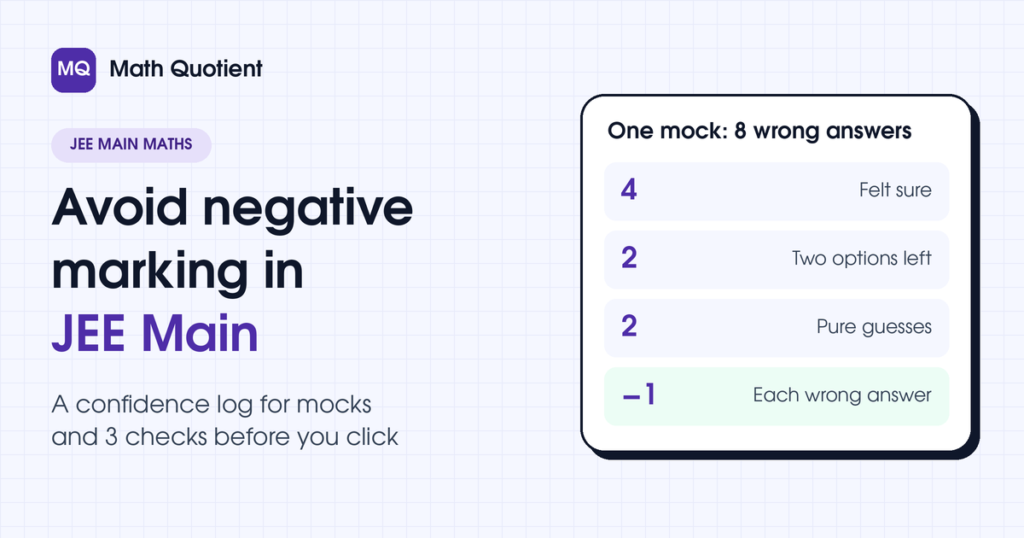
8 wrong answers in one mock
Quick answer
Tag every answer in your mocks: sure, two options left, or guess. Count the wrong answers in each tag.
If sure answers go wrong, add checks. If half-sure answers go wrong, fix the idea behind them.
In Section B, never type a number you have not worked out.
Negative marking in JEE Main: the rules that matter here
| Rule | What the JEE Main 2027 bulletin says |
|---|---|
| Right answer | +4 |
| Wrong answer | −1, in Section A (options) and in Section B (number answers) |
| No answer | 0. Marked for review with no option chosen also gives 0. |
| Equal total NTA scores | Maths NTA score first, then physics, then chemistry. Next, the student with the smaller share of wrong answers to right answers ranks higher. |
So a wrong answer costs twice. It takes 1 mark now, and it can cost a place in a tie. A wrong answer that could have been right costs 5 marks: the 4 you missed and the 1 you lost.
The full scheme, with the average marks a guess gives, is on our JEE Main maths marking scheme page. This page is about the step after: making fewer wrong answers.
Where wrong maths answers come from
Most students blame guessing. In practice, many wrong answers come from questions the student thought were done. Each cause has a different fix.
| What happened | Mistake type | The fix |
|---|---|---|
| You solved a different question: positive for non-negative, sum for product | DRC, did not read carefully | Check 1 below: circle the condition words |
| Your working was right but you kept a value that breaks the question | CNC, concept not clear | Checks 2 and 3: domain and range |
| A slip in a sign or a sum | CMT, calculation mistake | Redo the last two lines, not the whole question |
| A number changed between the question, the rough sheet and the screen | CWV, copied a wrong value | Read the number back from the screen before you save |
| You rushed the last questions | ROT, ran out of time | Leave unworked questions blank in the last minutes |
The confidence log: find your own leaks
General tips cannot tell you where your marks go. A log can. In each mock, write one letter next to every maths answer before you check it.
- S, sure: you worked it out and you trust it.
- H, half-sure: two options are left, or you are not sure of one step.
- G, guess: no working, or no option ruled out.
After the mock, mark it with +4, −1 and 0. Then count the right and wrong answers in each tag. Marks = 4 × right − wrong. Here is one made-up mock.
| Tag | Answered | Right | Wrong | Marks |
|---|---|---|---|---|
| S | 16 | 12 | 4 | 44 |
| H | 5 | 3 | 2 | 10 |
| G | 2 | 0 | 2 | −2 |
| Blank | 2 | – | – | 0 |
| Total | 25 | 15 | 8 | 52 |
What this log says:
- The biggest leak is the S row. 4 of the 8 wrong answers were “sure”. Those 4 cost 20 marks against a right answer. If checks had saved 2 of them, the score would be 62, not 52.
- The H row is working. 3 of 5 right is well above 1 in 5, so these answers pay. Keep answering them.
- The G row lost 2 marks. Left blank, the score would be 54. One mock is too small to judge guessing, so look at three mocks together.
Rules to set from your own log
- S right less than 9 times in 10? Add the three checks below to every S answer.
- H right less than half the time? You often rule out the right option. That is an idea not clear (CNC), so practise the topic, not the timing.
- G in Section B? Stop. A typed guess at a number almost never pays.
Free BMI Maths Test
Sure, but wrong? Find the reason.
A log shows where the minus marks come from. It does not show why. The Free BMI Maths Test finds your child’s real maths level and sorts every mistake into one of 6 types, such as DRC (did not read carefully) or CNC (concept not clear).
Three 30-second checks to avoid negative marking in JEE Main
These checks catch the “sure but wrong” answer. Each one comes with a JEE-style example. They are practice questions in the style of JEE Main, not real past questions.
Check 1: circle the condition words
Words like positive, non-negative, distinct, real and integer change the answer. Circle them on the rough sheet before you start.
How many solutions in positive integers does a + b + c = 7 have?
Show answer
Answer: 15. Give each of a, b and c 1 first. That leaves 4 to share among 3 letters: C(6, 2) = 15.
Trap: 36. That is the count for non-negative integers, C(9, 2), where a letter may be 0. Typing 36 turns +4 into −1. BMI type: DRC, did not read carefully.
Check 2: put the answer back into the question
A value can solve your working but break the question. Look for a denominator, a square root or a log, and test each value there.
Find the sum of all real values of x that satisfy (x² − 5x + 6) ÷ (x − 2) = 0.
Show answer
Answer: 3. The top is (x − 2)(x − 3), which is 0 at x = 2 and x = 3. At x = 2 the bottom is also 0, so the fraction does not exist there. Only x = 3 works.
Trap: 5, the sum 2 + 3. BMI type: CNC, concept not clear: a fraction is never 0 where its bottom is 0.
Check 3: ask if each value is possible
Some values cannot happen: sin x or cos x above 1, a probability above 1, a negative length. Drop them before you count.
How many values of x in [0, 2π] satisfy 2 sin²x − 3 sin x − 2 = 0?
Show answer
Answer: 2. Factorise: (2 sin x + 1)(sin x − 2) = 0. So sin x = −1/2 or sin x = 2. But sin x is never more than 1, so sin x = 2 gives nothing. sin x = −1/2 gives x = 7π/6 and x = 11π/6.
Trap: 4, from counting two values for sin x = 2 as well. BMI type: CNC, concept not clear.
All three questions are Section B. There are no options to warn you, so the check is the only thing between you and −1.
When to leave a JEE Main maths question blank
- Section B with no working: leave it blank.
- Section A with no option ruled out: leave it, unless your log shows your guesses pay over three mocks.
- Section A with one or two options ruled out: answer it, if your H row is right at least half the time.
- A check fails and there is no time to redo it: leave it blank. A known doubt is worth 0, not −1.
For how many minutes to give each round, see our JEE maths time management plan.
For UAE families
JEE Main 2027 Session 1 runs on 20, 21, 22, 23, 24 and 28 January 2027. The morning shift runs from 7:30 to 10:30 am UAE time. Use the weeks before it to build the habit.
- Students: keep the S, H and G letters in every mock. It takes about a second for each answer.
- Students: do the three checks by hand. Calculators are not allowed in the test hall.
- Parents: ask for two numbers after each mock: wrong answers, and how many of them were “sure”. Both should fall over the weeks.
What to do now
- Take one timed maths mock and tag every answer S, H or G.
- Mark it with +4, −1 and 0, and fill in the log table.
- Name the cause of each wrong answer with the table above.
- Add the three checks to every S answer in the next mock.
- After three mocks, set your own blank rule from the log.
Questions people ask about negative marking in JEE Main
How many marks does one wrong answer cost in JEE Main?
1 mark, in both Section A and Section B. Against a right answer, it costs 5 marks: the 4 you missed and the 1 you lost.
Should I attempt every question in JEE Main maths?
No. Answer what you have worked out and checked. In Section A, answer if you have ruled out options and your log shows those answers pay. Leave Section B blank without working.
Do wrong answers matter if two students tie?
Yes. After the maths, physics and chemistry NTA scores, the bulletin ranks the student with the smaller share of wrong answers to right answers higher.
How do I stop silly mistakes in JEE maths?
Find which kind they are first. Use a confidence log in mocks. Then add three checks to answers you feel sure of: condition words, put the answer back, and is the value possible.
Does marked for review count as an answer?
Marked for review with no option chosen gives 0. If you mark a question for review, keep an answer in it only if you would submit that answer.
Losing marks to wrong answers?
Start with the Free BMI Maths Test. It finds your real maths level and the reason for each mistake.
Sources
Facts checked on 14 November 2026. The mock log and the three questions are made up for this page. Every number and answer was checked in Python. NTA can change its rules, so check its public notices before the test.
- NTA: JEE (Main) 2027 Information Bulletin (marking scheme, negative marking in Sections A and B, tie rules, dates, shift times, items not allowed)
- NTA: JEE Main official website