
To do mental percentages fast, turn each one into an easy step. Swap the numbers, use a fraction you know, or multiply by one number for a rise or a fall.
This page gives 4 methods for mental percentages, each tied to an SAT question type. It also shows when Desmos is faster, and ends with a 5-minute drill with checked answers.
Swap. Use a fraction. Multiply once. Undo by dividing.
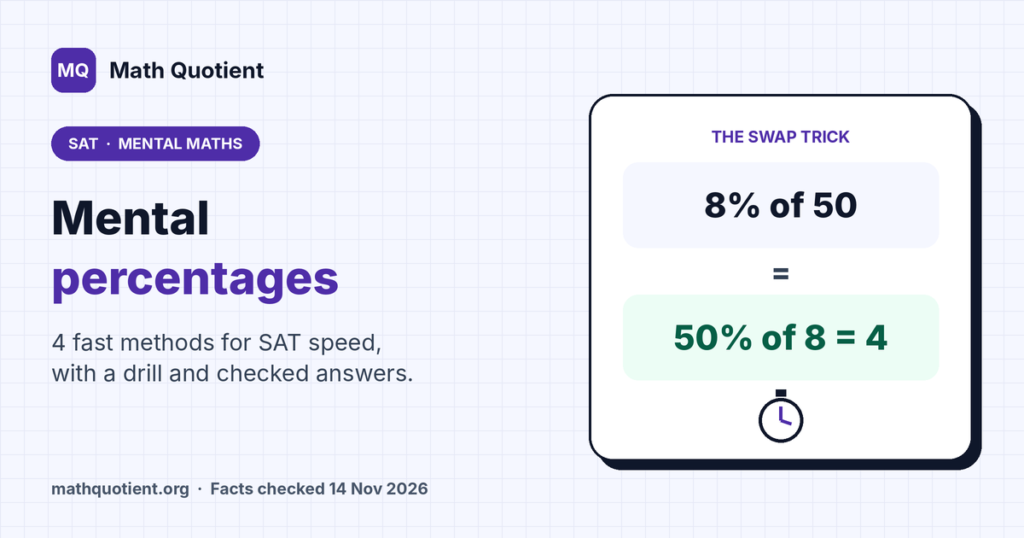
8% of 50 = 50% of 8 = 4
Quick answer
Swap: a% of b is the same as b% of a.
Fractions: 12.5% is 1/8, 37.5% is 3/8, 87.5% is 7/8.
Multipliers: up 15% means × 1.15. Down 35% means × 0.65.
Reverse: to undo a change, divide by the multiplier.
Already know the 10%, 5% and 1% build? It is on our mental maths tricks page. This page adds the next 4 methods.
4 methods for mental percentages at a glance
| Method | Use it when | Example | Check |
|---|---|---|---|
| 1. Swap | The other number is easy as a percent (25, 50) | 36% of 25 = 25% of 36 = 9 | A quarter of 36 is 9 |
| 2. Fraction anchor | The percent is 12.5, 37.5, 62.5, 87.5 or 66⅔ | 37.5% of 64 = 3/8 of 64 = 24 | 24 is a bit over a third of 64 |
| 3. Multiplier | A price or amount goes up or down | 35% off 140 = 0.65 × 140 = 91 | The answer is less than 140 |
| 4. Reverse | You know the new amount, not the start | After a 25% rise, 350: 350 ÷ 1.25 = 280 | 280 × 1.25 = 350 |
On the SAT, percentages are a listed skill in Problem-Solving and Data Analysis. That domain has 5 to 7 of the 44 maths questions. Percents also show up inside Algebra word problems.
The 4 methods, with 2 examples each
1. The swap trick
a% of b means a × b ÷ 100. The order of a and b does not matter. So pick the order that is easier.
- 8% of 50: swap to 50% of 8. Half of 8 is 4.
- 36% of 25: swap to 25% of 36. A quarter of 36 is 9.
SAT use: a “what is p% of n” step inside a longer word problem.
2. Fraction anchors
Learn these nine. Then many percents become one division.
| Percent | Fraction | Percent | Fraction |
|---|---|---|---|
| 12.5% | 1/8 | 62.5% | 5/8 |
| 20% | 1/5 | 66⅔% | 2/3 |
| 25% | 1/4 | 75% | 3/4 |
| 33⅓% | 1/3 | 87.5% | 7/8 |
| 37.5% | 3/8 |
- 37.5% of 64: an eighth of 64 is 8, so 3/8 is 24.
- 87.5% of 480: that is all of it minus an eighth. 480 − 60 = 420.
SAT use: answer choices given as fractions, and “what fraction of the total” questions.
3. One multiplier for a change
A rise of r% multiplies by (1 + r/100). A fall of r% multiplies by (1 − r/100). One step, not two.
- AED 260 goes up 15%: 1.15 × 260 = AED 299. (15% of 260 is 39, and 260 + 39 = 299.)
- 35% off AED 140: you pay 65%. 0.65 × 140 = AED 91.
SAT use: discount, tax and growth questions, and exponential models such as 500(1.06)ᵗ.
4. Reverse: divide by the multiplier
If you know the amount after the change, divide by the multiplier. Do not take the percent off the new amount.
- After a 25% rise the price is 350. 350 ÷ 1.25 = 280. (Fast: 1.25 is 5/4, so multiply by 4/5.)
- A bill is AED 168 with 5% VAT. 168 ÷ 1.05 = AED 160 before VAT.
SAT use: “What was the original price?” questions. A wrong choice is often the new amount minus the percent of itself.
Successive and reverse percents: why +20% then −20% is not zero
Two changes multiply. They do not add. +20% then −20% gives 1.2 × 0.8 = 0.96. That is 4% less than the start.
For two changes of a% and b%, the total change is a + b + (a × b ÷ 100) percent.
| Changes | Multipliers | Total change |
|---|---|---|
| +20% then −20% | 1.2 × 0.8 = 0.96 | −4% |
| +10% then +10% | 1.1 × 1.1 = 1.21 | +21%, not +20% |
| −30% then +30% | 0.7 × 1.3 = 0.91 | −9% |
Percent change also depends on the start. 48 to 60 is a rise of 12 on 48, so +25%. 60 to 48 is a fall of 12 on 60, so −20%.
Free BMI Maths Test
+20% then −20%: back to start? Find out why not.
If your child said yes, that is a concept gap, not a slip. The Free BMI Maths Test finds your child’s real maths level and sorts every mistake into 6 types, such as CNC (concept not clear) and CMT (calculation mistake).
When Desmos is faster, and how to check it in your head
College Board lets students use a calculator on the whole maths section. Bluebook has an embedded Desmos calculator. So mental maths is not a must. It is a speed and safety tool.
| Use your head | Use Desmos |
|---|---|
| Friendly numbers: 25% of 36, 3/8 of 64 | Awkward numbers: 17.3% of 2,486 |
| One or two changes: 1.2 × 0.8 | Many repeats: 1.035¹² |
| Answer choices far apart | Choices close together |
| Checking a Desmos answer | Solving for an unknown rate |
The estimate check. Before you type, say a rough answer. 17.3% is about 1/6, and 1/6 of 2,500 is about 417. Desmos gives 430.078. Close, so you can trust it. If Desmos showed 4,300.78, you would know a decimal point slipped.
5-minute mental percentages drill
Set a 5-minute timer. That is 15 seconds an item. Write only the answer. Then check below.
- 4% of 75
- 44% of 25
- 12.5% of 72
- 62.5% of 48
- 75% of 84
- 15% of 340
- 66⅔% of 27
- 87.5% of 160
- 33⅓% of 39
- 2% of 350
- 120 up 25%
- 350 down 30%
- 60 up 15%
- 450 after a 25% rise: start?
- 196 after 20% off: start?
- AED 231 with 5% VAT: before VAT?
- −10% then +10%: total?
- +50% then −50%: total?
- 25 to 35: percent change?
- 80 to 68: percent change?
Show the answers
1) 3 2) 11 3) 9 4) 30 5) 63 6) 51 7) 18 8) 140 9) 13 10) 7
11) 150 12) 245 13) 69 14) 360 15) 245 16) AED 220 17) −1% 18) −25% 19) +40% 20) −15%
17 or more right: keep a 5-minute drill twice a week. 12 to 16: redo the method you missed most. 11 or fewer: go back to the four methods, one a day.
Answers checked in Python. The score bands are Math Quotient’s advice.
For UAE families
- Use real receipts. UAE VAT is 5%. Ask your child for the price before VAT: total ÷ 1.05.
- Use sale signs. At a “30% off” sign, ask for the price you pay in one step: × 0.7.
- Time it. The SAT maths section gives about 95 seconds a question. A percent step should take 10 to 20 of them.
Want harder practice? Try our SAT-style percentages questions. They are different from the drill here.
What to do now
- Learn the nine fraction anchors. Say them out loud once a day for a week.
- Do the 5-minute drill. Note which method you missed most.
- In your next practice set, estimate every percent answer before you use Desmos.
- Write “multiply, not add” on top of any question with two changes.
One SAT-style worked example
The practice question
A shop raised the price of a phone by 25%. Later it took 20% off the new price. The sale price is AED 1,500. What was the price before the rise? (Made-up numbers.)
- AED 1,200
- AED 1,500
- AED 1,575
- AED 1,875
Show the answer
Answer: B, AED 1,500.
Multiply the changes: 1.25 × 0.8 = 1. The two changes cancel out. So the start price equals the sale price.
Mental route: 1.25 is 5/4 and 0.8 is 4/5. Their product is 1. No Desmos needed.
The traps: C adds 25 − 20 = 5% to 1,500: CNC, concept not clear. A takes 20% off 1,500 again: CNC. D adds 25% to the sale price: DRC, did not read carefully.
A practice question in the style of the SAT, written by Math Quotient. It is not a real past question. Answer checked in Python.
Questions people ask about mental percentages
How do I work out percentages in my head?
Pick the easiest route. Swap the numbers if that helps, use a fraction such as 1/8 for 12.5%, or multiply once for a rise or fall. Check that the answer size makes sense.
What is the fastest way to find 15%?
Find 10%, then add half of it. For 15% of 260: 10% is 26, half is 13, so 39. For a 15% rise, multiply by 1.15 in one step.
Why is +20% then −20% not the same as the start?
The second change is a percent of a bigger number. 1.2 × 0.8 = 0.96, so you end 4% below the start.
Should I use Desmos for percentages on the SAT?
Use it for awkward numbers and repeated growth. Use your head for friendly numbers and to check every Desmos answer with an estimate.
How do I find the original price after a rise?
Divide the new price by the multiplier. After a 25% rise to 350, the original is 350 ÷ 1.25 = 280. Do not take 25% off 350.
Keep exploring
Slow on percents, or wrong on them?
The Free BMI Maths Test shows your child’s real maths level and the reason for each mistake.
Sources
Facts checked on 14 November 2026. Rules can change.
- College Board: calculator policy (Desmos in Bluebook, whole Math section)
- College Board: the Math section, 44 questions and four domains
- College Board: content domains and skills (Percentages)
- College Board: how the SAT is structured (70 minutes for maths)
- UAE Government portal: VAT rate of 5 per cent