
Here are 10 SAT geometry questions on area and volume, with full working. Floors, trapezoids, boxes, cubes, a sphere, cones, a pyramid, a tank and scale factors. We wrote them in the SAT style; they are not past test items.
3 checks · 10 questions
What these SAT geometry questions cover
SAT Geometry and Trigonometry has four skills: area and volume; lines, angles and triangles; right triangles and trigonometry; and circles. Together they give 5 to 7 of the 44 maths questions. This set is area and volume only.
College Board’s framework says these questions ask for area, perimeter, surface area and volume, often of a real object. They also test scaling: if every length grows by a factor k, area grows by k² and volume by k³. Questions 3, 7 and 10 need a typed answer. All shapes and amounts are made up.
The SAT sheet, and what it leaves out
| Shape | On the Bluebook sheet | Not on the sheet |
|---|---|---|
| Flat shapes | Rectangle ℓw, triangle ½bh, circle πr² | Trapezoid ½(a + b)h, parallelogram bh |
| Boxes | Volume ℓwh | Surface area 2(ℓw + ℓh + wh); a cube has 6 equal faces |
| Round solids | Sphere (4/3)πr³, cone (1/3)πr²h, cylinder πr²h | Any curved surface area |
| Pyramid | (1/3)ℓwh | Surface area: add the faces |
| Scaling | Not given | Length × k, area × k², volume × k³ |
| Units | Not given | 1 m³ = 1,000 litres; 1 litre = 1,000 cm³ |
Time yourself: 16 minutes is near SAT pace. Desmos is in Bluebook. Typed answers take digits only, with no units.
SAT geometry questions: flat shapes and boxes
Question 1
A room is an 8 m by 6 m rectangle with a 3 m by 2 m rectangle cut out of one corner. The floor is covered with square tiles 50 cm on each side, with no gaps. How many tiles cover the floor?
- 42
- 84
- 168
- 192
Show answer
Answer: C, 168. Floor: 8 × 6 − 3 × 2 = 42 m². One tile: 0.5 × 0.5 = 0.25 m². Tiles: 42 ÷ 0.25 = 168.
Traps: B divides by the tile’s side, not its area. BMI type: CNC, concept not clear. D forgets the cut-out, and A stops at the area. BMI type: DRC, did not read carefully.
Question 2
A garden bed is a trapezoid. Its parallel sides are 9 m and 15 m long, and the distance between them is 8 m. What is the area of the bed, in square metres?
- 72
- 96
- 120
- 192
Show answer
Answer: B, 96. Area = ½ × (9 + 15) × 8 = 96. This formula is not on the sheet. If you forget it, split the bed into a rectangle and two triangles.
Traps: D forgets the ½. A and C use one parallel side only. BMI type: CNC.
Question 3
A closed box is 5 cm long, 4 cm wide and 3 cm tall. What is its total surface area, in square centimetres?
Show answer
Answer: 94. The 3 pairs of faces are 20, 15 and 12. Total: 2 × (20 + 15 + 12) = 94.
Traps: typing 60, the volume. BMI type: DRC. Typing 47 counts each face once. BMI type: CNC. Typing “94cm²”: BPT, bad presentation.
Question 4
A cube has a total surface area of 150 square inches. What is the volume of the cube, in cubic inches?
- 25
- 125
- 625
- about 1,837
Show answer
Answer: B, 125. 6 equal faces: one face is 150 ÷ 6 = 25, so an edge is 5. Volume: 5³ = 125.
Traps: A stops at one face. BMI type: DRC. C squares the face area, and D takes √150 as the edge. BMI type: CNC.
Question 5
Two solid statues are the same shape. The small one is 20 cm tall and the large one is 30 cm tall. The small statue holds 48 cm³ of metal. How much metal does the large statue hold?
- 72 cm³
- 108 cm³
- 162 cm³
- 216 cm³
Show answer
Answer: C, 162 cm³. k = 30 ÷ 20 = 1.5. Volume scales by k³ = 3.375, and 48 × 3.375 = 162.
Traps: A scales by k and B by k². BMI type: CNC. D works out 1.5³ as 1.5 × 3. BMI type: CMT, calculation mistake.
Free BMI Maths Test
Left out the ⅓, or tiled by the side? Find out why.
Dividing by a tile’s side is a concept gap. Leaving out a cut-out is a misread. The Free BMI Maths Test tells these apart across 6 mistake types, and shows your child’s real maths level.
SAT geometry questions: solids and tanks
Question 6
A ball touches all six faces of a cube-shaped box. The box has an inside edge of 10 cm. To the nearest cubic centimetre, how much space in the box is not filled by the ball?
- 215
- 476
- 524
- 895
Show answer
Answer: B, 476. The ball is 10 cm wide, so r = 5. Box: 1,000 cm³. Ball: (4/3)π × 125 ≈ 523.6 cm³. Space: about 476.
Traps: C is the ball. BMI type: DRC. D uses r² for r³, and A uses πr²h. BMI type: CNC.
Question 7
A paper cup is a cone with a base radius of 4 cm and a height of 9 cm. A jug holds 1.5 litres of water. What is the greatest number of cups that can be filled to the top from the jug? (1 litre = 1,000 cm³.)
Show answer
Answer: 9. One cup: (1/3) × π × 4² × 9 = 48π ≈ 150.8 cm³. 1,500 ÷ 150.8 ≈ 9.95, so only 9 cups are full.
Traps: typing 10 rounds up, but the tenth cup is not full. BMI type: DRC. Typing 3 leaves out the ⅓. BMI type: CNC.
Question 8
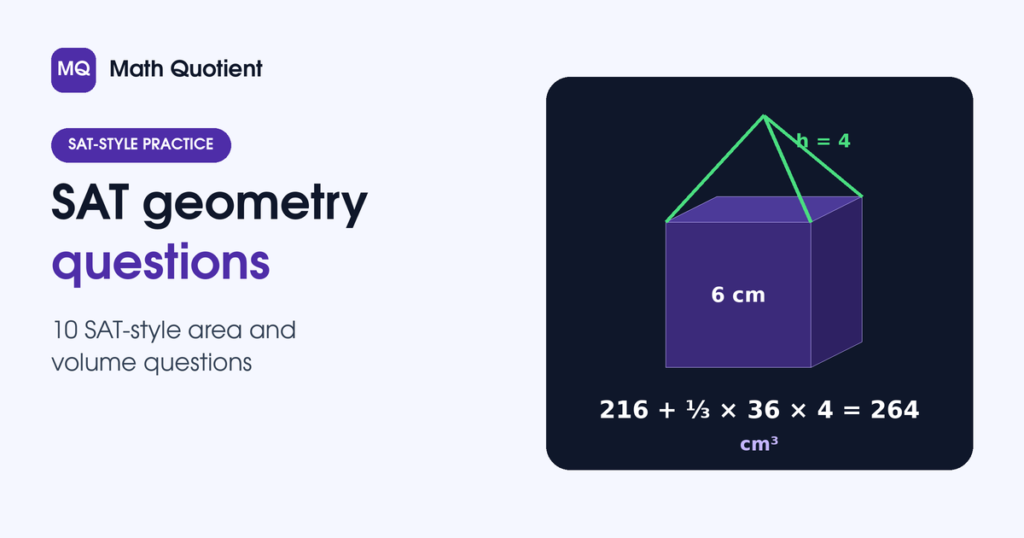
A solid is made of a cube with an edge of 6 cm and a square pyramid on top. The pyramid’s base is the top face of the cube, and its height is 4 cm. What is the volume of the solid?
- 216 cm³
- 264 cm³
- 288 cm³
- 360 cm³
Show answer
Answer: B, 264 cm³. Cube: 6³ = 216. Pyramid: (1/3) × 6 × 6 × 4 = 48. Total: 264.
Traps: D drops the ⅓, and C uses ½. BMI type: CNC. A leaves out the pyramid. BMI type: DRC.
Question 9
A water tank on a roof in Dubai is a box 2 m long, 1.5 m wide and 1.2 m tall. A pump fills it at 40 litres a minute. How many minutes does the pump take to fill the empty tank? (1 m³ = 1,000 litres.)
- 9
- 90
- 144
- 900
Show answer
Answer: B, 90. 2 × 1.5 × 1.2 = 3.6 m³ = 3,600 litres. 3,600 ÷ 40 = 90 minutes.
Traps: A and D use 100 or 10,000 litres in 1 m³. C multiplies by 40. BMI type: CNC.
Question 10
A closed box has a square base. Its height is 3 times the side of the base. The volume of the box is 648 cm³. What is the total surface area of the box, in square centimetres?
Show answer
Answer: 504. Let the side be s, so the height is 3s. Then 3s³ = 648, s³ = 216, s = 6 and the height is 18.
Two square ends: 2 × 36 = 72. Four sides: 4 × 6 × 18 = 432. Total: 504.
Traps: 432 leaves out both ends, and 468 counts one end. BMI type: DRC.
Score yourself
| Score | What it shows | Do this |
|---|---|---|
| 9 or 10 | Formulas and units are secure. | Move to Hard “Area and volume” items in the Student Question Bank. |
| 7 or 8 | A formula or unit slips. | Sketch each miss and label every length. |
| 0 to 6 | A basic gap. | Book the Free BMI Maths Test to find it. |
Parents: hold up a tissue box and ask, “Which formula gives the card, and which gives the space inside?”
Practise next
For official questions, filter College Board’s Student Question Bank by the Geometry and Trigonometry domain and the “Area and volume” skill.
Lost the ⅓ again?
The Free BMI Maths Test finds your real maths level and the reason for each mistake.
FAQ: SAT geometry questions on area and volume
Which area and volume formulas are on the SAT sheet?
Rectangle, triangle and circle areas, and the volumes of a box, cylinder, sphere, cone and pyramid. Surface area and the trapezoid are not on it.
Is surface area tested on the SAT?
Yes. The framework lists it, and the sheet does not give it. Add the areas of the faces.
What happens to volume when every length doubles?
Volume becomes 2³ = 8 times as big. Area becomes 4 times as big.
Sources
Facts checked on 14 November 2026. All 10 answers and every wrong option were worked out again in Python.