
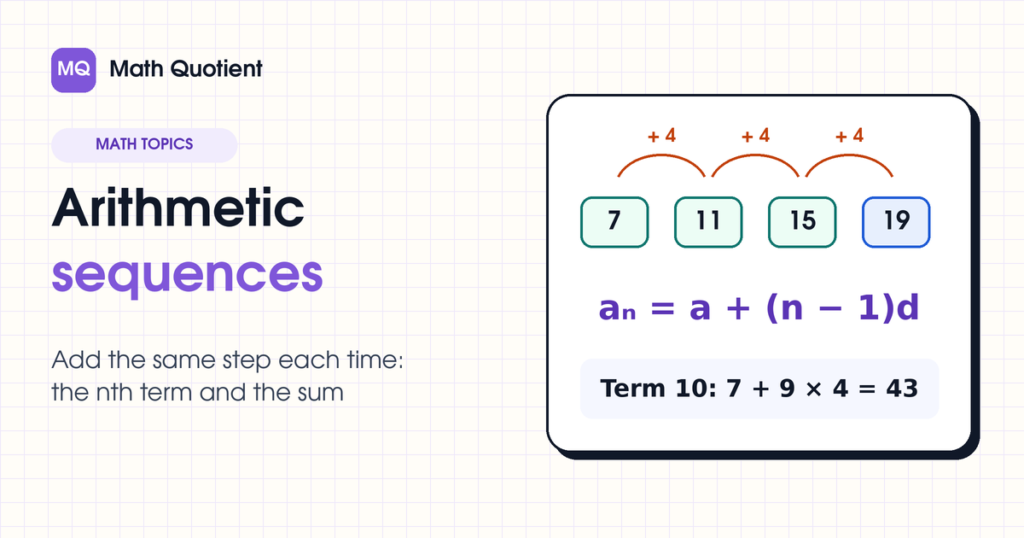
An arithmetic sequence is a list of numbers where you add the same amount each time. That amount is the common difference, d. The nth term is aₙ = a + (n − 1)d, where a is the first term.
Same step, every time.
aₙ = a + (n − 1)d
Hello, curious mind!
What is an arithmetic sequence?
Each term is the one before it plus a fixed number, d, the common difference.
d can be negative or a fraction: 20, 17, 14, … has d = −3, and 1.5, 2, 2.5, … has d = 0.5.
Why n − 1? Term n is n − 1 steps after term 1.
Is it arithmetic? The gap test
Take each term from the next one. Same gap every time? Then it is arithmetic.
| Sequence | Next term − term | Arithmetic? |
|---|---|---|
| 3, 9, 15, 21 | 6, 6, 6 | Yes, d = 6 |
| 40, 31, 22, 13 | −9, −9, −9 | Yes, d = −9 |
| 2, 4, 8, 16 | 2, 4, 8 | No: the gaps grow |
Remember this
d = a term − the term just before it.
How to use the arithmetic sequence formula: 3 worked examples
Example 1: find the 25th term of 13, 9, 5, …
a = 13 and d = 9 − 13 = −4.
a₂₅ = 13 + 24 × (−4) = 13 − 96.
a₂₅ = −83.
Example 2: is 301 a term of 4, 13, 22, …?
a = 4 and d = 9. Set the formula equal to 301: 4 + (n − 1) × 9 = 301.
(n − 1) × 9 = 297, so n − 1 = 33.
n = 34. A whole number, so 301 is term 34.
For 300, n − 1 = 296 ÷ 9 ≈ 32.9, not a whole number. So 300 is not a term.
Example 3: find a and d from two terms
Term 4 is 19 and term 11 is 54. Find term 20.
Term 4 to term 11 is 7 steps. So 7d = 54 − 19 = 35 and d = 5.
Go back 3 steps from term 4: a = 19 − 15 = 4.
a₂₀ = 4 + 19 × 5 = 99.
Adding the terms: the arithmetic series
An arithmetic series is the sum of the terms. Write the sum forwards and backwards. Each pair adds to first + last, and n pairs count the sum twice.
Sₙ = n(first + last) ÷ 2 = n(2a + (n − 1)d) ÷ 2
Example: 6 + 10 + 14 + … + 86
Count the terms first: n = (86 − 6) ÷ 4 + 1 = 21.
First + last = 6 + 86 = 92.
S₂₁ = 21 × 92 ÷ 2 = 966.
A Dubai savings plan (made-up numbers)
A student saves AED 50 in week 1, then AED 25 more each week than the week before. What is the total after 12 weeks?
Week 12: 50 + 11 × 25 = AED 325.
Sum: 12 × (50 + 325) ÷ 2 = 12 × 375 ÷ 2.
AED 2,250 in total.
The straight-line link: d is the slope
Open the brackets in the formula. For 4, 9, 14, …, aₙ = 4 + 5(n − 1) = 5n − 1.
That is a linear equation in n. The points (1, 4), (2, 9), (3, 14) sit on one straight line with slope 5, the step.
The −1 is not the first term. It is “term 0”, one step before term 1.
The middle term is the mean
In any three terms in a row, the middle one is the mean of the other two. So k + 2, 3k and 4k + 1 are in an arithmetic sequence when 2 × 3k = (k + 2) + (4k + 1).
That gives 6k = 5k + 3, so k = 3. The terms are 5, 9 and 13. Check: both gaps are 4.
Common arithmetic sequence mistakes
- Using a + nd, not a + (n − 1)d. For Example 1, 13 + 25 × (−4) = −87. That is term 26.
- Counting gaps, not terms. From 6 to 86 in steps of 4 there are 20 gaps but 21 terms. Add 1.
- Finding d the wrong way round. For 13, 9, 5, d is 9 − 13 = −4, not 13 − 9 = 4.
- Dropping the minus. Using +96 for 24 × (−4) gives 109, not −83.
- Giving a term when the question asks for a sum. AED 325 is week 12, not the total.
Check this with the Free BMI Maths Test
- Uses a + nd for the nth term: CNC, concept not clear.
- Counts the gaps and forgets to add 1: CNC, concept not clear.
- Takes term 1 away from term 2 the wrong way: CWV, copied a wrong value.
- Loses a minus sign when d is negative: CMT, calculation mistake.
- Gives the term when the question asks for the total: DRC, did not read carefully.
The Free BMI Maths Test finds which of the 6 mistake types your child makes, and their real maths level. About the Free BMI Maths Test
Test prep corner
Arithmetic sequences in SAT and JEE Main maths
SAT Algebra lists “Linear functions” (College Board). JEE Main 2027 maths Unit 6 names arithmetic progressions (NTA). These are SAT-style and JEE-style questions, not real past questions.
SAT-style: The first term of a sequence is 18. Each later term is 7 more than the term before it. Which function gives the nth term? (A) f(n) = 7n + 18 (B) f(n) = 7n + 11 (C) f(n) = 18n + 7 (D) f(n) = 11n + 7
aₙ = 18 + 7(n − 1) = 7n + 11, answer (B). Check with n = 1: 7 + 11 = 18. Trap: (A) gives 25 for the first term.
JEE-style, number answer: In an arithmetic progression, the sum of the first 10 terms is 155 and the sum of the first 20 terms is 610. Find the common difference.
S₁₀ = 5(2a + 9d) = 155, so 2a + 9d = 31. S₂₀ = 10(2a + 19d) = 610, so 2a + 19d = 61. Take one from the other: 10d = 30, so d = 3 (and a = 2). Trap: S₂₀ is not 2 × S₁₀, because the last 10 terms are bigger.
Want more? Try our JEE-style maths questions or the SAT-style linear equations questions, with full working.
Facts checked on 14 November 2026 on satsuite.collegeboard.org and jeemain.nta.nic.in.
Quick check: 5 arithmetic sequence questions
1. What is the common difference of 12, 7, 2, …?
Not quite. The terms go down, so d is negative.
Yes! 7 − 12 = −5.
Not quite. Take term 1 from term 2: 7 − 12.
2. What is the 8th term of 3, 7, 11, …?
Yes! 3 + 7 × 4 = 31.
Not quite. That uses 8 steps. Term 8 is 7 steps on.
Not quite. 32 is 8 × 4. Start from 3.
3. How many terms are in 10, 13, 16, …, 70?
Not quite. 20 is the number of gaps. Add 1.
Not quite. Add 1 once, not twice.
Yes! (70 − 10) ÷ 3 + 1 = 21.
4. What is the sum of the first 8 terms of 2, 5, 8, …?
Not quite. 23 is the 8th term, not the sum.
Yes! 8 × (2 + 23) ÷ 2 = 100.
Not quite. You forgot to halve.
5. Which list is an arithmetic sequence?
Not quite. The gaps are 3, 5, 7. These are square numbers.
Yes! Every gap is 0.3.
Not quite. This one doubles. It is geometric.
Got 2 or fewer right? Book the Free BMI Maths Test to find the cause.
Questions people ask about arithmetic sequences
What is the arithmetic sequence formula?
The nth term is aₙ = a + (n − 1)d, where a is the first term and d is the common difference. The sum of n terms is Sₙ = n(2a + (n − 1)d) ÷ 2.
How do I find how many terms there are?
Use (last − first) ÷ d + 1. The “+ 1” counts the first term, which the gaps leave out.
What is the difference between a sequence and a series?
A sequence is the list of terms. A series is what you get when you add them. For example, 1 + 3 + 5 + … to 50 terms is a series, and its sum is 2,500.
Are arithmetic sequences on the SAT?
Not by that name in College Board’s skill list. The SAT tests “Linear functions”, and an arithmetic sequence is one: aₙ = dn + (a − d).
Does your child use n, not n − 1?
The Free BMI Maths Test finds your child’s real maths level and the reason for each mistake.