
Here are 10 SAT-style ratio questions and rate questions with full working. Each answer shows the set-up, the trap in each wrong option and its mistake type. They are practice questions written by Math Quotient, not real past questions.
3 tools · 10 questions
What these SAT ratio questions cover
On College Board’s list, “Ratios, rates, proportional relationships, and units” comes first in the Problem-Solving and Data Analysis domain. The whole domain gives 5 to 7 of the 44 maths questions on each SAT.
Parts and rates
Part of a total, best buy, a rate over time, average speed, two people working together.
Change and scale
A ratio that changes, a table, density, an enlarged photo, fuel cost on a trip.
All amounts are made up. Type answers for 4 and 9.
Pick the tool before you calculate
| The question gives | Use this tool | First step |
|---|---|---|
| A ratio and a total | Parts total | Add the parts. Divide the total by that sum. |
| An amount over a time or a price | Unit rate | Find the amount for 1 unit: per minute, per bottle, per hour. |
| A shape or a recipe made bigger | Scale factor | New ÷ old. Square it for area. |
| Two rates working together | Add the unit rates | Never add or average the times. |
Give yourself about 16 minutes, close to real SAT pace. Bluebook has Desmos for every maths question. In a typed answer, enter digits only: no units, commas or currency signs. On scratch paper, write the unit next to every number.
SAT-style ratio questions: parts and rates
Question 1
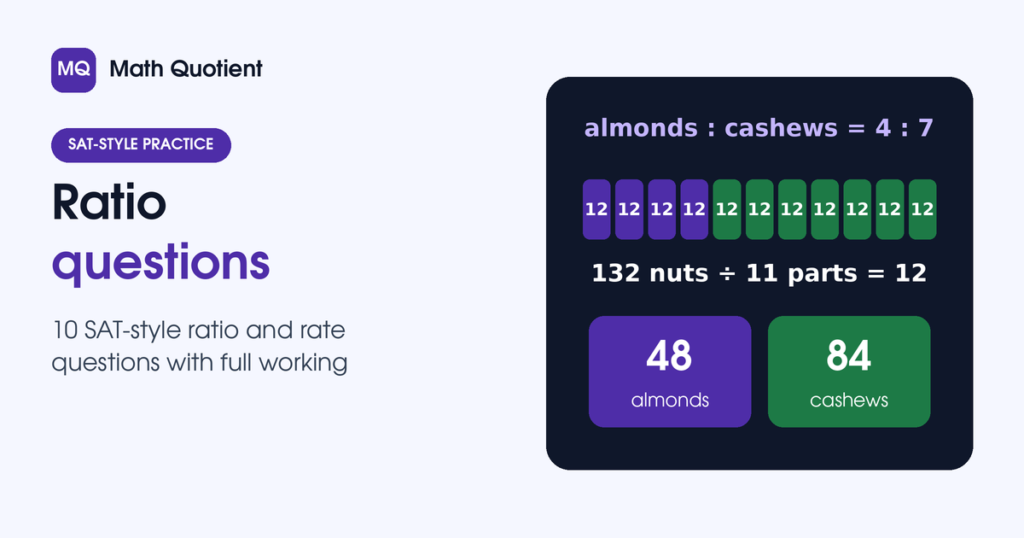
A bag of mixed nuts holds only almonds and cashews, in the ratio 4 : 7. The bag holds 132 nuts. How many are cashews?
- 48
- 77
- 84
- 231
Show answer
Answer: C, 84. The parts total is 4 + 7 = 11. One part is 132 ÷ 11 = 12. Cashews are 7 parts: 7 × 12 = 84.
Traps: A is the almonds. BMI type: DRC, did not read carefully. B divides by 12, not 11. BMI type: CMT, calculation mistake. D treats 132 as the almonds and scales up by 7 ÷ 4. BMI type: CNC, concept not clear.
Question 2
A shop in Karama sells water in two packs. A 12-bottle pack costs AED 15.00. An 18-bottle pack costs AED 21.60. Which pack costs less per bottle, and by how much?
- The 12-bottle pack, by AED 0.05
- The 18-bottle pack, by AED 0.05
- The 18-bottle pack, by AED 6.60
- The 12-bottle pack, by AED 0.10
Show answer
Answer: B. 15.00 ÷ 12 = AED 1.25 a bottle. 21.60 ÷ 18 = AED 1.20 a bottle. The bigger pack is AED 0.05 cheaper per bottle.
Traps: C compares the pack prices, not the price per bottle. BMI type: CNC. A picks the cheaper pack, not the cheaper bottle. BMI type: DRC.
Question 3
A printer prints 45 pages in 2.5 minutes. At this rate, how many pages does it print in 8 minutes?
- 14
- 144
- 160
- 360
Show answer
Answer: B, 144. The unit rate is 45 ÷ 2.5 = 18 pages a minute. In 8 minutes: 18 × 8 = 144.
Traps: A sets the proportion upside down: 45 × 2.5 ÷ 8 ≈ 14. BMI type: CNC. C rounds the rate to 20 a minute. BMI type: CMT. D multiplies 45 by 8 and forgets the 2.5 minutes. BMI type: DRC.
Question 4
A train covers 4.2 km between two stations in 3.5 minutes. What is its average speed, in kilometres per hour? (Made-up figures.)
Show answer
Answer: 72. 4.2 ÷ 3.5 = 1.2 km a minute. An hour has 60 minutes: 1.2 × 60 = 72.
Trap: typing 1.2, the speed per minute. BMI type: DRC. Typing “72km/h”: BPT, bad presentation. Type the number only.
Question 5
Hessa can pack 120 boxes in 4 hours. Omar can pack 120 boxes in 6 hours. Working together at these rates, how many hours do they need to pack 120 boxes?
- 2
- 2.4
- 5
- 10
Show answer
Answer: B, 2.4 hours. Hessa packs 120 ÷ 4 = 30 boxes an hour. Omar packs 120 ÷ 6 = 20. Together: 50 an hour. 120 ÷ 50 = 2.4 hours.
Traps: C averages the times and D adds them, but together they must beat Hessa’s 4 hours. BMI type: CNC. A guesses half of 4. BMI type: ROT, ran out of time.
Free BMI Maths Test
Set the ratio up the wrong way round? Find out why.
An upside-down proportion is a concept gap. A rounded rate is a calculation slip. The Free BMI Maths Test tells these apart across 6 mistake types, and shows your child’s real maths level.
SAT-style ratio questions: change and scale
Question 6
In a swimming squad, the ratio of boys to girls is 3 : 5. Then 6 more boys join, and no one leaves. Now the ratio is 1 : 1. How many girls are in the squad?
- 9
- 15
- 24
- 30
Show answer
Answer: B, 15. Let the boys be 3k and the girls 5k. After 6 join, 3k + 6 = 5k. So 2k = 6 and k = 3. Girls: 5 × 3 = 15.
Traps: A is the boys at the start, C is the whole squad at the start, and D is the whole squad at the end. BMI type: DRC.
Question 7
The table shows the parking fee y, in dirhams, for x hours at a mall car park.
| Hours, x | 2 | 5 | 8 |
|---|---|---|---|
| Fee, y (AED) | 9 | 22.5 | 36 |
Which equation fits the table?
- y = 2x + 5
- y = 4.5x
- y = (2/9)x
- y = x + 7
Show answer
Answer: B, y = 4.5x. y ÷ x is 4.5 in every column: 9 ÷ 2, 22.5 ÷ 5, 36 ÷ 8. A fixed ratio y ÷ x means y = kx.
Traps: A and D fit only the first column. Always test a second column. BMI type: DRC. C uses x ÷ y. BMI type: CNC.
Question 8
A gold bar has a mass of 965 grams. The density of gold is 19.3 grams per cubic centimetre. What is the volume of the bar, in cubic centimetres?
- 0.02
- 50
- 984.3
- 18,624.5
Show answer
Answer: B, 50. Density = mass ÷ volume, so volume = mass ÷ density: 965 ÷ 19.3 = 50.
Traps: D multiplies and A divides the wrong way. The units do not come out as cm³. BMI type: CNC. C adds the two numbers. BMI type: CNC.
Question 9
A photo is 12 cm by 18 cm. It is enlarged so that the shorter side is 30 cm, with the shape kept the same. What is the area of the enlarged photo, in square centimetres?
Show answer
Answer: 1350. The scale factor is 30 ÷ 12 = 2.5. The longer side becomes 18 × 2.5 = 45 cm. Area: 30 × 45 = 1,350. Type 1350, with no comma.
Or: old area 216 × 2.5² = 1,350.
Trap: typing 540, which is 216 × 2.5. Area scales by the square of the factor. BMI type: CNC. Typing “1,350”: BPT.
Question 10
A car uses 7.5 litres of petrol per 100 km. Petrol costs AED 2.80 a litre. What does the petrol for a 360 km trip from Dubai cost?
- AED 21.00
- AED 75.60
- AED 100.80
- AED 134.40
Show answer
Answer: B, AED 75.60. Litres: 7.5 × 360 ÷ 100 = 27. Cost: 27 × 2.80 = 75.60.
Desmos route: type 7.5·3.6·2.8.
Traps: D divides 360 by 7.5 to get 48 litres. That uses the rate upside down. BMI type: CNC. C uses 36 litres: 360 ÷ 10. BMI type: CMT. A is the cost of 7.5 litres only. BMI type: DRC.
Your score, and next steps
| Right answers | Reading | Next step |
|---|---|---|
| 10 or 9 within 16 minutes | Your set-ups are sound. | Move on to Hard questions in the Student Question Bank. |
| 8 or 7, or slow | Units slip, or the set-up takes too long. | Rework each miss with units written in. |
| 6 or under | Something basic is missing. | Find the cause with the Free BMI Maths Test. |
Parents: when your child finds a rate, ask “per what?” The answer names the unit rate.
Practise next
For official questions on this skill, filter College Board’s Student Question Bank by “Ratios, rates, proportional relationships, and units”.
Per what? Still not sure?
The Free BMI Maths Test finds your real maths level and the reason for each mistake.
Questions people ask about SAT ratio and rate questions
How many SAT maths questions are about ratios and rates?
There is no official count for this skill alone. It shares the 5 to 7 Problem-Solving and Data Analysis questions with six other skills.
Why can’t I average the times when two people work together?
Times do not add up the way work does. Rates do. Add the work done per hour, then divide the job by that total.
Can I type units in a typed answer?
No. Type the number only, with no comma or currency sign. That is in Bluebook’s directions.
Sources
Facts checked on 14 November 2026. All 10 answers and every wrong option were worked out again in Python.