
This set gives 10 JEE complex numbers questions, written in the JEE Main format and solved step by step. Every solution begins with a quick sketch on the Argand diagram, and every wrong option gets its reason. Math Quotient wrote these JEE-style items; none is a past-paper question.
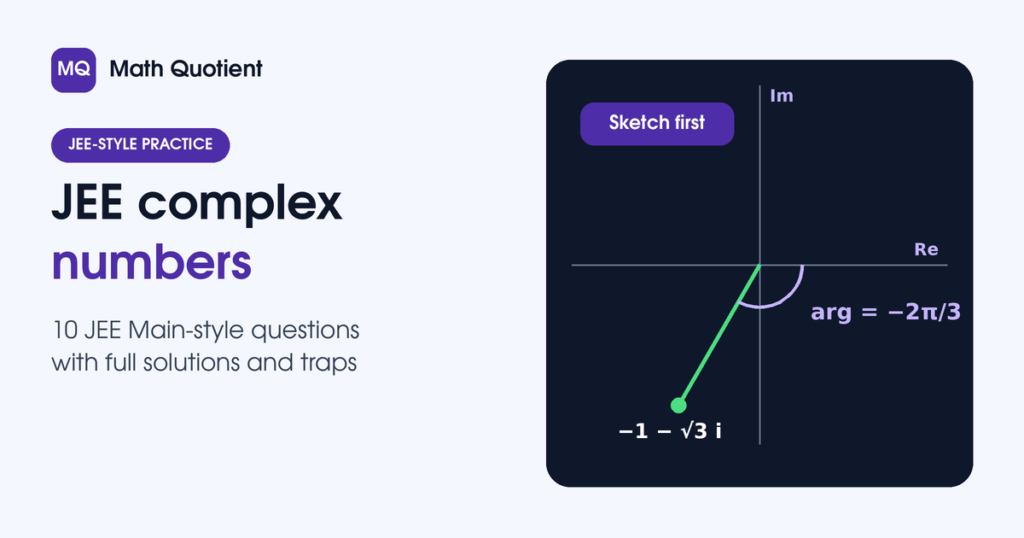
arg(−1 − √3 i) = ?
JEE complex numbers: what NTA lists
NTA’s JEE Main 2027 maths topic list puts complex numbers in Unit 2, “Complex Numbers and Quadratic Equations”. It names a + ib form, the Argand diagram, the algebra of complex numbers, modulus and argument, and quadratic equations with complex roots.
Algebra and argument
Conjugate, powers of i, modulus rules, argument, a line on the Argand diagram.
Geometry and roots
A circle, a square root, a quadratic, and two number answers.
The 2027 list does not name De Moivre’s theorem or the cube roots of unity, so this set leaves them out. Q9 and Q10 take a typed integer, as Section B does.
How to sit this set
Set a 25-minute timer. The tags show a pace for each question.
Sketch before you solve. Mark the point, line or circle and its quadrant.
No calculator. NTA bars them from the centre.
Mark +4, −1 or 0, as NTA does in both sections. See our JEE Main marking scheme page.
Principal argument of z = a + ib: find α = tan⁻¹|b/a|, then use the quadrant.
| Quadrant | Signs of a, b | arg z |
|---|---|---|
| First | +, + | α |
| Second | −, + | π − α |
| Third | −, − | −(π − α) |
| Fourth | +, − | −α |
Each trap carries a Free BMI Maths Test code: CNC (concept not clear), DRC (did not read carefully), CWV (copied a wrong value) or CMT (calculation mistake).
JEE-style complex numbers questions 1 to 5
Question 1
A complex number z satisfies z + 2z̄ = 6 − 3i, where z̄ is the conjugate of z. Find z.
- 2 − i
- 2 + 3i
- 2 − 3i
- 3 + 2i
Solution to question 1
Correct: B, 2 + 3i. With z = x + iy, z + 2z̄ = 3x − iy. So 3x = 6 and −y = −3: x = 2, y = 3.
Check: (2 + 3i) + 2(2 − 3i) = 6 − 3i.
Why the others tempt: A treats z̄ as z (CNC). C drops the sign on y (CMT). D swaps the parts (CWV).
Question 2
Find the value of i + i² + i³ + … + i²⁰²⁷.
- 0
- −1
- i
- −1 + i
Solution to question 2
Correct: B, −1. Powers of i repeat in fours (i, −1, −i, 1), and each four adds to 0. 2027 = 4 × 506 + 3, leaving i − 1 − i = −1.
Why the others tempt: A assumes the groups of 4 use up every term (CNC). D stops one term early, at i²⁰²⁶ (CMT). C keeps only the first leftover term (DRC).
Question 3
Find |z| when z = (3 + 4i)(1 − i) / (2 + i).
- √10
- 5√2
- 10
- 7√10/5
Solution to question 3
Correct: A, √10. Do not expand. The modulus of a product or quotient is the product or quotient of the moduli: |z| = 5 × √2 / √5 = √10.
Why the others tempt: B forgets to divide by |2 + i| (DRC). C gives |z|² (CNC). D takes |3 + 4i| as 3 + 4 = 7 (CNC).
Question 4
Find the principal argument of z = −1 − √3 i.
- π/3
- 2π/3
- −2π/3
- 4π/3
Solution to question 4
Sketch: both parts are negative, so z is in the third quadrant.
Correct: C, −2π/3. α = tan⁻¹(√3/1) = π/3. In the third quadrant, arg z = −(π − π/3) = −2π/3.
Why the others tempt: A is tan⁻¹ of the ratio with no quadrant check (CNC). B is the second quadrant (CWV). D is the right angle, but outside (−π, π], so it is not the principal value (CNC).
Question 5
The points z = x + iy with |z − 2| = |z + 4i| lie on which line?
- x + 2y + 3 = 0
- x − 2y + 3 = 0
- 2x + y + 3 = 0
- x + 2y − 3 = 0
Solution to question 5
Sketch: z is equally far from (2, 0) and (0, −4), so it lies on the perpendicular bisector.
Correct: A, x + 2y + 3 = 0. Square both sides: (x − 2)² + y² = x² + (y + 4)². This gives −4x + 4 = 8y + 16, so x + 2y + 3 = 0.
Check: the midpoint (1, −2) is on the line: 1 − 4 + 3 = 0.
Why the others tempt: B reads z + 4i as z − 4i (DRC). C swaps x and y (CWV). D loses a sign moving terms (CMT).
Free BMI Maths Test
Wrong quadrant or a lost sign?
A missed quadrant and a slip with i² are two different causes. The Free BMI Maths Test separates them, sorts every mistake into 6 types and shows your child’s real level.
Questions 6 to 10: circles, roots and number answers
Question 6
z moves on the circle |z − 1 − i| = 2. What is the greatest value of |z|?
- 2 − √2
- 2
- 2 + √2
- 4
Solution to question 6
Sketch: centre (1, 1), radius 2. |z| is the distance from the origin.
Correct: C, 2 + √2. The centre is √2 from the origin. The farthest point is one radius beyond it: √2 + 2.
Why the others tempt: A is the least value, 2 − √2 (DRC). B is the radius only (CNC). D takes |1 + i| as 2 (CNC).
Question 7
Find the square roots of 5 − 12i.
- ±(3 − 2i)
- ±(2 − 3i)
- ±(3 + 2i)
- ±(2 + 3i)
Solution to question 7
Correct: A, ±(3 − 2i). Let (a + ib)² = 5 − 12i: a² − b² = 5, ab = −6, and a² + b² = |5 − 12i| = 13. So a² = 9, b² = 4, and a, b have opposite signs.
Check: (3 − 2i)² = 9 − 12i − 4 = 5 − 12i.
Why the others tempt: C ignores the sign of ab and gives 5 + 12i (CNC). B swaps a and b and gives −5 − 12i (CWV). D makes both mistakes.
Question 8
1 + 2i is a root of x² + px + q = 0, where p and q are real. Find (p, q).
- (−2, 5)
- (2, 5)
- (−2, −3)
- (2, −3)
Solution to question 8
Correct: A, (−2, 5). With real coefficients the other root is 1 − 2i. Sum 2 = −p, so p = −2. Product (1 + 2i)(1 − 2i) = 1 + 4 = 5 = q.
Why the others tempt: B sets p equal to the sum, not minus the sum (CNC). C works the product as 1 − 4, a slip with i² (CMT). D makes both mistakes.
Question 9
How many complex numbers z satisfy z² + |z| = 0?
Solution to question 9
Correct: 3. Let z = x + iy. Then z² = x² − y² + 2ixy, and |z| is real. The imaginary part gives 2xy = 0.
If y = 0: x² + |x| = 0, so x = 0. If x = 0: −y² + |y| = 0, so |y| = 0 or 1. The solutions are 0, i and −i.
Traps: 1 keeps only z = 0 (CNC). 2 finds ±i but forgets z = 0 (DRC).
Question 10
(1 + i)¹⁰ = ki for a real number k. Find k.
Solution to question 10
Correct: 32. Square first: (1 + i)² = 1 + 2i − 1 = 2i. So (1 + i)¹⁰ = (2i)⁵ = 32i⁵ = 32i.
Check: |1 + i|¹⁰ = (√2)¹⁰ = 32.
Traps: 1024 takes |1 + i| as 2 (CNC). −32 takes i⁵ as −i (CMT).
Mark your score (40 is full marks)
| Score | Meaning | Next step |
|---|---|---|
| 32+ in 25 minutes | Sketches and checks work. | Mix complex numbers into timed sets. |
| 20-31, or over time | Quadrants or signs cost marks. | Redo each miss, sketch first. |
| Below 20 | A gap in the base ideas. | Book the Free BMI Maths Test. |
Below 20? The Free BMI Maths Test shows the cause. Many CMT codes? Write i² = −1 each time it appears.
Practise next
Still dropping marks on i² and arguments?
Book the Free BMI Maths Test. It shows your child’s true maths level and the cause of each error.
Common questions about JEE complex numbers
How many complex numbers questions come in JEE Main?
No count per unit is published. Complex numbers sit in Unit 2, with quadratic equations, one of 14 maths units.
What range does the principal argument use?
The usual range runs from −π to π, with π included and −π left out. Points below the real axis get a negative argument.
Do I need De Moivre’s theorem for JEE Main 2027?
NTA’s 2027 topic list does not name it. Powers like (1 + i)¹⁰ can be done by squaring first, as in question 10.
Sources
Facts checked on 14 November 2026. Answers and options verified in Python with complex arithmetic.
- NTA: JEE (Main) 2027 Information Bulletin (paper pattern, marking, calculators)
- NTA: JEE (Main) 2027 Paper 1 topic list (Unit 2)