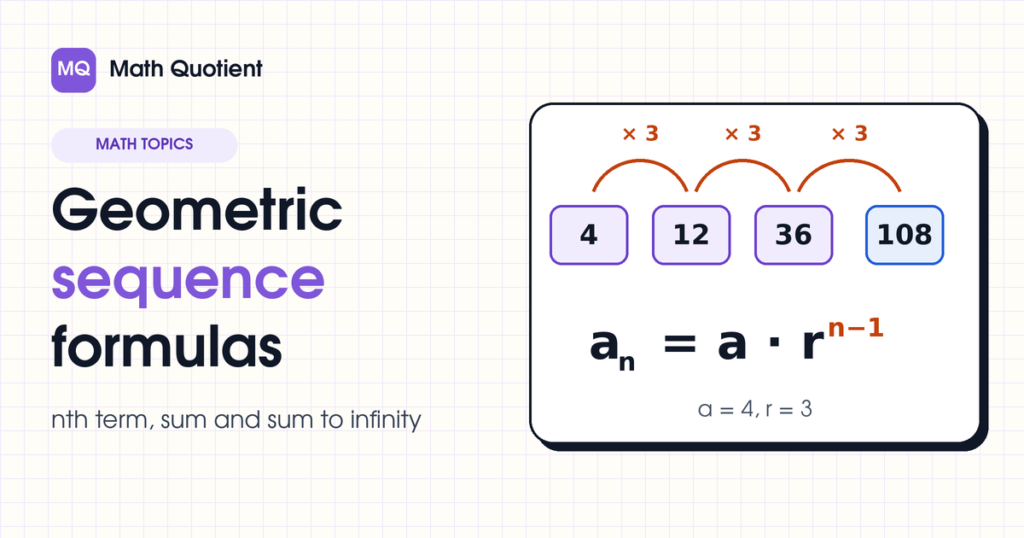
A geometric sequence is a list of numbers where you multiply by the same number each time. The geometric sequence formulas are aₙ = a·rⁿ⁻¹ for the nth term, Sₙ = a(rⁿ − 1)/(r − 1) for the sum of n terms, and S∞ = a/(1 − r) when −1 < r < 1.
Same multiplier, every step.
aₙ = a · rⁿ⁻¹
Hello, curious mind!
What is a geometric sequence?
Each term is the one before it times a fixed number, r, the common ratio.
The first term is a, so the terms are a, ar, ar², ar³ and so on. The nth term has rⁿ⁻¹, because the first term has no r. (See exponents if powers are new.)
Is it geometric? The ratio test
Divide each term by the term before it. All the same? Then it is geometric.
| Sequence | Term ÷ term before | Geometric? |
|---|---|---|
| 2, −6, 18, −54 | −3, −3, −3 | Yes, r = −3 |
| 96, 48, 24, 12 | ½, ½, ½ | Yes, r = ½ |
| 5, 10, 20, 35 | 2, 2, 1.75 | No: the last ratio breaks |
Remember this
r = a later term ÷ the term just before it.
How to use the geometric sequence formulas: 3 worked examples
Example 1: find the 9th term of 3, −6, 12, −24, …
a = 3 and r = −6 ÷ 3 = −2.
a₉ = 3 × (−2)⁸. The power 8 is even, so the sign is +.
(−2)⁸ = 256, so a₉ = 768.
Example 2: find a and r from two terms
Term 3 is 20 and term 6 is 160. Find term 10.
Term 3 to term 6 is 3 steps, so r³ = 160 ÷ 20 = 8 and r = 2.
a × 2² = 20, so a = 5.
a₁₀ = 5 × 2⁹ = 5 × 512 = 2,560.
Example 3: the sum of the first 7 terms of 4 + 12 + 36 + …
a = 4, r = 3, n = 7. Use Sₙ = a(rⁿ − 1)/(r − 1).
3⁷ = 2,187, so S₇ = 4 × 2,186 ÷ 2.
S₇ = 4,372. Check by adding: 4 + 12 + 36 + 108 + 324 + 972 + 2,916 = 4,372.
For r < 1, the form a(1 − rⁿ)/(1 − r) gives the same answer with a positive bottom.
Sum to infinity: when it exists and why
Take 90 + 30 + 10 + …, where r = ⅓. The running totals are 90, 120, 130, 133.33, 134.44 and so on. They creep up to 135 but never pass it.
When −1 < r < 1, rⁿ shrinks towards 0. So the sum formula becomes S∞ = a/(1 − r). Here S∞ = 90 ÷ ⅔ = 135.
With r = 2 the terms grow without end. With r = −1 the totals jump between two values. Neither has a sum.
Bonus: 0.777… is 0.7 + 0.07 + 0.007 + …, with a = 0.7 and r = 0.1. So 0.777… = 0.7 ÷ 0.9 = 7/9.
Same idea on the SAT: from aₙ = a·rⁿ⁻¹ to f(t) = a·bᵗ
The SAT writes growth as a function, f(t) = a·bᵗ, with start value a and multiplier b. It is a geometric sequence that counts from 0, not 1.
Dubai savings (made-up numbers): AED 2,000 grows by 5% a year, so b = 1.05.
| Years passed, t | Year number, n | Value (AED) |
|---|---|---|
| 0 | 1 | 2,000.00 |
| 1 | 2 | 2,100.00 |
| 2 | 3 | 2,205.00 |
| 3 | 4 | 2,315.25 |
As a function, f(t) = 2,000 × 1.05ᵗ. As a sequence, aₙ = 2,000 × 1.05ⁿ⁻¹. So f(3) = a₄. Check what the input counts: years passed, or terms.
Common geometric sequence mistakes
- Dividing the wrong way. For 6, 12, 24, r = 12 ÷ 6 = 2, not ½.
- Using rⁿ, not rⁿ⁻¹. 5 × 2¹⁰ = 5,120 is term 11, not term 10.
- A sum to infinity with r = 2. 5 ÷ (1 − 2) = −5 is nonsense. There is no sum.
- Losing the sign. 3 × (−2)⁸ is +768, not −768.
- Giving a term when the question asks for a sum. Underline “sum” or “term” first.
Check this with the Free BMI Maths Test
- Finds r as term 1 ÷ term 2: CNC, concept not clear.
- Uses rⁿ in place of rⁿ⁻¹: CNC, concept not clear.
- Uses the sum to infinity when r = 2: CNC, concept not clear.
- Slips a sign with a negative ratio: CMT, calculation mistake.
- Gives the nth term when the question asks for the sum: DRC, did not read carefully.
The Free BMI Maths Test finds which of the 6 mistake types your child makes, and their real maths level. About the Free BMI Maths Test
Test prep corner
Geometric sequences in JEE Main and SAT maths
NTA’s JEE Main 2027 maths topic list has a unit called “Sequence and Series”, with geometric progressions and geometric means. College Board lists exponential equations and nonlinear functions in SAT Advanced Math. These are SAT-style and JEE-style practice questions, not real past questions.
SAT-style: The first term of a sequence is 500. Each later term is 1.2 times the term before it. Which expression gives the nth term? (A) 500(1.2)ⁿ (B) 500(1.2)ⁿ⁻¹ (C) 600(1.2)ⁿ⁻¹ (D) 500 + 1.2(n − 1)
Put n = 1. Only (B) gives 500, because 1.2⁰ = 1. Answer (B). Trap: (A) gives 600 for the first term.
JEE-style, number answer: Three geometric means are put between 2 and 162. All terms are positive. Find the sum of the three means.
Five terms, 2 to 162, so 162 = 2r⁴, r⁴ = 81 and r = 3. The means are 6, 18 and 54. Their sum is 78. Trap: r = −3 also gives 81, but the terms must be positive.
Practise with our JEE-style maths questions, or read the JEE Main maths guide.
Facts checked on 12 November 2026 on jeemain.nta.nic.in and satsuite.collegeboard.org.
Quick check: 5 geometric sequence questions
1. What is the common ratio of 10, 30, 90, …?
Not quite. Divide the other way: 30 ÷ 10.
Yes! 30 ÷ 10 = 3.
Not quite. 20 is the gap between terms. For r, divide.
2. What is the 5th term of 2, 10, 50, …?
Not quite. That uses 5⁵. The power is n − 1 = 4.
Not quite. 250 is the 4th term.
Yes! 2 × 5⁴ = 1,250.
3. What is the sum to infinity of 12 + 6 + 3 + …?
Yes! 12 ÷ (1 − ½) = 24.
Not quite. 21 is only 3 terms.
Not quite. r = ½, so the sum exists.
4. What is the sum of the first 5 terms of 1 + 4 + 16 + …?
Not quite. 256 is term 5, not the sum.
Yes! (4⁵ − 1) ÷ 3 = 1,023 ÷ 3 = 341.
Not quite. That is 6 terms. Use n = 5.
5. Which common ratio gives a sum to infinity?
Not quite. 1.5 > 1, so the terms grow.
Not quite. The terms grow in size.
Yes! −0.5 is between −1 and 1.
Got 2 or fewer right? Book the Free BMI Maths Test to find the cause.
Questions people ask about geometric sequences
What are the geometric sequence formulas?
nth term: aₙ = a·rⁿ⁻¹. Sum of n terms: Sₙ = a(rⁿ − 1)/(r − 1), for r ≠ 1. Sum to infinity: S∞ = a/(1 − r), only when −1 < r < 1.
How do I find the common ratio?
Divide any term by the one just before it. For two terms k steps apart, divide the later by the earlier and take the kth root.
When does a geometric series have a sum to infinity?
Only when the common ratio is between −1 and 1. Then the total settles on a/(1 − r).
What is the difference between arithmetic and geometric sequences?
Arithmetic adds the same number each time: 5, 8, 11. Geometric multiplies by the same number: 5, 15, 45.
Are geometric sequences on the SAT?
Not by that name. College Board lists exponential equations and nonlinear functions in Advanced Math. Growth by a fixed percent, f(t) = a·bᵗ, is the same idea.
Keep exploring
rⁿ or rⁿ⁻¹: does your child mix them up?
The Free BMI Maths Test finds your child’s real maths level and the reason for each mistake.
Written by Himanshu Jain
B.Tech, IIT Delhi. Founder of Math Quotient.