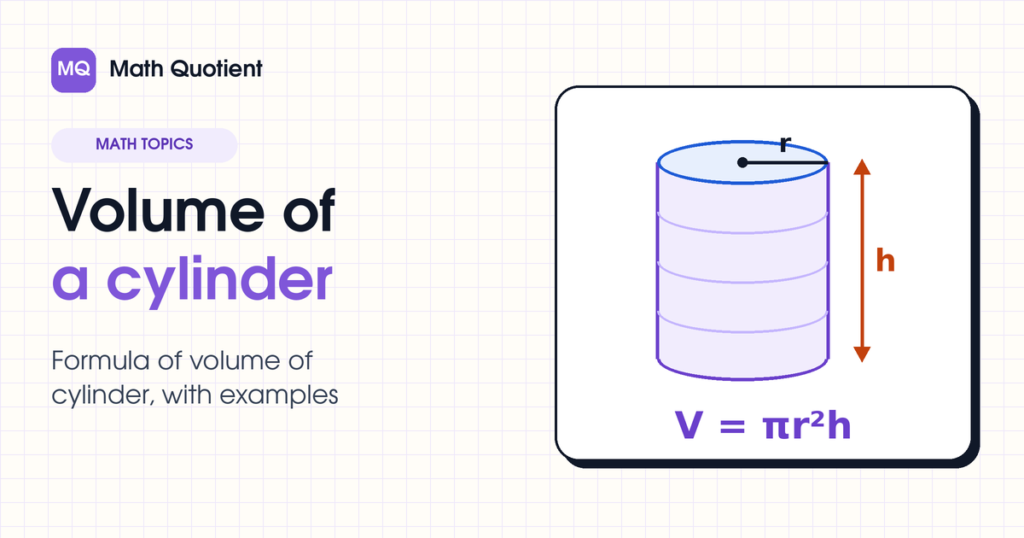
The formula of volume of cylinder is V = πr²h. Find the area of the circle at the end, πr², then multiply by the height, h. Here r is the radius, half the width across.
A cylinder is a stack of equal circles.
V = πr² × h
Hello, curious mind!
What is the volume of a cylinder?
The volume of a cylinder is the space inside it: the area of its circle end times its height, V = πr²h.
Think of a stack of coins. Each coin is a thin circle with area πr². More coins make a taller stack. So volume = circle area × height.
r² means r × r (see exponents). π is about 3.14159. Keep π, or use the π key, until the last step.
What happens when r or h changes
| Change | New volume | Why |
|---|---|---|
| Double the height | 2 times | h is not squared |
| Double the radius | 4 times | 2² = 4 |
| Triple the radius | 9 times | 3² = 9 |
| Double r, halve h | 2 times | 4 × ½ = 2 |
Remember this
Given the width across? Halve it first.
How to use the formula of volume of cylinder: 3 worked examples
Example 1: find the volume of a candle
A candle is 10 cm across and 12 cm tall.
The diameter is 10 cm, so r = 5 cm.
V = π × 5² × 12 = π × 25 × 12 = 300π.
V ≈ 942.5 cm³.
Example 2: find the height from the volume
A tin holds 1,000 cm³ and has a radius of 5 cm. How tall is it?
Turn the formula round: h = V ÷ (πr²).
πr² = 25π ≈ 78.54 cm².
h = 1,000 ÷ 78.54 ≈ 12.7 cm.
To find r, divide V by πh, then take the square root. If V = 392π cm³ and h = 8 cm, then r² = 392 ÷ 8 = 49, so r = 7 cm.
Example 3: a hollow pipe
A pipe is 200 cm long. Its outer radius is 5 cm and its inner radius is 4 cm. How much metal is in it?
Take the hole away from the full cylinder: V = π(R² − r²)h.
V = π × (25 − 16) × 200 = 1,800π.
V ≈ 5,654.9 cm³.
π(5 − 4)² × 200 = 200π is far too small. Square each radius first, then subtract.
Units and litres
Volume is in cubic units, such as cm³ or m³. For litres:
- 1 cm³ = 1 mL, so 1,000 cm³ = 1 L.
- 1 m³ = 100 × 100 × 100 = 1,000,000 cm³ = 1,000 L.
So a litre is not 1 m³. That mix-up is common on maths help forums, and it makes an answer 1,000 times wrong.
A rooftop water tank in Dubai (made-up numbers)
A round tank has a radius of 0.6 m and a height of 1.5 m.
V = π × 0.6² × 1.5 = 0.54π ≈ 1.6965 m³.
× 1,000: the tank holds about 1,696 litres when full.
A drinks can (made-up numbers)
A can 6 cm across and 12 cm tall: V = π × 3² × 12 = 108π ≈ 339.3 cm³, so about 339 mL.
Bonus: the longest straight straw that fits in a shorter can, 6 cm across and 8 cm tall, is 10 cm. It runs from a bottom edge to the far top edge. That uses Pythagoras’ theorem: 6² + 8² = 10².
Common volume of a cylinder mistakes
- Using the diameter as the radius. For the candle, π × 10² × 12 = 1,200π. That is 4 times too big.
- Squaring the height. π × 5 × 12² = 720π. Only r is squared.
- Mixing cm and m. A tank with r = 50 cm and h = 2 m is not π × 50² × 2. Use r = 0.5 m: V = 0.5π ≈ 1.571 m³, about 1,571 L.
- Rounding π too early. For r = 9 cm and h = 20 cm, π × 81 ≈ 254.47. Rounding that to 254 gives 5,080 cm³. The true answer is about 5,089.4 cm³.
- Leaving out units. “339” alone could mean cm³, mL or m³. Write the unit every time.
Check this with the Free BMI Maths Test
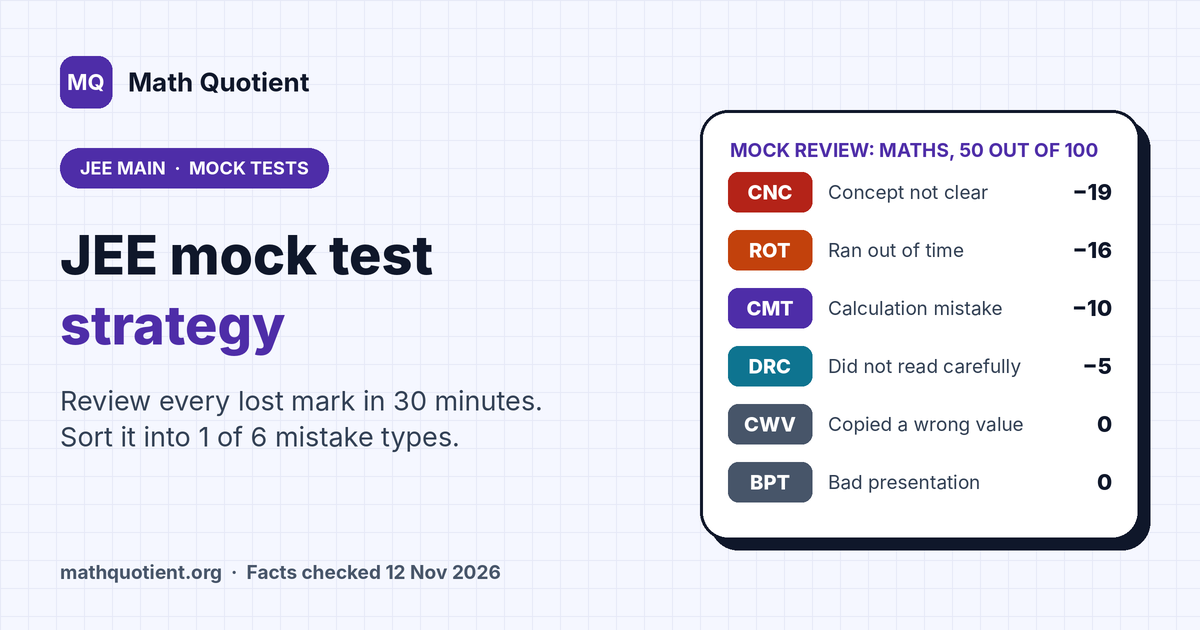
- Uses the diameter as the radius: DRC, did not read carefully.
- Squares the height instead of the radius: CNC, concept not clear.
- Mixes cm and m in one sum: CWV, copied a wrong value.
- Rounds π too early, so the answer is off: CMT, calculation mistake.
- Leaves out units: BPT, bad presentation.
The Free BMI Maths Test finds which of the 6 mistake types your child makes, and their real maths level. About the Free BMI Maths Test
Test prep corner
Cylinder volume in SAT maths
College Board lists “Area and volume” in SAT Geometry and Trigonometry. The reference sheet in College Board’s digital SAT practice tests gives V = πr²h. So the SAT tests whether you can use it, not whether you remember it. These are SAT-style practice questions, not real past questions.
SAT-style: Cylinder A has radius 3 and height 10. Cylinder B has twice the radius and half the height. The volume of B is how many times the volume of A? (A) 1 (B) 2 (C) 4 (D) 8
A: π × 9 × 10 = 90π. B: π × 36 × 5 = 180π. So B is 2 times A, answer (B). Fast way: 2² × ½ = 2. Trap: (C), from doubling r and forgetting the height.
SAT-style: A full cylinder of water has radius 6 cm and height 10 cm. All of it is poured into an empty cylinder of radius 4 cm. How high, in cm, does the water reach?
The volume stays the same: π × 36 × 10 = 360π. In the new cylinder, π × 16 × h = 360π, so h = 360 ÷ 16 = 22.5. Trap: 10 × 6 ÷ 4 = 15, which forgets to square the radii.
Practise more with our SAT-style maths practice questions.
Facts checked on 11 November 2026 on satsuite.collegeboard.org.
Quick check: 5 volume of a cylinder questions
1. A cylinder has r = 2 cm and h = 5 cm. What is its volume?
Yes! π × 4 × 5 = 20π.
Not quite. Square the radius, not the height.
Not quite. Square the radius: 2² = 4.
2. A cylinder is 8 cm across and 3 cm tall. What is its volume?
Not quite. 8 cm is the diameter. Halve it.
Yes! r = 4, so π × 16 × 3 = 48π.
Not quite. Halve 8, then square it.
3. V = 98π cm³ and r = 7 cm. What is h?
Not quite. Divide by 7², not 7.
Not quite. 49 is r². Divide 98 by it.
Yes! h = 98 ÷ 49 = 2.
4. How many litres is 2,500 cm³?
Yes! 2,500 ÷ 1,000 = 2.5.
Not quite. Divide by 1,000, not 100.
Not quite. 1,000 cm³ is 1 L.
5. You triple the radius and keep the height. The volume becomes how many times bigger?
Not quite. The radius is squared.
Not quite. Square 3, do not double it.
Yes! 3² = 9.
Got 2 or fewer right? Book the Free BMI Maths Test to find the cause.
Questions people ask about the volume of a cylinder
What is the formula of volume of cylinder?
V = πr²h, where r is the radius of the circle end and h is the height. It is the circle area times the height.
How do I find the height from the volume?
Divide the volume by πr². For example, 1,000 cm³ ÷ (π × 5²) ≈ 12.7 cm.
How do I change cm³ to litres?
Divide by 1,000, as 1,000 cm³ = 1 L. For m³, multiply by 1,000, as 1 m³ = 1,000 L.
What is the volume of a hollow cylinder?
V = π(R² − r²)h, where R is the outer radius and r is the inner radius. Square each radius before you subtract.
Is the formula on the SAT sheet?
Yes. The reference sheet in College Board’s digital SAT practice tests gives V = πr²h, with the area of a circle.
Keep exploring
Radius or diameter: does your child mix them up?
The Free BMI Maths Test finds your child’s real maths level and the reason for each mistake.
Written by Himanshu Jain
B.Tech, IIT Delhi. Founder of Math Quotient.