Yes, you can use the Desmos calculator on every question in the SAT Math section. It is built into Bluebook, the College Board test app. Use it when a graph shows the answer faster than algebra. Work by hand when the sum is short, or when the answer must be exact.
Desmos is a tool, not a method. Know the 5 moves, and know when to skip it.
5 Desmos moves · 95 s a question
When to use Desmos on the SAT, and when not
Use Desmos when
The question hides a graph: two equations, a curve, a “how many solutions” question, a data table, or an equation that is slow to solve with algebra.
Work by hand when
The sum is one or two lines, the answer must be an exact fraction or root, the question has a letter you cannot fix by sliding, or the question is about what a number in a model means.
College Board says the same: “The Math section includes some questions where it’s better not to use a calculator, even though you’re allowed to.” Bluebook gives you both a graphing and a scientific Desmos calculator. You can switch between them at any time in the Math section. No calculator is allowed in Reading and Writing.
The 5 Desmos SAT calculator moves at a glance
Speed differs for each student, so we give no times in seconds. The table shows what you type in Desmos and how many lines the same question takes by hand.
| Question type | Desmos move | What you type | By hand | Our pick |
|---|---|---|---|---|
| Hard equation in x | 1. Graph each side, read the crossings | y=3/(x−1) and y=x+1 | 3 lines, plus a check | Desmos if the algebra is messy |
| Highest or lowest value, zeros | 2. Tap the key points of a curve | y=−5x²+20x+1 | 2 lines | Either |
| System of 2 equations | 3. Graph both, tap the crossing | 4x−3y=18 and 2x+5y=−4 | 4 lines | Desmos |
| Line of best fit from data | 4. Table, then a regression | y₁~mx₁+b | Slow if the points are not on a perfect line | Desmos |
| “Exactly one solution” with a constant k | 5. Slider for k | y=x²+6x+k and y=2x | 3 lines (discriminant) | Hand; use the slider to check |
The 5 Desmos moves, worked
These are SAT-style practice questions by Math Quotient, not real past questions.
Move 1: graph each side of an equation
Question: what values of x solve 3/(x − 1) = x + 1?
In Desmos: type y = 3/(x − 1) on one line and y = x + 1 on the next. Tap each point where the graphs cross. Desmos shows (−2, −1) and (2, 3). The answers are the x-values: −2 and 2.
By hand: multiply both sides by (x − 1): 3 = (x + 1)(x − 1) = x² − 1. So x² = 4, and x = 2 or x = −2. Check that neither makes x − 1 zero. Both are fine.
Move 2: tap the key points of a curve
Question: a ball’s height in metres after t seconds is h = −5t² + 20t + 1. What is its greatest height?
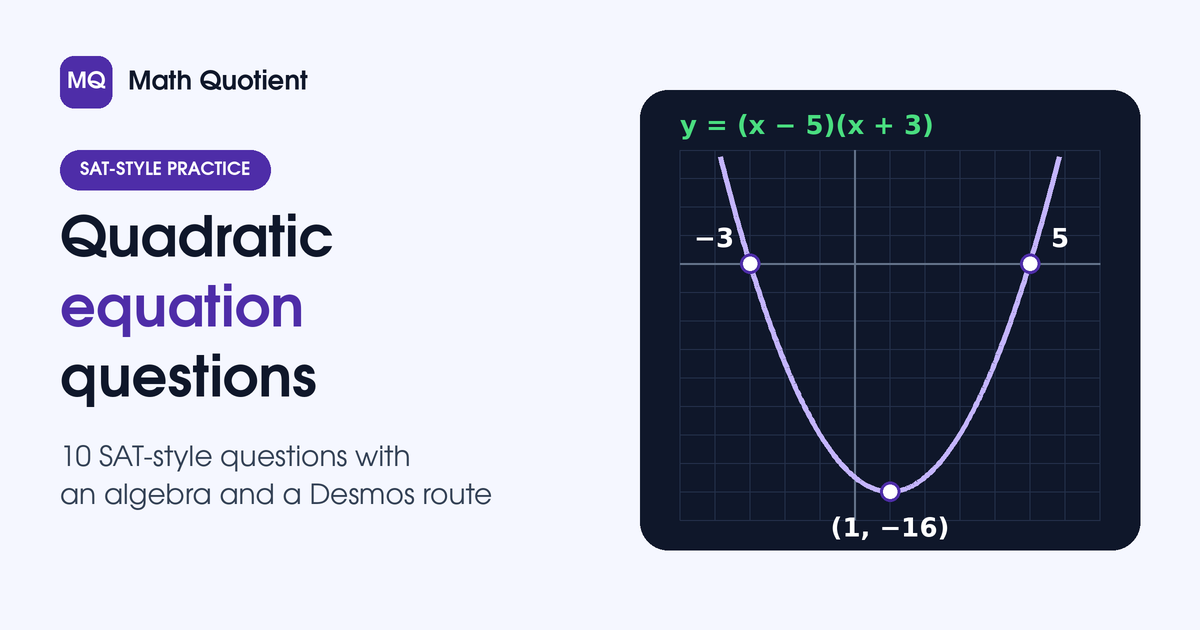
In Desmos: type y = −5x² + 20x + 1. Use x for t, because Desmos graphs x and y. Tap the top of the curve: (2, 21). The greatest height is 21 metres, the y-value.
Read the question: it asks for the height. Typing 2, the time, loses the mark.
Move 3: solve a system by its crossing point
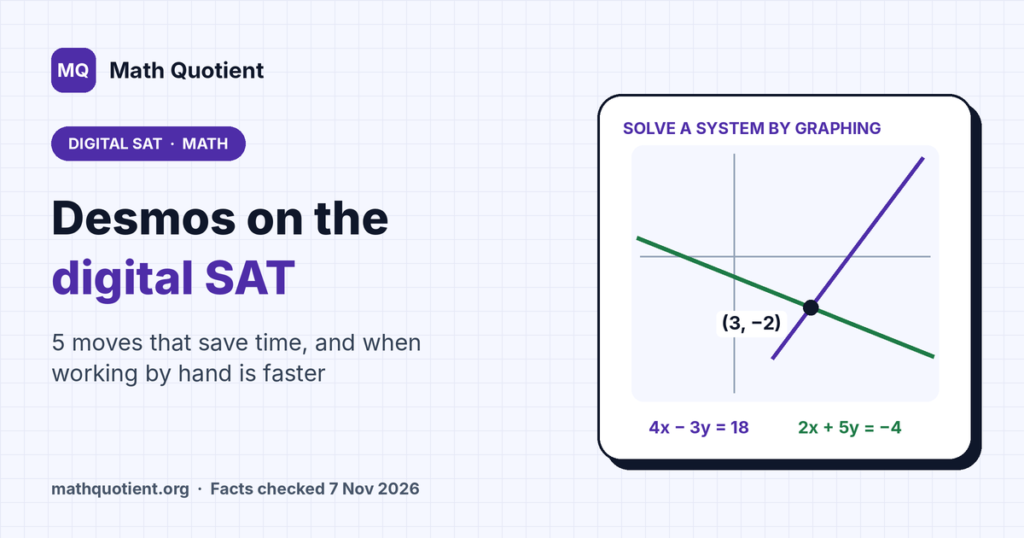
Question: 4x − 3y = 18 and 2x + 5y = −4. What is x − y?
In Desmos: type both equations as they are, with no need to make y the subject. Tap the crossing: (3, −2). Then x − y = 3 − (−2) = 5.
Move 4: a line of best fit from a table
Question: the table shows 5 data points: (1, 8.1), (3, 13.9), (4, 17.2), (6, 22.8), (8, 29.1). Which line fits best: y = 3x + 5, y = 2.5x + 6, y = 3.5x + 4.5 or y = 5x + 3?
In Desmos: add a table and type the points into the x₁ and y₁ columns. On a new line type y₁ ~ mx₁ + b. The ~ sign (tilde) tells Desmos to fit the line. It shows m ≈ 2.99, b ≈ 5.06 and r ≈ 0.9998. The best choice is y = 3x + 5.
Copy each value from the table with care. One wrong number moves the whole line. That is CWV, copied a wrong value.
Move 5: a slider for “how many solutions”
Question: the graphs of y = x² + 6x + k and y = 2x meet at exactly one point. What is k?
In Desmos: type both. Desmos offers a slider for k. Move it until the curve just touches the line. It touches at k = 4.
By hand, which is safer: set them equal: x² + 4x + k = 0. One solution means the discriminant is 0: 4² − 4k = 0, so k = 4. A slider can stop at 3.9 or 4.1. Use it to check an exact value, not to find it.
When working by hand is faster than Desmos
- One-step sums. 20% of 450, or 2x + 7 = 31. Typing takes longer than thinking.
- Exact answers. Desmos shows 1.414, not √2. If the choices have roots, fractions or π, do the algebra.
- “What does this number mean?” If a model is C = 15 + 4n, a question on what 4 means needs words, not a graph.
- No solution or every value works. Two lines that look parallel on a screen may still cross far away. Compare the slopes by hand.
Get your thoughts down on the scratch paper first, then use the calculator. College Board gives the same advice.
What Desmos fixes, and what it cannot
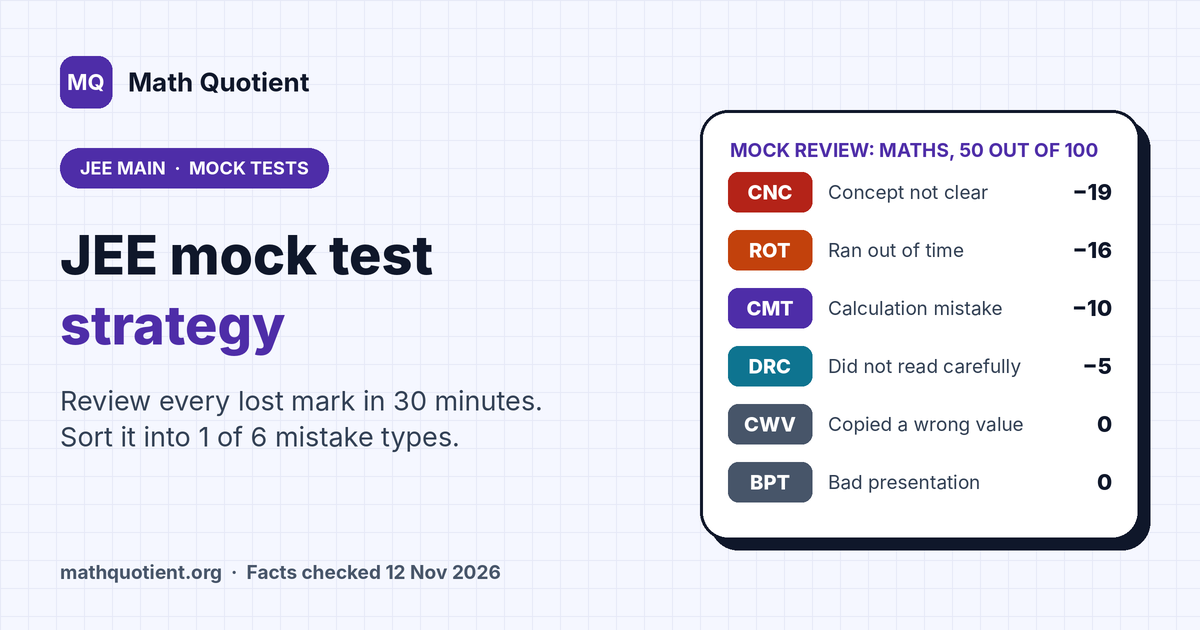
The Free BMI Maths Test sorts every maths mistake into 6 types. Desmos helps with some of them, and not with others.
| Mistake type | Does Desmos help? |
|---|---|
| CMT: calculation mistake | Yes, if you type the right thing. |
| CWV: copied a wrong value | Only if you check what you typed against the question. |
| ROT: ran out of time | Sometimes. It saves time on graph questions, and loses time on short sums. |
| CNC: concept not clear | No. If you do not know what to type, Desmos cannot tell you. |
| DRC: did not read carefully | No. Desmos shows the point. You must still know which number the question asks for. |
| BPT: bad presentation | No. Desmos does not write your working for you. Set out your scratch work in clear steps. |
Desmos stops calculation mistakes (CMT) and copied values (CWV) only if you type them right. It cannot fix a concept that is not clear (CNC). The Free BMI Maths Test finds which of the 6 mistake types your child makes.
Free BMI Maths Test
Desmos cannot fix a concept that is not clear
The Free BMI Maths Test shows which of the 6 mistake types your child makes, so you know what to practise with Desmos and what to practise by hand.
How to practise with the same Desmos you get on test day
- Use Bluebook. College Board says you can learn the Desmos options in the test preview, in a full practice test in Bluebook, or on the Desmos website.
- Use the test version on the Desmos site. Desmos has a Testing page and a Test Mode app with the exact calculator for each test. In the College Board version, images, folders and notes are turned off.
- Use the reference sheet too. Bluebook has a reference sheet of common formulas for the maths section. Practise with it so you know what is on it.
For UAE families
Practise on the same laptop or tablet your child will take to the test centre, with Bluebook on it. A small screen makes Desmos harder to read. Find this out at home, not on test day.
Your own calculator: College Board’s rules
You may bring an approved handheld calculator instead of, or as well as, Desmos. It must not have CAS (computer algebra). Graphing, scientific and 4-function calculators are allowed, but College Board does not suggest 4-function ones. Not allowed: phone calculator apps, calculators with a QWERTY keyboard, wireless, Bluetooth, a camera or paper tape. No power cords. Turn off all sound. If your calculator stops working and you have no spare, you can carry on with Desmos.
What to do now
- Do the 5 moves on this page in Desmos. Time each one, then time it by hand.
- In your next practice test, write a D next to each question where you used Desmos. Afterwards, check: did it save time, or cost time?
- Read how the digital SAT maths section works, then plan your weeks with the 8-week SAT maths practice plan.
One SAT-style question, both ways
The practice question
A juice shop in Bur Dubai sells small juices for AED 9 and large juices for AED 14. One day it sells 120 juices for AED 1,355 in total. How many large juices does it sell?
Show the answer, both ways
Answer: 55.
By hand: if all 120 were small, they would cost 120 × 9 = 1,080. The real total is 1,355, so 1,355 − 1,080 = 275 is extra. Each large juice adds 14 − 9 = 5. So 275 ÷ 5 = 55 large juices.
In Desmos: let x be small and y be large. Type x + y = 120 and 9x + 14y = 1355. Tap the crossing: (65, 55). The question asks for large juices, so the answer is y = 55.
Check: 65 × 9 = 585 and 55 × 14 = 770. 585 + 770 = 1,355. It works.
Common mistake: typing 65, the number of small juices. That is DRC, did not read carefully. Before you type, say which letter stands for what.
This is a practice question in the style of the SAT, written by Math Quotient. It is not a real past question.
Questions people ask about Desmos on the SAT
Can I use Desmos on the whole SAT maths section?
Yes. Bluebook has a built-in Desmos calculator for the entire Math section, with graphing and scientific options. You cannot use any calculator in the Reading and Writing section.
Is Desmos faster than a handheld calculator?
For graphs, systems and data tables, Desmos is often faster because it draws the graph. For short sums, a handheld you know well is just as quick. College Board says to use the calculator you know best.
Can I bring my own calculator to the SAT?
Yes, if it is approved: a graphing calculator without CAS, or a scientific or 4-function one. Phone apps, QWERTY keyboards, wireless or Bluetooth devices and power cords are not allowed. Bring fresh batteries.
How do I practise with the SAT Desmos?
Use the test preview or a full practice test in Bluebook. You can also use the College Board version of the calculator on the Desmos Testing page or in the Desmos Test Mode app.
Keep exploring
Is it the calculator, or the concept?
The Free BMI Maths Test finds your real maths level and which of the 6 mistake types you make, so you know what Desmos can fix and what it cannot.
Sources
Facts checked on 7 November 2026. Every answer on this page checked in Python.
- College Board: SAT calculator policy
- College Board: calculator use on the Math section
- College Board: 2026-27 SAT weekend student guide
- College Board: how the SAT is structured
- College Board: what is Bluebook
- Desmos: the College Board version of the calculator
- Desmos: practise with testing calculators and regressions
Written by Himanshu Jain
B.Tech, IIT Delhi. Founder of Math Quotient, Bur Dubai.