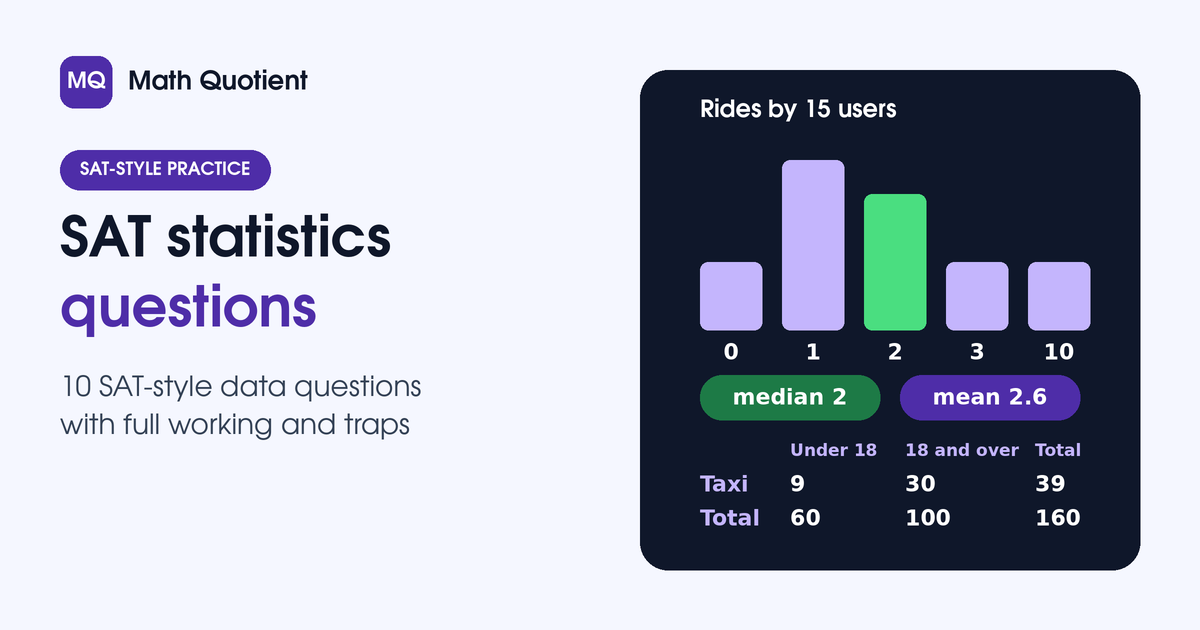
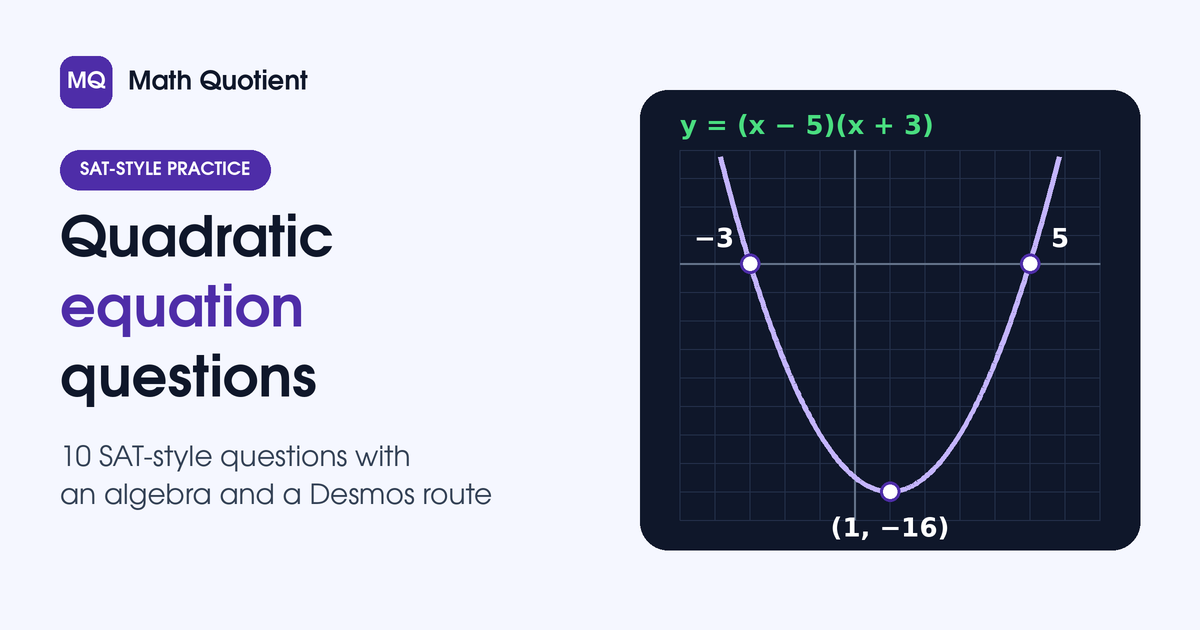
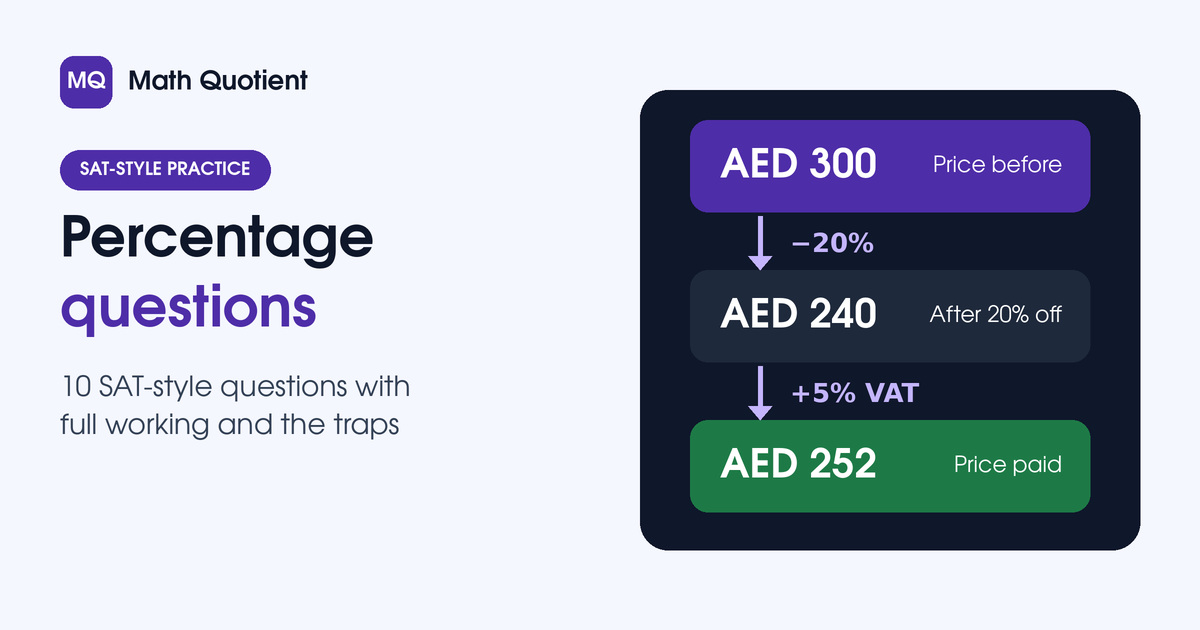
Here are 12 SAT-style maths questions with full answers: 3 from each of the 4 areas the SAT tests. Each answer gives the working, a target time, the mistake that most often loses the mark, and a Desmos tip where the calculator is faster. These are practice questions in the style of the SAT, not real past questions.
Right answer, right time, and the reason behind each wrong one.
12 questions · 16 minutes
What this SAT maths practice set covers
College Board splits SAT maths into 4 areas. This set takes 3 questions from each, with both question types you meet on test day: multiple choice, and questions where you type the answer.
Algebra
Linear equations, lines and systems.
Advanced maths
Quadratics, exponentials, radicals and functions.
Problem solving and data
Percentages, averages, tables and probability.
Geometry and trigonometry
Triangles, circles and angles.
The numbers show how many questions College Board puts in each area on one SAT. On test day you have 44 maths questions in two 35-minute modules. Bluebook, the testing app, has a built-in Desmos calculator for the whole maths section, and a reference sheet of common formulas. Facts checked on 6 November 2026.
How to use these questions
Time yourself. Start a stopwatch. The target times add up to 16 minutes. On the real test the average is about 95 seconds, so 12 questions at full pace take about 19 minutes. The 3 spare minutes are for checking.
Answer all 12 before you open any answer. Write each answer and the time you took.
Mark your work. For each wrong answer, read the “common mistake” line. Does it match what you did? Note the mistake type.
Look for a pattern. Two or more mistakes of the same type tell you what to fix first. A slow right answer counts as a warning too.
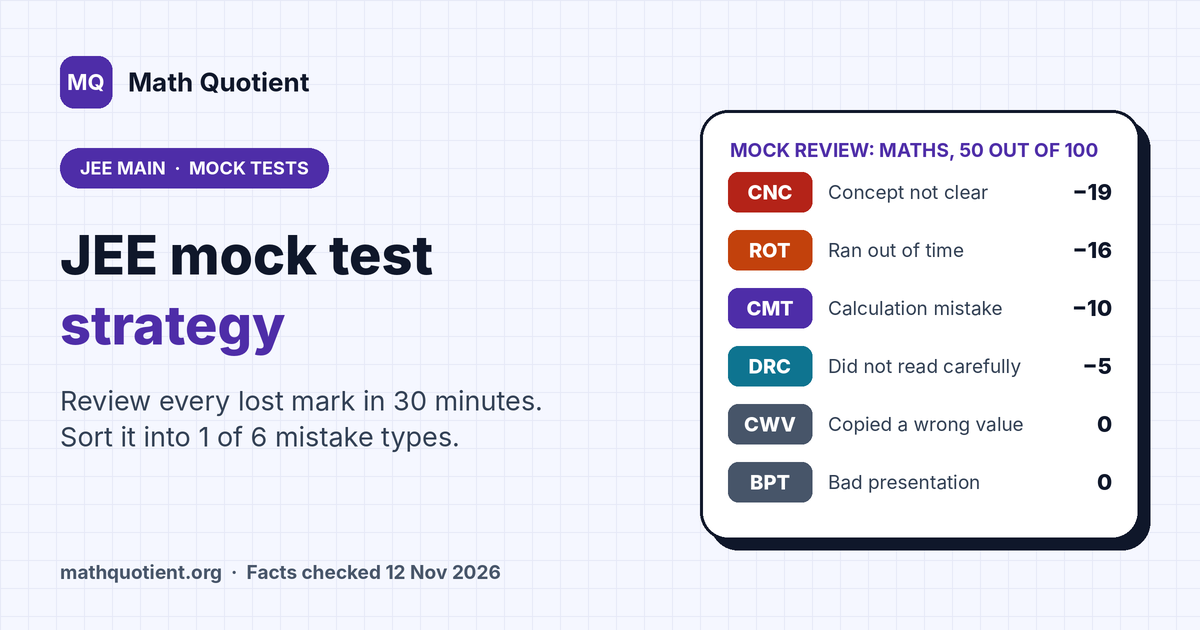
The mistake types come from the BMI Maths Test: CNC concept not clear, DRC did not read carefully, CWV copied a wrong value, CMT calculation mistake, BPT bad presentation, ROT ran out of time.
Algebra: SAT-style questions 1 to 3
Question 1
A delivery service charges a fixed AED 12 plus AED 2.50 for each kilometre. One delivery cost AED 47. How many kilometres was the delivery?
- 14
- 18.8
- 23.6
- 35
Show answer to question 1
Answer: A, 14.
Working: Cost = 12 + 2.5k. So 12 + 2.5k = 47. Take away 12: 2.5k = 35. Divide by 2.5: k = 14.
Skill: write and solve a linear equation from words. Target time: 60 seconds.
Common mistake: dividing 47 by 2.5 and choosing B, 18.8. This forgets that AED 12 is paid once, whatever the distance. BMI type: CNC, concept not clear.
Desmos tip: type y = 12 + 2.5x and y = 47. Tap the point where the lines cross: (14, 47).
Question 2
3x + 2y = 16
x − y = 2
If (x, y) solves the system above, what is the value of x + y?
Show answer to question 2
Answer: 6.
Working: From the second equation, x = y + 2. Put this into the first: 3(y + 2) + 2y = 16, so 5y + 6 = 16 and y = 2. Then x = 4. So x + y = 4 + 2 = 6.
Skill: solve a system of two linear equations. Target time: 75 seconds.
Common mistake: finding x = 4 and typing 4. The question asks for x + y. BMI type: DRC, did not read carefully. Before you type, read the last line of the question again.
Desmos tip: type both equations as they are. Desmos draws both lines. Tap the crossing point: (4, 2). Then add the two numbers.
Question 3
2x + ky = 7
6x + 9y = 12
In the system above, k is a constant. For what value of k does the system have no solution?
Show answer to question 3
Answer: 3.
Working: A system of two lines has no solution when the lines are parallel: same slope, different intercept. Divide the second equation by 3: 2x + 3y = 4. The first equation is 2x + ky = 7. The x parts already match, so the y parts must match too: k = 3. Then the equations are 2x + 3y = 7 and 2x + 3y = 4. These can never both be true, so there is no solution.
Skill: number of solutions of a linear system. Target time: 90 seconds.
Common mistake: writing the ratio the wrong way round, 6 ÷ 2 × 9, and typing 27. BMI type: BPT, bad presentation. When the ratios are written in a jumble, it is easy to mix them up. Line up the two equations, one under the other, before you compare them.
Desmos tip: type both equations with k. Desmos offers a slider for k. Move it until the two lines are parallel.
Advanced maths: SAT-style questions 4 to 6
Question 4
f(x) = x² − 8x + 12. What is the minimum value of f(x)?
- −16
- −4
- 4
- 12
Show answer to question 4
Answer: B, −4.
Working: Complete the square: x² − 8x + 12 = (x − 4)² − 16 + 12 = (x − 4)² − 4. A square is never below 0, so the smallest value is −4, when x = 4.
Skill: vertex of a parabola. Target time: 60 seconds.
Common mistake: choosing C, 4. That is the x-value where the minimum happens, not the minimum value. BMI type: DRC, did not read carefully.
Desmos tip: type y = x² − 8x + 12 and tap the lowest point. Desmos shows (4, −4). The answer is the second number.
Question 5
A library has 2,400 members. The number of members grows by 5% each year. How many members will it have after 2 years?
Show answer to question 5
Answer: 2,646 (type 2646).
Working: Growing by 5% means multiplying by 1.05 each year. After 2 years: 2,400 × 1.05² = 2,400 × 1.1025 = 2,646.
Skill: exponential growth. Target time: 75 seconds.
Common mistake: adding 5% of 2,400 (120) twice and typing 2,640. In year 2 the 5% is taken of the new, bigger number. BMI type: CNC, concept not clear.
Desmos tip: type 2400(1.05)^2 straight into the calculator. It is faster than two steps by hand, and there is no rounding on the way.
Question 6
√(2x + 7) = x + 2. Which of these gives all the solutions of the equation?
- x = 1 only
- x = −3 only
- x = 1 and x = −3
- There is no solution.
Show answer to question 6
Answer: A, x = 1 only.
Working: Square both sides: 2x + 7 = x² + 4x + 4. So x² + 2x − 3 = 0, which is (x + 3)(x − 1) = 0. That gives x = −3 or x = 1. Now check each one in the first equation. For x = 1: √9 = 3 and 1 + 2 = 3. True. For x = −3: √1 = 1 but −3 + 2 = −1. False. So only x = 1 works.
Skill: radical equations and false solutions. Target time: 120 seconds.
Common mistake: choosing C. Squaring both sides can add an answer that does not work in the first equation. You must check. BMI type: CNC, concept not clear. A second mistake: spending 3 minutes on the algebra when a graph gives the answer in 30 seconds. BMI type: ROT, ran out of time.
Desmos tip: type y = √(2x + 7) and y = x + 2. The curves meet only once, at (1, 3). That is answer A.
Free BMI Maths Test
Losing marks on questions you know?
The Free BMI Maths Test shows why: a concept that is not clear, a question read too fast, or a calculation slip. It also finds your real maths level.
Problem solving and data: SAT-style questions 7 to 9
Question 7
A jacket costs AED 1,200 before tax. In a sale, this price drops by 15%. Then a 5% tax is added to the sale price. What is the final price?
- AED 1,020
- AED 1,071
- AED 1,080
- AED 1,260
Show answer to question 7
Answer: B, AED 1,071.
Working: A 15% drop means × 0.85: 1,200 × 0.85 = 1,020. Adding 5% tax means × 1.05: 1,020 × 1.05 = 1,071.
Skill: percentage change, one step after another. Target time: 75 seconds.
Common mistake: taking 15% − 5% = 10% off the first price and choosing C, AED 1,080. The tax is 5% of the sale price, not of AED 1,200. BMI type: CNC, concept not clear. Choosing A means you stopped before the tax. BMI type: DRC, did not read carefully.
Desmos tip: type 1200 × 0.85 × 1.05 in one line.
Question 8
The mean of a student’s first 6 practice test scores is 82. After a seventh test, the mean of all 7 scores is 84. What was the score on the seventh test?
Show answer to question 8
Answer: 96.
Working: Work with totals, not means. Total of the first 6: 6 × 82 = 492. Total of all 7: 7 × 84 = 588. Seventh score: 588 − 492 = 96.
Skill: mean and total. Target time: 90 seconds.
Common mistake: thinking the new score is 2 more than the new mean, and typing 86. One new score must lift all 7 scores by 2 each, so it must be 7 × 2 = 14 above the old mean of 82. BMI type: CNC, concept not clear.
Desmos tip: no graph needed. Type 7 × 84 − 6 × 82 to check.
Question 9
A made-up survey asked 200 students which calculator they used on a timed maths test, and whether they finished on time.
| Calculator | Finished on time | Did not finish | Total |
|---|---|---|---|
| Desmos | 72 | 18 | 90 |
| Handheld | 66 | 44 | 110 |
| Total | 138 | 62 | 200 |
One student who finished on time is chosen at random. What is the probability that this student used Desmos?
- 9/25
- 11/23
- 12/23
- 4/5
Show answer to question 9
Answer: C, 12/23.
Working: The student is chosen from those who finished on time, so the total is 138, not 200. Of these 138, 72 used Desmos. 72/138 = 12/23.
Skill: probability from a two-way table. Target time: 90 seconds.
Common mistake: dividing by the wrong total: 72/200 = 9/25 (A) or 72/90 = 4/5 (D). BMI type: DRC, did not read carefully. Taking 66 from the wrong row gives 66/138 = 11/23 (B). BMI type: CWV, copied a wrong value.
Desmos tip: type 72/138. Desmos shows 0.5217. Then type 12/23 and check it gives the same number.
Geometry and trigonometry: SAT-style questions 10 to 12
Question 10
In triangle ABC, angle C is 90°. sin A = 5/13. What is cos B?
- 5/12
- 5/13
- 12/13
- 13/5
Show answer to question 10
Answer: B, 5/13.
Working: A and B add up to 90°. For two such angles, cos B = sin A. Or draw it: the side opposite A is 5 and the longest side is 13. That same side of 5 is next to angle B. So cos B = 5/13.
Skill: sine and cosine of the two acute angles in a right triangle. Target time: 60 seconds.
Common mistake: working out the third side (12) and choosing C, 12/13. That is cos A, not cos B. BMI type: CNC, concept not clear.
Desmos tip: not needed. A quick sketch with the sides 5, 12 and 13 is faster.
Question 11
A circle in the xy-plane has the equation x² + y² − 6x + 8y = 11. What is the radius of the circle?
Show answer to question 11
Answer: 6.
Working: Complete the square for x and for y. x² − 6x = (x − 3)² − 9. y² + 8y = (y + 4)² − 16. So (x − 3)² + (y + 4)² = 11 + 9 + 16 = 36. The radius is √36 = 6. The centre is (3, −4).
Skill: equation of a circle. Target time: 90 seconds.
Common mistake: typing 36. That is the radius squared. BMI type: DRC, did not read carefully. Another one: adding 11 + 9 + 16 and writing 34. BMI type: CMT, calculation mistake.
Desmos tip: type the equation as it is. Desmos draws the circle. Tap the right-most point, (9, −4), and the centre is 6 to its left.
Question 12
A circle has a radius of 9. An arc of the circle is cut off by a central angle of 80°. The length of the arc is kπ. What is the value of k?
Show answer to question 12
Answer: 4.
Working: The full circle is 2π × 9 = 18π long. The arc is 80/360 of it: (80/360) × 18π = 4π. So k = 4.
Skill: arc length. Target time: 75 seconds.
Common mistake: using 80/180 instead of 80/360 and typing 8. A full turn is 360°. BMI type: CNC, concept not clear.
Desmos tip: type (80/360) × 2 × 9 to check. Leave π out, because the question asks for k.
Score yourself
Count your right answers. Then count how many you got right inside the target time.
| Right answers | What it means | What to do next |
|---|---|---|
| 11 or 12 | Strong across all 4 areas. | Do a full practice test in Bluebook at real pace. Check how many came in under target time. |
| 9 or 10 | Good, with one weak spot. | Look at the mistake types. If 2 are the same type, fix that first. |
| 8 or fewer | The cause matters more than the score. | Book the Free BMI Maths Test to find the cause. |
8 or fewer right? Book the Free BMI Maths Test to find the cause. It finds which of the 6 mistake types you make, and your real maths level.
Practise next
For official questions, use College Board’s free Student Question Bank, the full-length practice tests in Bluebook, and Official SAT Prep on Khan Academy. For a plan, use these guides:
Lost marks you should have got?
The Free BMI Maths Test finds your real maths level and which of the 6 mistake types cost you the marks.
Questions people ask about SAT maths practice
Where can I find free official SAT maths practice?
College Board gives three free sources: full-length practice tests in the Bluebook app, the Student Question Bank with thousands of official questions, and Official SAT Prep on Khan Academy.
How long should each SAT maths question take?
The maths section has 44 questions in 70 minutes, which is about 95 seconds a question. Early questions in each module are easier, so aim to answer them faster and save time for the harder ones at the end.
Are these real SAT questions?
No. These are SAT-style practice questions written by Math Quotient. They follow the 4 SAT maths areas and question types, but they are not real past questions.
Can I use Desmos on every SAT maths question?
Yes. Bluebook has a built-in Desmos calculator that you can use for the whole maths section. You may also bring your own approved calculator. Desmos is not always faster, so practise knowing when to use it.
Sources
Facts checked on 6 November 2026. Answers checked in Python.
- College Board: the SAT maths section (4 areas and question counts, easiest to hardest in each module)
- College Board: 2026-27 SAT weekend student guide (44 questions, 70 minutes, two 35-minute modules)
- College Board: calculator policy (Desmos in Bluebook, own calculator)
- College Board: tools on the digital SAT (reference sheet)
- College Board: free official practice
Written by Himanshu Jain
B.Tech, IIT Delhi. Founder of Math Quotient, Bur Dubai.