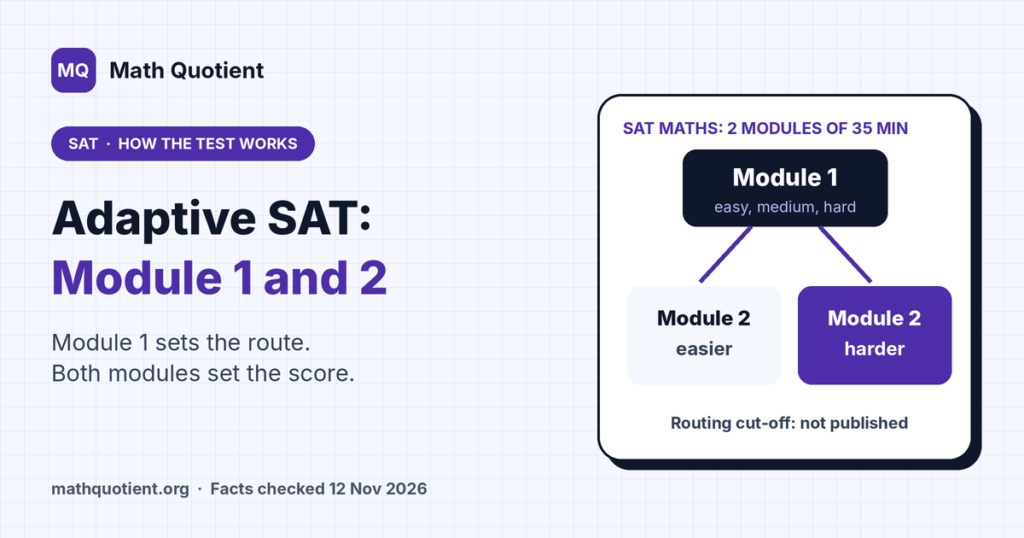
The adaptive SAT starts every student on a Module 1 with a broad mix of easy, medium and hard questions. Your Module 1 result then sets Module 2 as more or less difficult, and your score uses both.
This page explains how the routing and scoring work, in College Board’s own words. Where College Board gives no number, we say “not published”. Then it shows what to change in practice.
Module 1 sets the route. Both modules set the score.
Module 1 then Module 2
Quick answer
Each SAT section has two modules. Module 1 is a mix of easy, medium and hard questions.
How you do on Module 1 decides if Module 2 is easier or harder. College Board does not publish the cut-off.
Your score comes from the questions you get right in both modules, and how hard those questions are.
So the best plan is simple: make Module 1 as accurate as you can.
The adaptive SAT in one table
| Question | College Board’s answer |
|---|---|
| What is the design called? | “Multistage adaptive.” Each section is given in two stages, called modules, of equal length and timed on their own. |
| How big is the Math section? | 44 questions in 70 minutes: two modules of 35 minutes. Each module has 20 operational questions and 2 pretest questions. |
| What is in Module 1? | “A broad mix of easy, medium, and hard questions.” |
| What is in Module 2? | “A targeted mix” that is more or less difficult, based on how you did in Module 1. |
| Can I go back to a question? | Yes, within the module you are in. You can also mark questions to come back to. |
| Do the pretest questions count? | No. Answers to them do not affect your score. |
| How is the score worked out? | With Item Response Theory. The score depends on which questions you got right, including how hard they were. |
| What score do I need in Module 1 for the harder route? | Not published. |
| What is the top score on the easier route? | No number is published. See the Module 2 section below. |
Sources: College Board pages on test structure, how scores are calculated and the 2026-27 Student Guide, checked on 12 November 2026.
For what each maths domain tests, see our digital SAT maths guide. This page stays on the routing and the scoring.
Module 1: what it decides
Module 1 does two jobs at once.
- It counts in your score. College Board’s score uses your answers from both modules. A mark lost in Module 1 is lost for good.
- It picks your Module 2. College Board says the second module is “tailored” to how you did on the first. It does not say how many right answers, or which ones, move you to the harder route.
Inside Module 1, the maths questions run from easiest to hardest. So a slip in the first part is a mark that was easy to keep.
Module 1 gets half the section’s time: 35 minutes for 22 questions. That is about 95 seconds a question on average. You cannot move time from one module to the other.
Module 2: easier or harder, and what it means for the score
The harder Module 2 has more hard questions and fewer easy ones. The easier one is the other way round. Both have the same length and time.
What College Board shows about score ranges
A figure on College Board’s scoring page shows the section score range for each route:
| Route in maths | Range in College Board’s figure | Exact numbers |
|---|---|---|
| Easier Module 2 | From 200 to a little above the maths benchmark of 530 | Not published |
| Harder Module 2 | From a little below the benchmark up to 800 | Not published |
The benchmark of 530 is College Board’s maths college readiness benchmark. Source: College Board scoring and benchmarks pages, checked on 12 November 2026.
So the ranges overlap near the benchmark, and only the harder route reaches 800 in the figure. Exact caps printed on other websites do not come from College Board.
Two things College Board says that sound opposite
- “Students won’t be advantaged just for seeing a higher difficulty set of questions.” And you “won’t get a lower score just because you saw a lower difficulty set”.
- Two students with the same number of right answers “may earn differing section scores”.
Both are true. The route is not a reward or a penalty. It follows from Module 1. The score then reads your whole pattern of answers, including how hard each right answer was. College Board’s blog gives one example. Get a couple of Module 1 questions wrong, and 800 for the section is not possible. That holds even with every Module 2 answer right.
Myths about the adaptive SAT
| What people say | Verdict | Why |
|---|---|---|
| “The easier Module 2 caps you at a set score.” | Not published | College Board’s figure shows the easier range ending a little above 530. It gives no exact cap. |
| “You need a set number right in Module 1 for the harder route.” | Not published | College Board does not publish a routing cut-off. |
| “Skip the hard questions in Module 1 and leave them blank.” | False | College Board says it is better for most students to guess than to leave a question blank. |
| “You can tell your route from how Module 2 feels.” | Not published | Bluebook does not tell you, and College Board gives no sign to look for. A hard question can sit in either route. |
| “The pretest questions are the hardest ones.” | Not published | College Board says 2 pretest questions sit in each module. It does not say where or how hard. |
| “Bluebook practice tests are not adaptive.” | False | College Board says its full-length practice tests in Bluebook are adaptive. The paper PDF tests are nonadaptive. |
Free BMI Maths Test
Losing easy marks in Module 1? Find out why.
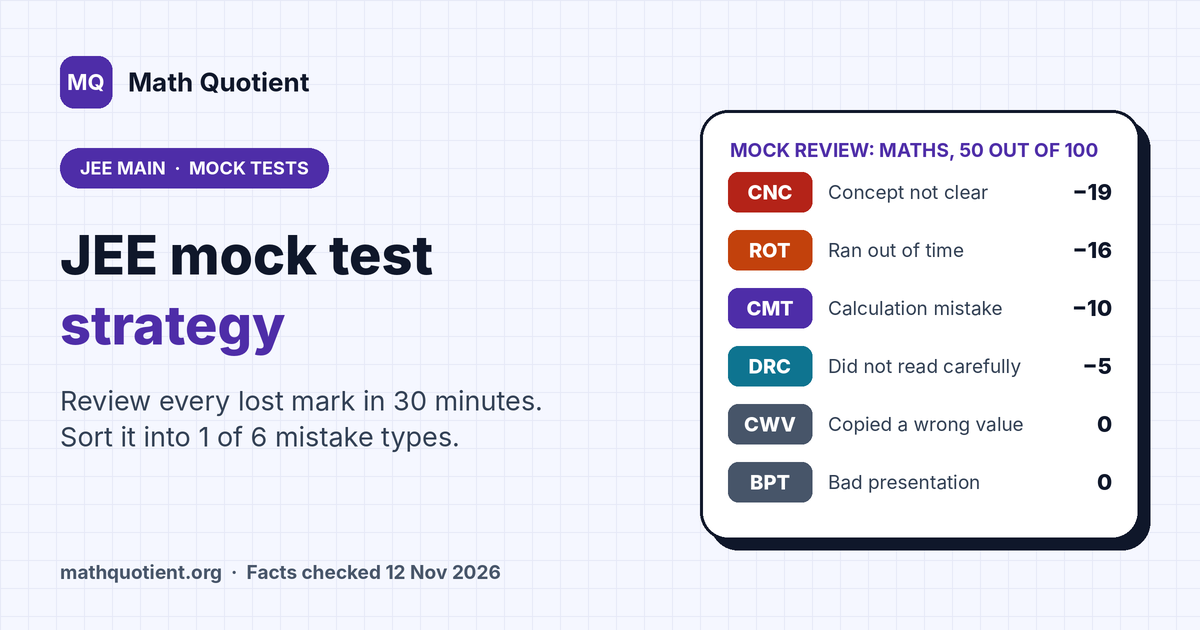
Easy marks often go to DRC (did not read carefully), CMT (calculation mistake) or ROT (ran out of time). The Free BMI Maths Test finds your child’s real maths level and which of the 6 mistake types they make.
What to change in practice: a 4-step plan
- Practise the real routing. Do full-length practice tests in Bluebook, since these adapt like the real test. Use the paper PDF tests for skill work, not to feel the routing.
- Make the first half of Module 1 safe. These questions are the easiest in the module. For each one, read the last line of the question again before you choose. Is it asking for x, for 2x, or for a total?
- Pace by checkpoints, not by panic. 35 minutes for 22 questions is about 95 seconds each. At about 17 minutes, aim to be near question 11. Mark a long question, move on, and come back. Never leave a blank when time ends.
- Treat Module 2 the same, whatever it feels like. You cannot know your route, so do not guess at it. Start Module 2 fresh and use the same checks.
For hard questions at the level of the harder route, try our hard SAT maths questions for Module 2, with full working.
For UAE families
- Practise on the test device. Do Bluebook practice tests on the laptop or tablet your child will bring, so the tools feel normal.
- Read the practice score, not the feeling. “Module 2 was hard” tells you little. The practice score report tells you more.
- Next dates. Saturday 5 December 2026 and Saturday 6 March 2027. See SAT test dates in the UAE for the deadlines in UAE time.
What to do now
- Download Bluebook and do one full-length adaptive practice test.
- Count the mistakes in the first 11 questions of each Module 1. Those are your cheapest marks.
- Practise the “read the last line again” check on 20 easy questions.
One SAT-style Module 1 question
The practice question
A water tank holds 240 litres when full. It is now 3/8 full. How many more litres of water are needed to fill the tank?
- 90
- 120
- 150
- 640
Show the answer
Answer: C, 150 litres.
The tank has 3/8 × 240 = 90 litres in it. It needs 240 − 90 = 150 more litres. Or: it is 5/8 empty, and 5/8 × 240 = 150.
The trap: choice A, 90, is the water already in the tank. The student did the hard part right and answered a different question. In the Free BMI Maths Test, this is DRC, did not read carefully. Choice D, 640, comes from 240 ÷ 3/8: CNC, concept not clear.
Why this one slip costs more than 1 mark: first, the mark is lost. Second, it is part of the Module 1 result that sets your Module 2. College Board does not publish by how much. But its own blog example shows that a couple of Module 1 misses can rule out 800.
A practice question in the style of the SAT, written by Math Quotient. It is not a real past question. Answer and choices checked in Python.
Questions people ask about the adaptive SAT
How does the adaptive SAT work?
Each section has two equal modules. Your Module 1 result decides if Module 2 is more or less difficult. Your score uses both modules.
Can you get 800 with an easier Module 2?
College Board’s scoring figure shows the easier route’s range ending a little above 530, and only the harder route reaching 800. It publishes no exact top number for the easier route.
How do I know if I got the harder Module 2?
You do not know during the test. Bluebook does not say, and College Board publishes no sign to look for.
Do all questions count?
No. Each module has 2 pretest questions that do not affect your score. College Board does not say which ones they are, so answer every question as if it counts.
Should I spend more time on Module 1?
You cannot. Each module is timed on its own, 35 minutes in maths. What you can do is spend Module 1’s time on accuracy. Secure the early questions first, then give the rest of the time to the harder ones.
Keep exploring
Is Module 1 costing easy marks?
The Free BMI Maths Test shows your child’s real maths level and the reason for each mistake.
Sources
Facts checked on 12 November 2026. College Board may change the test or its wording.
- College Board: how SAT scores are calculated (multistage adaptive design, Figure 2)
- College Board: how the SAT is structured
- College Board: Math section overview (easiest to hardest)
- College Board: 2026-27 SAT Weekend Student Guide
- College Board: SAT benchmarks
- College Board blog: what is digital SAT adaptive testing?
- College Board: how students practise for the digital SAT
- College Board: full-length practice tests (paper tests are nonadaptive)
Written by Himanshu Jain
B.Tech, IIT Delhi. Founder of Math Quotient, Bur Dubai.