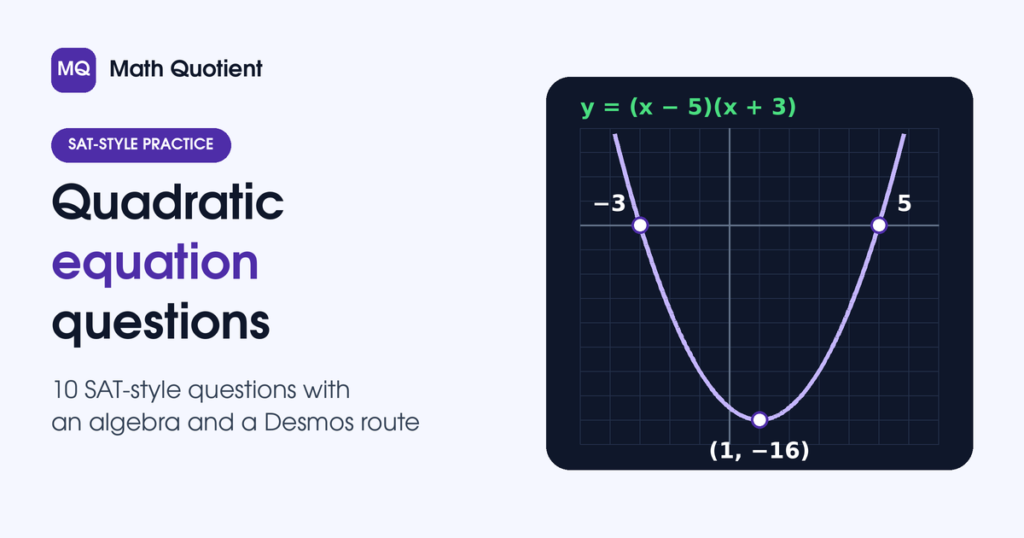
These are 10 SAT-style quadratic equation questions with full working. Each answer shows an algebra route and a Desmos route, says which is faster, and names the trap and its mistake type. These are practice questions, not real past questions.
10 questions · 16 minutes
What this SAT quadratics set covers
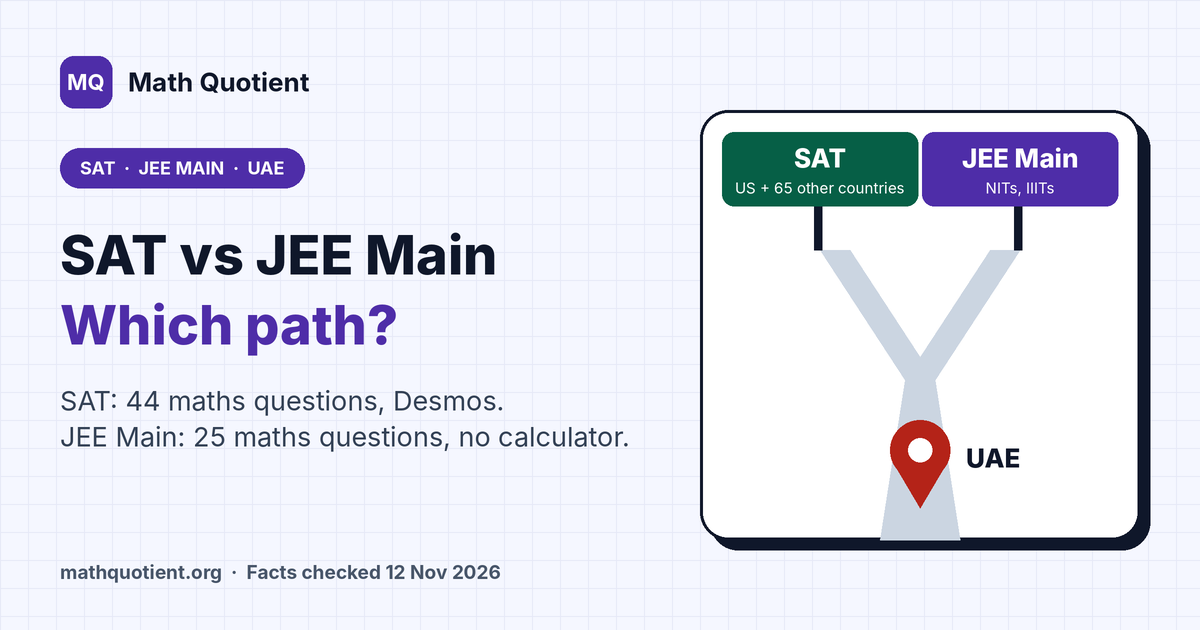
Quadratics sit in Advanced Math. Each SAT has 13 to 15 Advanced Math questions out of 44, says College Board. Its skills include nonlinear equations and nonlinear functions.
Read the form
Vertex, product of solutions, how many solutions, factored form.
Build and use it
Equation from a vertex, an area, a rocket model, decimals, building from roots.
Algebra or Desmos: pick the faster route
Bluebook has Desmos for the whole maths section. It is not always faster.
| The question asks for | Faster route |
|---|---|
| Solutions with ugly numbers or decimals | Desmos: tap the x-intercepts |
| The vertex, or the highest or lowest value | Either: read vertex form, or tap the turning point |
| Sum or product of solutions | Algebra: −b/a and c/a |
| Which form or equation matches | Algebra: test a point or find the roots |
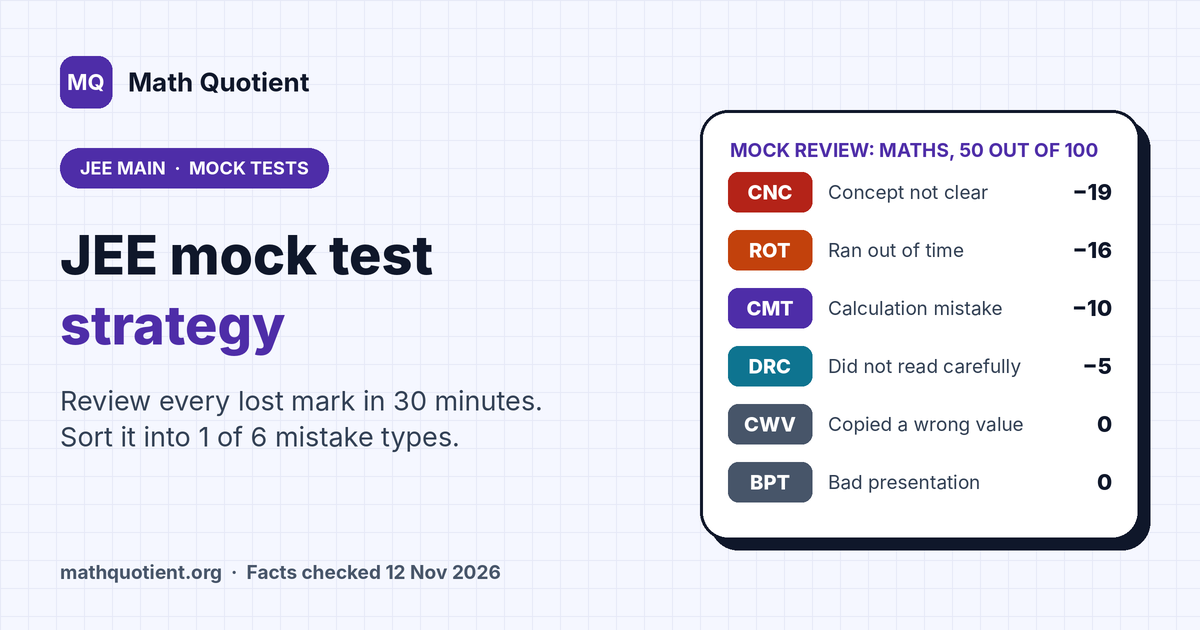
Allow 16 minutes. Try algebra first, then check in Desmos. A typed answer is one answer of up to 5 characters, or 6 with a minus sign (College Board). Mark each wrong answer with its Free BMI Maths Test mistake type.
SAT-style quadratic equation questions 1 to 5
Question 1
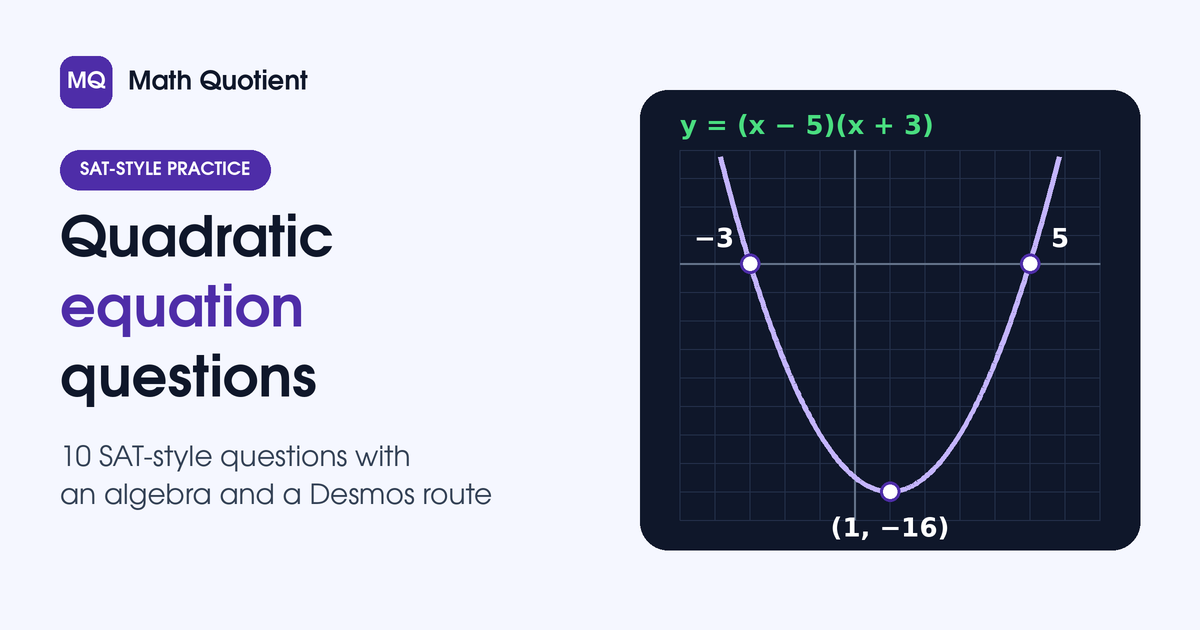
The function f is defined by f(x) = (x + 7)(x − 3). For what value of x does f(x) reach its minimum?
- −7
- −2
- 2
- 3
Show answer
Answer: B, −2.
Algebra: the roots are −7 and 3. The vertex is halfway between them: (−7 + 3) ÷ 2 = −2.
Desmos: tap the lowest point, (−2, −25). Equally quick.
Trap: C takes the numbers in the brackets, 7 and −3, so the midpoint is 2. BMI type: CNC, concept not clear.
Question 2
The graph of y = −3(x + 4)² + 11 is a parabola. What are the coordinates of its vertex?
- (−4, 11)
- (4, 11)
- (−4, −11)
- (11, −4)
Show answer
Answer: A, (−4, 11).
Algebra: y = a(x − h)² + k has vertex (h, k). Here x + 4 = x − (−4), so h = −4.
Desmos: tap the top point. Algebra is faster.
Trap: B reads the vertex as (4, 11), the sign from the bracket. BMI type: CNC. D swaps x and y. BMI type: BPT, bad presentation.
Question 3
What is the product of the solutions of 2x² − 9x − 18 = 0?
Show answer
Answer: −9.
Algebra: the product of the solutions is c/a = −18 ÷ 2 = −9. Check: the solutions are −1.5 and 6.
Desmos: tap both x-intercepts, then multiply. Slower.
Trap: typing 6 or −1.5, a solution and not the product. BMI type: DRC, did not read carefully.
Question 4
How many distinct real solutions does 5x² + 2x − 1 = 0 have?
- Zero
- Exactly one
- Exactly two
- Infinitely many
Show answer
Answer: C, exactly two.
Algebra: the discriminant is b² − 4ac = 4 − 4(5)(−1) = 24. It is above 0, so there are two real solutions.
Desmos: the graph crosses the x-axis twice. Equally fast.
Trap: A comes from copying c as +1: 4 − 20 = −16. BMI type: CWV, copied a wrong value. A sign slip in −4ac does the same: CMT, calculation mistake.
Question 5
f(x) = x² − 2x − 15. Which form of f(x) shows the x-intercepts of its graph as constants or coefficients?
- (x − 1)² − 16
- (x − 5)(x + 3)
- x(x − 2) − 15
- (x + 5)(x − 3)
Show answer
Answer: B, (x − 5)(x + 3).
Algebra: find two numbers that multiply to −15 and add to −2: −5 and 3. The x-intercepts are 5 and −3.
Desmos: slower here.
Trap: D has the signs swapped. BMI type: CMT. A is equal to f(x) but shows the vertex.
Free BMI Maths Test
Lost marks on the vertex question? Find out why.
A sign read from the bracket is a concept gap. A lost minus is a copying slip. The Free BMI Maths Test tells them apart and finds your real maths level.
SAT-style quadratic questions 6 to 10
Question 6
The graph of y = f(x) is a parabola with vertex (3, −8). It passes through the point (5, 0). Which equation defines f?
- f(x) = 2(x − 3)² − 8
- f(x) = 2(x + 3)² − 8
- f(x) = (x − 3)² − 8
- f(x) = 4(x − 3)² − 8
Show answer
Answer: A.
Algebra: f(x) = a(x − 3)² − 8. Put in (5, 0): 4a − 8 = 0, so a = 2.
Desmos: graph all four. Slower.
Trap: C assumes a = 1. BMI type: CNC. B puts the vertex at (−3, −8). D gives 8 at x = 5.
Question 7
A rectangular play area in a Dubai park is 4 metres longer than it is wide. Its area is 96 square metres. What is its width, in metres? (Made-up numbers.)
Show answer
Answer: 8.
Algebra: w(w + 4) = 96, so (w + 12)(w − 8) = 0. A width cannot be −12, so w = 8.
Desmos: y = x(x + 4) meets y = 96 at x = 8. Equally quick.
Trap: typing 12, the length. BMI type: DRC. Typing −12 keeps a root that cannot be a width. BMI type: CNC.
Question 8
A model rocket is launched from a balcony. Its height above the ground, in metres, t seconds after launch is h(t) = −5(t − 6)(t + 1). What is the best meaning of 6 in this model? (Made-up model.)
- The rocket reaches its highest point 6 seconds after launch.
- The rocket hits the ground 6 seconds after launch.
- The rocket is launched 6 metres above the ground.
- The rocket rises 6 metres each second.
Show answer
Answer: B.
Algebra: h(6) = 0, so at t = 6 the rocket is at the ground. The top is halfway between the roots, at t = 2.5.
Desmos: the graph meets the axis at 6 and tops out at (2.5, 61.25).
Trap: A mixes up a zero and the vertex. BMI type: CNC.
Question 9
What is the greater solution of 0.5x² − 3.1x + 4.2 = 0?
- 2.1
- 2
- 4.2
- 8.4
Show answer
Answer: C, 4.2.
Desmos (faster here): type y = 0.5x² − 3.1x + 4.2 and tap the right-hand x-intercept: (4.2, 0).
Algebra: b² − 4ac = 9.61 − 8.4 = 1.21, and √1.21 = 1.1. Here 2a = 1, so x = 3.1 ± 1.1: 4.2 or 2.
Trap: A divides by 2, not by 2a. D divides by a. BMI type: CMT. B is the smaller solution. Slow decimal working by hand: ROT, ran out of time.
Question 10
Which equation has exactly the solutions x = −2/3 and x = 5?
- (3x + 2)(x − 5) = 0
- (3x − 2)(x + 5) = 0
- (2x + 3)(x − 5) = 0
- (x + 2)(3x − 5) = 0
Show answer
Answer: A.
Algebra: set each bracket to 0. 3x + 2 = 0 gives x = −2/3, and x − 5 = 0 gives x = 5.
Desmos: slower here.
Trap: B has both signs swapped. BMI type: CNC. C gives −3/2: the fraction is upside down. BMI type: CMT.
Score yourself
| Right answers | What it means | What to do next |
|---|---|---|
| 9 or 10 within 16 minutes | You read every form well. | Try a harder Advanced Math set. |
| 7 or 8, or slow | Sign slips or the slow route. | Redo each wrong one by the other route. |
| 6 or fewer | A gap behind the slips. | Book the Free BMI Maths Test to find the cause. |
6 or fewer right? Book the Free BMI Maths Test to find the cause. Parents: two CNC marks on vertex questions mean one idea to fix.
Practise next
More official questions: College Board’s free Student Question Bank, Advanced Math.
Right method, wrong sign?
The Free BMI Maths Test finds your real maths level and the reason for each mistake.
Questions people ask about SAT quadratics
How many quadratic questions are on the SAT?
College Board gives no separate count. Quadratics are part of Advanced Math, which has 13 to 15 questions on each SAT.
Should I use Desmos for quadratic questions?
Use it for ugly numbers and to check answers. For a sum, a product or a matching form, algebra is faster.
How do I find the vertex fast?
In vertex form a(x − h)² + k, the vertex is (h, k): change the sign inside the bracket only. In factored form, take the midpoint of the roots. In standard form, x = −b/2a.
Are these real SAT questions?
No. Math Quotient wrote them in SAT style. For official questions, use College Board’s Student Question Bank.
Sources
Facts checked on 12 November 2026. Every answer and trap value checked in Python.
Written by Himanshu Jain
B.Tech, IIT Delhi. Founder of Math Quotient, Bur Dubai.