The best squaring numbers trick depends on the number. A number ending in 5 has a one-step rule. Any other 2-digit number is fast with a split, or with the “up and down” method. This page shows four methods, a way to check a square backwards, and a 5-minute drill. It matters most in JEE Main, because NTA bars calculators.
4 methods · 8 worked squares · 20-square drill
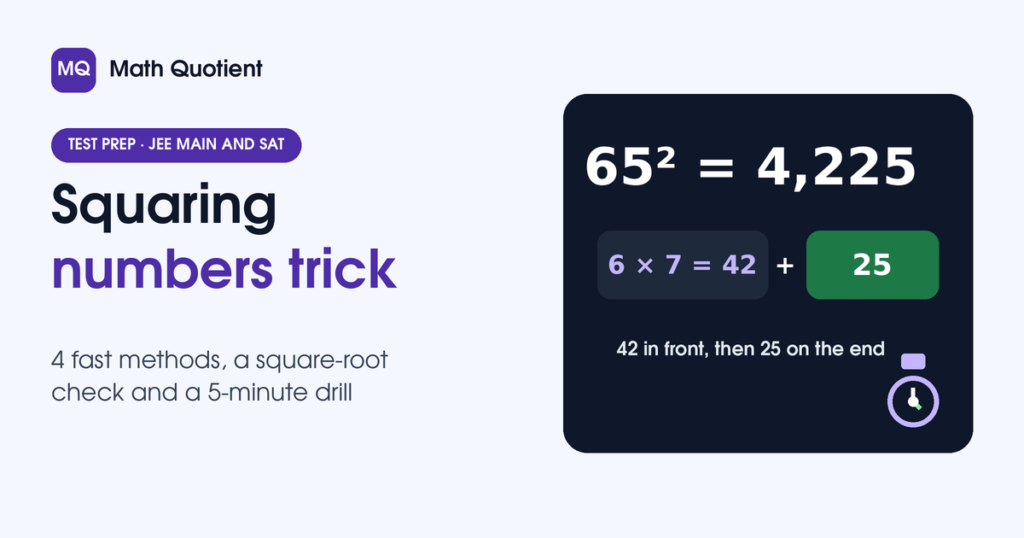
65² = 4,225
Quick answer
Look at the last digit first. Ends in 5? Use Method 1. One away from a round number, such as 69 or 31? Use Method 4.
Anything else: split into tens and units (Method 2), or go up and down to a round number (Method 3).
Check: the last digit of the square, and which two round squares it sits between.
Which squaring numbers trick fits which number
| Method | Numbers it fits | Example | Quick check |
|---|---|---|---|
| 1. Ends in 5 | 15, 65, 115, 6.5 | 65² = 4,225 | Always ends in 25 |
| 2. Split: tens and units | Any 2-digit number with a small units digit | 43² = 1,849 | 3² = 9, so it ends in 9 |
| 3. Up and down | Numbers 2 to 4 from a round number | 38² = 1,444 | 8² = 64, so it ends in 4 |
| 4. Near a round base | 1 or 2 from 30, 70, 200, 300 and so on | 203² = 41,209 | Just over 200² = 40,000 |
Squares near 50 and near 100 have their own short rule on our mental maths tricks for the SAT and JEE page. This page covers every other number.
The four squaring methods, with worked squares
Every square on this page was checked in Python.
Method 1: numbers that end in 5
Take the digits in front of the 5. Multiply them by the next whole number. Write 25 on the end.
- 65²: 6 × 7 = 42. Answer: 4,225.
- 115²: the front is 11, so 11 × 12 = 132. Answer: 13,225.
Why it works: (10n + 5)² = 100n(n + 1) + 25. It works for decimals too: 6.5² = 42.25.
Method 2: the (a + b)² split
Split the number into tens and units. Then (a + b)² = a² + 2ab + b². Say the three parts in order and add as you go.
- 43²: 40² = 1,600. 2 × 40 × 3 = 240. 3² = 9. Answer: 1,600 + 240 + 9 = 1,849.
- 67²: 60² = 3,600. 2 × 60 × 7 = 840. 7² = 49. Answer: 3,600 + 840 + 49 = 4,489.
The middle part is where most slips happen. Double the tens first (2 × 60 = 120), then multiply by the units (120 × 7 = 840).
Method 3: up and down
Move the number up to a round number. Move it down by the same amount. Multiply those two, then add the amount squared. In symbols, n² = (n − d)(n + d) + d².
- 38²: up 2 to 40, down 2 to 36. 40 × 36 = 1,440. Add 2² = 4. Answer: 1,444.
- 83²: down 3 to 80, up 3 to 86. 80 × 86 = 6,880. Add 3² = 9. Answer: 6,889.
The product with a round number is easy: 40 × 36 is just 4 × 36 with a 0 on the end.
Method 4: near any round base
Pick the nearest round base, B. Then (B ± k)² = B² ± 2Bk + k². This is the split with a minus sign, and it works well for 3-digit numbers.
- 69²: 69 = 70 − 1. 4,900 − 140 + 1 = 4,761.
- 203²: 203 = 200 + 3. 40,000 + 1,200 + 9 = 41,209.
Two more: 31² = 900 + 60 + 1 = 961, and 298² = 90,000 − 1,200 + 4 = 88,804.
Check a square backwards: square roots in your head
A square can end only in 0, 1, 4, 5, 6 or 9. So 5,842 is not a perfect square: it ends in 2. This table gives the last digit of every square.
| Number ends in | 0 | 1 or 9 | 2 or 8 | 3 or 7 | 4 or 6 | 5 |
|---|---|---|---|---|---|---|
| Square ends in | 0 | 1 | 4 | 9 | 6 | 5 |
To find a square root, use the last digit and two round squares.
- √7,396: it is between 80² = 6,400 and 90² = 8,100, so the root is in the 80s. It ends in 6, so the root ends in 4 or 6. 85² = 7,225 is below 7,396, so the root is 86.
- √1,764: it is between 40² and 50², so the root is in the 40s. It ends in 4, so the root ends in 2 or 8. 45² = 2,025 is above 1,764, so the root is 42.
Method 1 helps here: 85² and 45² tell you which half of the range you are in.
When a mental square is slower than the normal way
| If you see | Do this | Why |
|---|---|---|
| A 3-digit number far from a round base, such as 437 | Multiply in full, or use Desmos on the SAT | Every part is large, so you hold too much in your head |
| An SAT question with a long square in it | Use Desmos | A calculator is allowed on every SAT maths question |
| You only need to compare, such as √50 or 7 | Square the small number: 7² = 49 | 49 is less than 50, so √50 is bigger |
| A method you learnt days ago | Use your normal way in the timed paper | A new method under time pressure adds slips |
College Board’s own advice is that on some SAT maths questions it is better not to use the calculator you are allowed. 65² or √1,764 is quicker in your head than on a keypad. In JEE Main, every square is by hand.
Free BMI Maths Test
Fast squares, but slips in the paper? Check the cause.
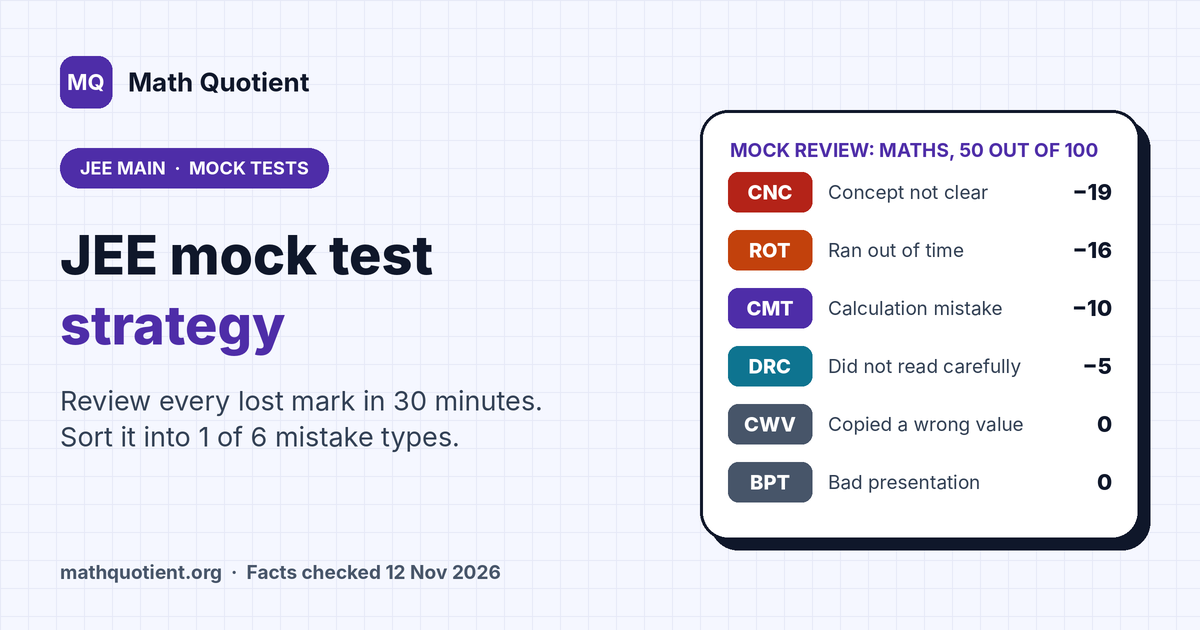
A wrong middle part in 67² is a calculation mistake (CMT). Not reaching the last questions is ROT, ran out of time. They need different fixes. The Free BMI Maths Test sorts each mistake into one of 6 types and finds your child’s real maths level.
A 5-minute timed drill: 20 squares
Set a timer for 5 minutes: 15 seconds a square. Pick the method first, then work. After each answer, check the last digit with the table above.
| Set | Square these |
|---|---|
| A. Ends in 5 | 1) 25 · 2) 55 · 3) 95 · 4) 105 |
| B. Split | 5) 71 · 6) 62 · 7) 73 · 8) 84 |
| C. Up and down | 9) 34 · 10) 68 · 11) 76 · 12) 88 |
| D. Near a base | 13) 39 · 14) 61 · 15) 199 · 16) 302 |
| E. Mixed | 17) 4.5 · 18) 19 · 19) 87 · 20) 0.15 |
Show the 20 answers
A: 625 · 3,025 · 9,025 · 11,025
B: 5,041 · 3,844 · 5,329 · 7,056
C: 1,156 · 4,624 · 5,776 · 7,744
D: 1,521 · 3,721 · 39,601 · 91,204
E: 20.25 · 361 · 7,569 · 0.0225
Scoring (an MQ guide only): 17 or more correct in 5 minutes? Use the methods in timed papers. Under 14? Do one set a day with no timer first. The set with the most slips shows which method needs work.
For UAE families: where squares come up in the tests
In JEE Main, NTA lists calculators among the items you may not carry. Squares come up in many steps: the discriminant b² − 4ac, the distance between two points, and right triangles. For example, the distance from (0, 0) to (21, 20) is √(441 + 400) = √841 = 29. Our Pythagoras’ theorem page has more on this.
On the SAT, Desmos is built into Bluebook. Squaring in your head is for quick checks, not long sums.
What to do now
- Students: learn the squares from 11² to 30² by heart first. The methods build on them.
- Students: add one method a week. Run the 5-minute drill on Mondays and Thursdays.
- Parents: keep the stopwatch and write down which set had slips, not only the total.
- Both: our JEE maths time management plan shows how to pace the 25 maths questions.
A JEE-style worked example: a discriminant with a fast square
Our own JEE-style question, not taken from a real paper.
Number answer: Find the larger root of 2x² − 65x + 500 = 0.
Discriminant: b² − 4ac = 65² − 4 × 2 × 500. Method 1 gives 65² = 4,225: 6 × 7 = 42, then 25. 4 × 2 × 500 = 4,000. So the discriminant is 225.
Square root backwards: 225 ends in 5, and Method 1 gives 15² = 225. So √225 = 15.
Roots: x = (65 ± 15) ÷ 4, so x = 20 or x = 12.5. The larger root is 20. Type 20.
Check: 2 × 400 − 65 × 20 + 500 = 800 − 1,300 + 500 = 0.
Questions people ask about the squaring numbers trick
What is the best squaring numbers trick?
There is no single best one. Use the ending-in-5 rule for numbers like 65. Use up and down, or a round base, when the number is close to a multiple of 10. Use the tens-and-units split for the rest.
How do I square a number ending in 5?
Multiply the digits in front of the 5 by the next whole number, then write 25 on the end. For 85², 8 × 9 = 72, so the answer is 7,225.
How do I square any 2-digit number fast?
Go up and down to the nearest round number, multiply, then add the gap squared. For 38², 40 × 36 = 1,440, plus 4 is 1,444.
Does this help on the SAT?
Only a little. Desmos is allowed on every SAT maths question. Mental squares help you check that an answer has the right size and compare roots quickly.
How do I check a square is right?
Check the last digit: 7² ends in 9, so 67² must end in 9. Then check the size: 67² must sit between 60² = 3,600 and 70² = 4,900.
Keep exploring
Slips in long working?
The Free BMI Maths Test shows whether a slip is a calculation mistake, a misread or a gap in the concept, and finds your child’s real maths level.
Sources
- NTA, JEE (Main) 2027 Information Bulletin, section 8.13: calculators and log tables are on the list of barred items; section 2.4: 25 maths questions in Paper 1.
- College Board, SAT calculator policy: the Desmos calculator inside Bluebook, and the advice that some maths questions go faster without it.
Facts checked on 12 November 2026. We wrote the drill, the scoring bands and the JEE-style question. Each square and root on the page was verified in Python.
Written by Himanshu Jain
B.Tech, IIT Delhi. Founder of Math Quotient, Bur Dubai.