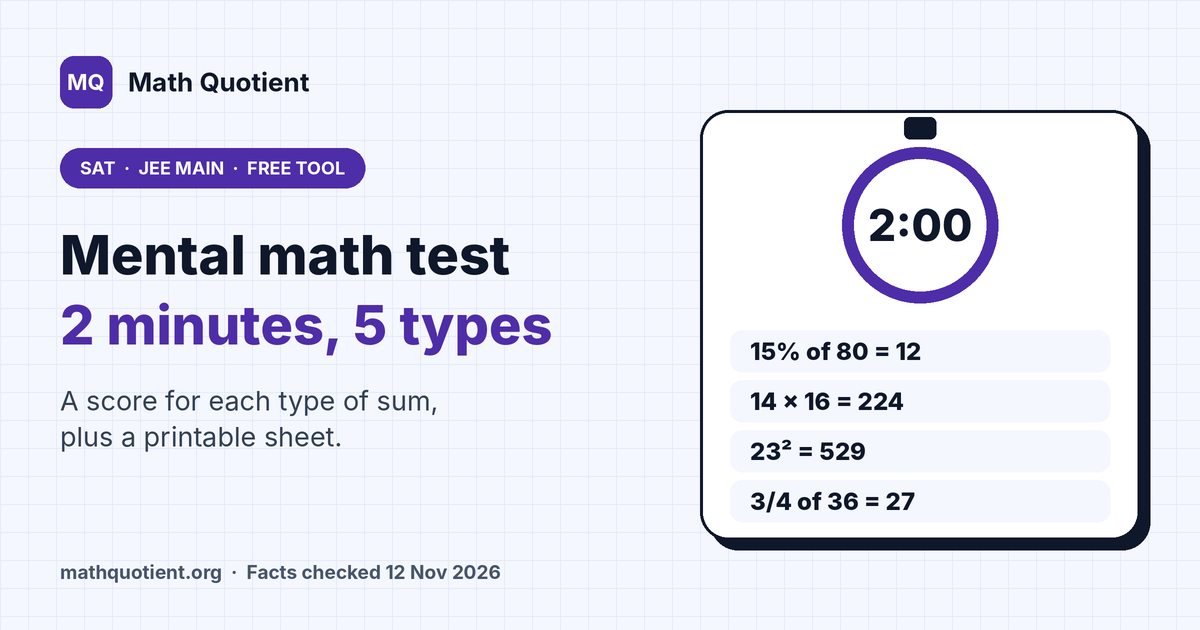
These math tricks for fast multiplication save the most time in JEE Main, where no calculator is allowed. On the SAT, Desmos does long sums, so a trick helps only with quick checks and easy products. Below: five methods, when each is slower, and a 10-minute drill.
5 methods · 10 worked sums · 20-sum drill
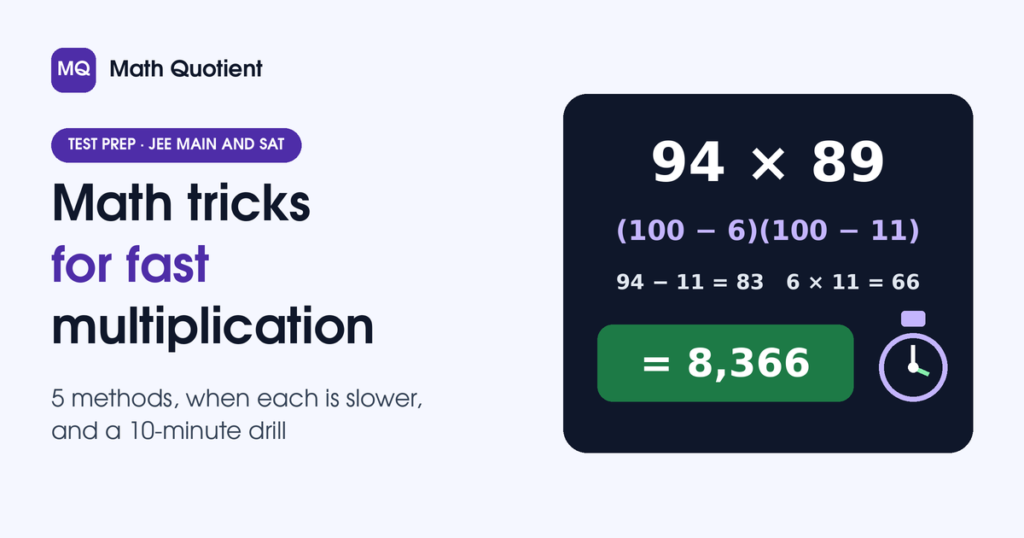
94 × 89 = 8,366
Quick answer
Five methods: numbers near 100, difference of squares, doubling and halving, split and add, and the 2-digit cross method.
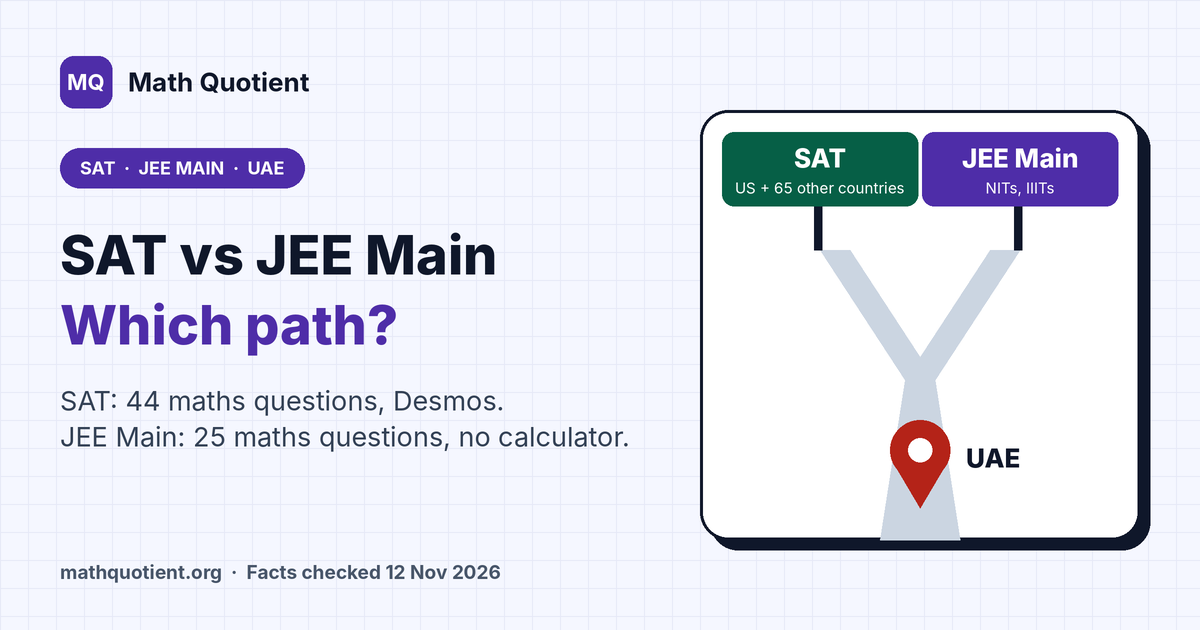
Who gains most: JEE Main students, as NTA bars calculators. The SAT allows Desmos on every maths question.
Check every answer: the size and the last digit.
Which multiplication method fits which numbers
Look at the two numbers first. Then pick the method.
| Method | Numbers it fits | Example | Helps most in |
|---|---|---|---|
| 1. Near 100 | Both numbers within about 12 of 100 | 94 × 89 = 8,366 | JEE Main: determinants, products of roots |
| 2. Difference of squares | Same distance from an easy middle number | 68 × 72 = 4,884 | JEE Main: (a − b)(a + b) steps |
| 3. Double and halve | One number ends in 5, the other is even | 16 × 35 = 560 | Both tests: rates and unit prices |
| 4. Split and add | A 1-digit number times a 3-digit number | 7 × 386 = 2,702 | JEE Main: totals in long working |
| 5. Cross method | Any two 2-digit numbers | 43 × 62 = 2,666 | JEE Main: when no other method fits |
For × 11, × 25, × 99 and squares near 50 and 100, see our mental maths tricks for the SAT and JEE.
The five math tricks, with two worked sums each
Every sum here was checked in Python. Write down only the answer.
1. Two numbers near 100
Find each number’s distance from 100. Take one distance from the other number for the hundreds. Multiply the distances for the last two digits.
- 94 × 89: 94 is 6 below 100 and 89 is 11 below. 94 − 11 = 83. 6 × 11 = 66. Answer: 8,366.
- 104 × 109: both are above 100, by 4 and 9. 104 + 9 = 113. 4 × 9 = 36. Answer: 11,336.
One above, one below? 96 × 107: 96 + 7 = 103, so start at 10,300, then take away 4 × 7 = 28. Answer: 10,272.
2. Difference of squares
Two numbers the same distance either side of a middle number: (m − d)(m + d) = m² − d². Square the middle, then take away the distance squared.
- 68 × 72: the middle is 70 and the distance is 2. 4,900 − 4 = 4,884.
- 89 × 91: the middle is 90 and the distance is 1. 8,100 − 1 = 8,099.
Quick test: if the two numbers add to an even total, there is a whole-number middle. 63 + 77 = 140, so 63 × 77 = 4,900 − 49 = 4,851.
3. Double one number, halve the other
Double one number and halve the other. The product stays the same. Stop when one number is round.
- 16 × 35: halve 16 and double 35. You get 8 × 70 = 560.
- 15 × 46: double 15 and halve 46. You get 30 × 23 = 690.
Decimals too: 4.5 × 18 becomes 9 × 9 = 81.
4. Split and add
Break the bigger number into parts. Multiply each part. Add from the biggest part.
- 7 × 386: 2,100 + 560 + 42 = 2,702.
- 23 × 47: split 23 into 20 and 3. 20 × 47 = 940 and 3 × 47 = 141. 940 + 141 = 1,081.
5. The 2-digit cross method
Work right to left: units times units, then the cross (outer pair plus inner pair), then tens times tens. Carry as you go.
- 43 × 62: 3 × 2 = 6. Cross: 4 × 2 + 3 × 6 = 26, so write 6 and carry 2. Tens: 4 × 6 = 24, plus 2 is 26. Answer: 2,666.
- 78 × 36: 8 × 6 = 48, so write 8 and carry 4. Cross: 7 × 6 + 8 × 3 = 66, plus 4 is 70, so write 0 and carry 7. Tens: 7 × 3 = 21, plus 7 is 28. Answer: 2,808.
Most slips happen at the carries.
When a trick is slower than the normal way
A method saves time only when the numbers suit it.
| If you see | Do this | Why |
|---|---|---|
| Numbers more than about 12 from 100 | Use the cross method or split | 85 × 88 gives 73 and then 15 × 12 = 180, a 3-digit carry |
| Two numbers with an odd sum | Skip difference of squares | The middle is not a whole number |
| No number ends in 5 or 0 after halving | Skip doubling and halving | 57 × 64 never becomes round |
| A 3-digit by 3-digit product on the SAT | Use Desmos | It is allowed on every maths question |
College Board says some SAT maths questions are better done without a calculator, even though one is allowed. Typing 16 × 35 takes longer than doubling and halving.
Last rule: use a method in a timed paper only when it beats your normal way in practice.
Free BMI Maths Test
Fast sums, but still short of time? Check the cause.
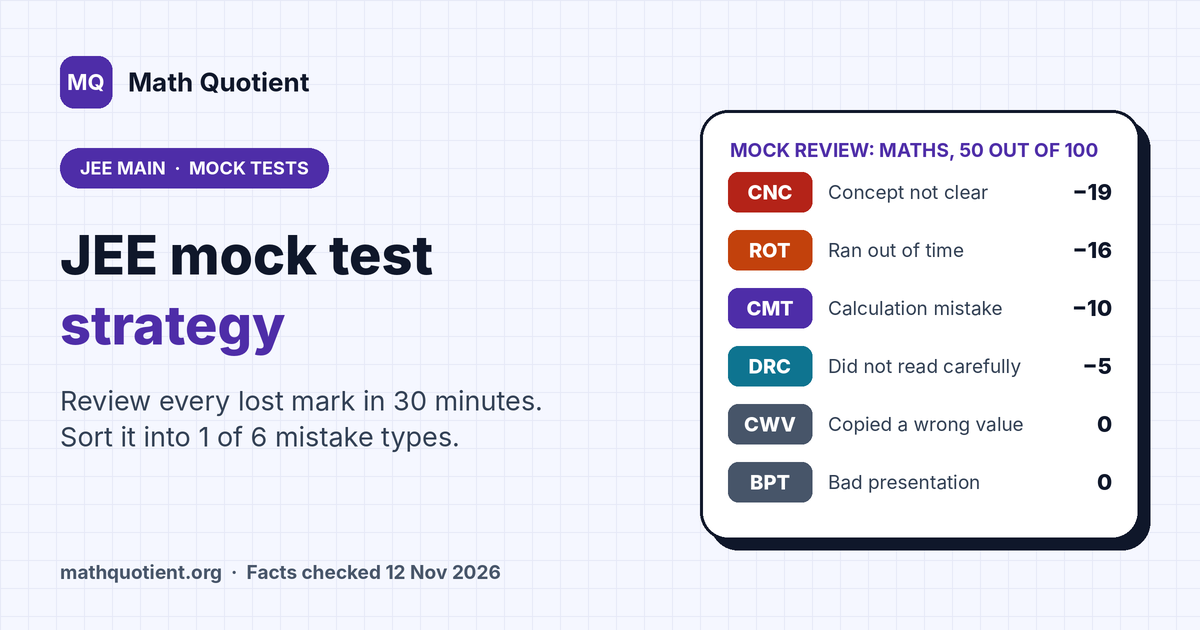
Running out of time (ROT) often comes from a concept that is not clear (CNC), not slow sums. A trick used too early adds calculation mistakes (CMT). The Free BMI Maths Test sorts each mistake into one of 6 types and finds your child’s real maths level.
A 10-minute timed drill: 20 sums
Set a timer for 10 minutes: 30 seconds a sum. Check the last digit and the size of each answer. For 93 × 98, 3 × 8 = 24, so the answer ends in 4. Both numbers are under 100, so it is under 10,000.
| Set | Sums |
|---|---|
| A. Near 100 | 1) 93 × 98 · 2) 106 × 103 · 3) 91 × 96 · 4) 108 × 97 |
| B. Difference of squares | 5) 59 × 61 · 6) 45 × 35 · 7) 84 × 76 · 8) 38 × 42 |
| C. Double and halve | 9) 14 × 45 · 10) 24 × 35 · 11) 4.5 × 14 · 12) 16 × 15 |
| D. Split and add | 13) 6 × 427 · 14) 9 × 238 · 15) 13 × 54 · 16) 34 × 21 |
| E. Cross method | 17) 32 × 41 · 18) 56 × 73 · 19) 27 × 64 · 20) 89 × 47 |
Show the 20 answers
A: 9,114 · 10,918 · 8,736 · 10,476
B: 3,599 · 1,575 · 6,384 · 1,596
C: 630 · 840 · 63 · 240
D: 2,562 · 2,142 · 702 · 714
E: 1,312 · 4,088 · 1,728 · 4,183
How to score it (our guide, not an official figure): 18 or more right means the methods are ready for timed papers. Fewer than 15 means slow down and do one set a day. The set with the most slips is your next practice.
For a stronger check, use the digit-sum test on the mental maths tricks page.
For UAE families: where these methods fit
JEE Main Paper 1 has 25 maths questions: 20 with options and 5 with a number answer. Right gets +4 and wrong gets −1. Every sum is by hand, so a fast, checked product protects marks.
On the SAT, Bluebook has Desmos built in, and you may bring an allowed calculator. Mental methods there are for quick checks and short sums. Our SAT calculator rules page has the details.
What to do now
- Students: learn one method a week, not all five at once.
- Students: do the drill twice a week, on paper, with a timer. JEE Main students: no calculator in any practice.
- Parents: time the drill with a phone and keep the scores. Same slips each week means the method is fast but not yet safe.
- Both: read JEE maths time management to plan where saved seconds go.
A JEE-style worked example: a determinant in 10 seconds
This is a practice question in the style of JEE Main. It is not a real past question.
Number answer: Find the value of the determinant with first row 97, 12 and second row 8, 103.
Set up: the determinant is 97 × 103 − 12 × 8.
Fast step: 97 and 103 sit 3 either side of 100. Difference of squares gives 10,000 − 9 = 9,991. Then 12 × 8 = 96.
Answer: 9,991 − 96 = 9,895. Type 9895.
Check: the last digits give 7 × 3 = 21 and 2 × 8 = 16. So the answer must end in the last digit of 11 − 6, which is 5. It does. The long way takes four rows of working.
Questions people ask about math tricks for multiplication
What are the best math tricks for fast multiplication?
The one that fits the numbers. Near 100: the distance method. Either side of a round middle: difference of squares. A 5 with an even number: double and halve. Any other two 2-digit numbers: the cross method.
Do multiplication tricks help on the SAT?
A little. Desmos is allowed on every maths question. Mental methods help with short products and with checking the size of a Desmos answer.
How do I multiply numbers near 100 fast?
Use the distances from 100. For 94 × 89: 94 − 11 = 83 and 6 × 11 = 66, so 8,366.
How long before a trick is ready for a test?
When it is faster than your normal way in practice, with no extra slips. For most students that takes a few weeks of short daily practice. This is our guide, not a fixed rule.
Is Vedic maths the same as these tricks?
Some books give these methods Vedic names. The maths behind them is ordinary algebra, such as (a − b)(a + b) = a² − b². We teach only that maths, as a speed tool for JEE Main and the SAT.
Keep exploring
Is it slow sums, or something else?
The Free BMI Maths Test finds your child’s real maths level and the reason for each mistake.
Sources
- NTA, JEE (Main) 2027 Information Bulletin: maths paper pattern and marking (section 2.4), items you may not carry, including calculators (section 8.13).
- College Board, SAT calculator policy: Desmos built into Bluebook, your own allowed calculator, and some questions better done without one.
Facts checked on 12 November 2026. The drill and scoring guide are our own. Every sum was checked in Python.
Written by Himanshu Jain
B.Tech, IIT Delhi. Founder of Math Quotient, Bur Dubai.