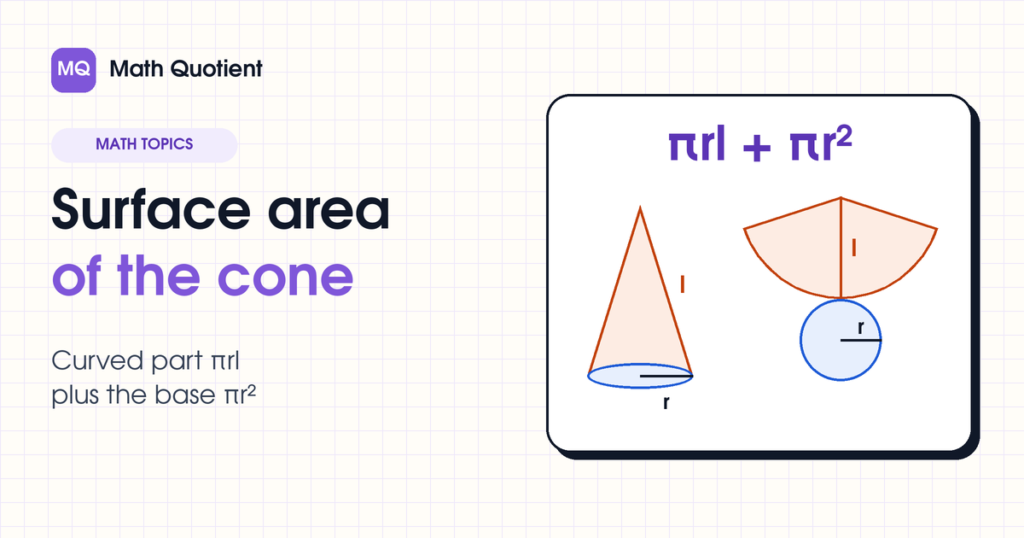
The surface area of the cone is πr² + πrl. The πr² part is the round base. The πrl part is the curved side. Here l is the slant height, the length down the sloping side.
Open a cone flat and you get a circle and a fan.
S = πr² + πrl
Hello, curious mind!
What is the surface area of a cone?
It is the total area of the outside: the round base plus the curved side.
| Part | Formula | What it covers |
|---|---|---|
| Base | πr² | The flat circle at the bottom |
| Curved surface | πrl | The sloping side only |
| Total surface | πr² + πrl = πr(r + l) | Base and side together |
Why the curved part is πrl
Cut the cone down one side and lay it flat. The side opens into a sector: a fan cut from a big circle of radius l. That big circle would have area πl².
The fan’s curved edge was the rim of the base, so it is 2πr long. The big circle’s edge is 2πl. So the fan is 2πr ÷ 2πl = r ÷ l of the big circle.
Fan area = (r ÷ l) × πl² = πrl
The fan angle is (r ÷ l) × 360°. A cone with r = 4 and l = 9 opens into a 160° fan.
Remember this
Area uses the slant height l. Volume uses the height h.
How to find the surface area of the cone: 3 worked examples
Example 1: r and l are given
A cone has a base radius of 4 cm and a slant height of 9 cm. Find its total surface area.
Curved part: π × 4 × 9 = 36π.
Base: π × 4² = 16π.
Total = 52π ≈ 163.4 cm².
Example 2: r and h are given (find l first)
A cone has a radius of 20 cm and a height of 21 cm, measured straight up the middle.
h, r and l make a right-angled triangle, with l the longest side. By Pythagoras’ theorem: l = √(20² + 21²) = √841 = 29 cm.
Curved part: π × 20 × 29 = 580π. Base: π × 20² = 400π.
Total = 980π ≈ 3,078.8 cm².
Example 3: total area is given (find r)
A closed cone has a total surface area of 33π cm² and a slant height of 8 cm. Find r.
πr² + 8πr = 33π. Divide by π: r² + 8r − 33 = 0.
Factorise: (r + 11)(r − 3) = 0. See quadratic equations.
A length cannot be negative, so r = 3 cm. Check: 9π + 24π = 33π.
Open cone or closed cone?
Ask one question: is there a flat circle to cover? If not, use the curved part only.
| Object | Base? | Use |
|---|---|---|
| Party hat, ice-cream cone, funnel | No | πrl |
| Solid cone, cone with a lid | Yes | πr² + πrl |
| Tent with a groundsheet | Yes (sheet) | πrl + πr² |
A party hat (made-up numbers)
A card hat has r = 8 cm and l = 20 cm. Card = π × 8 × 20 = 160π ≈ 502.7 cm². No base: a head goes there.
A desert camp tent (made-up numbers)
A cone tent has a radius of 2 m and a height of 2.1 m.
l = √(2² + 2.1²) = √8.41 = 2.9 m.
Canvas for the side: π × 2 × 2.9 = 5.8π ≈ 18.22 m².
Add a groundsheet of 4π: total 9.8π ≈ 30.79 m².
Common surface area of a cone mistakes
- Using h in place of l. In Example 2, π × 20 × 21 = 420π. The true curved area is 580π.
- Adding a base the object does not have. The party hat becomes 160π + 64π = 224π.
- Taking the width across as r. A cone 8 cm across with l = 9 cm has r = 4 cm. Using 8 gives 72π for the side, twice the true 36π.
- Squaring wrongly when finding l. Writing 20² as 40 gives √(40 + 441) ≈ 21.9, not 29.
- Leaving the unit as cm. A surface is an area, so the unit is squared.
Check this with the Free BMI Maths Test
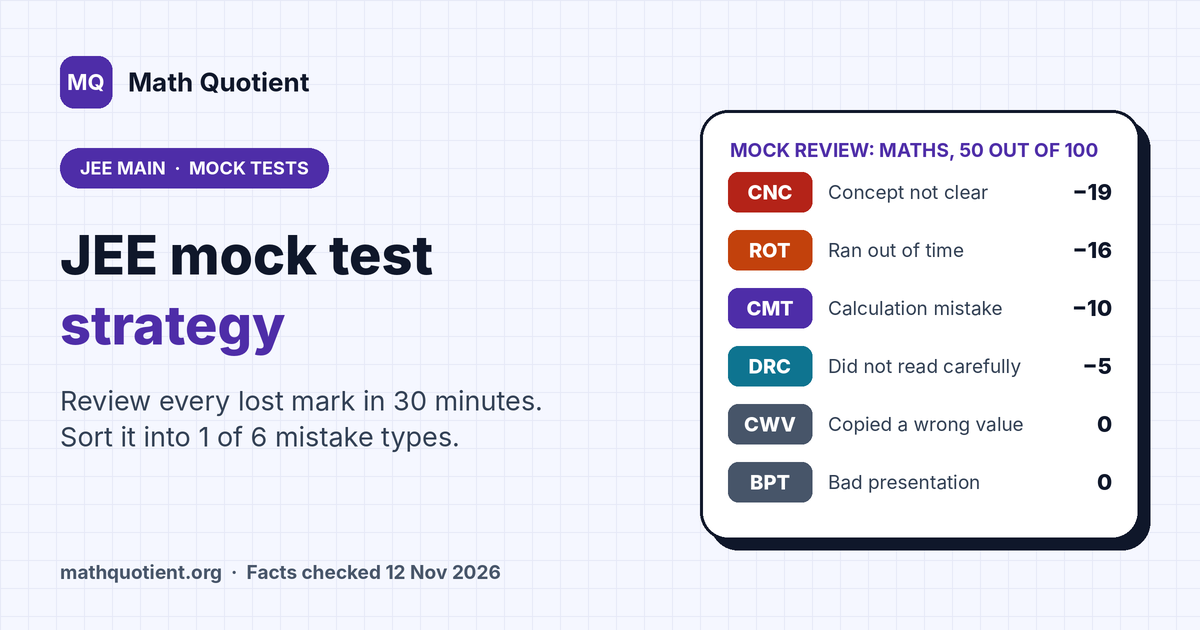
- Uses the height h in place of the slant height l: CNC, concept not clear.
- Adds the base for an open cone: DRC, did not read carefully.
- Puts the diameter where the radius goes: CWV, copied a wrong value.
- Squares wrongly in l = √(r² + h²): CMT, calculation mistake.
- Leaves the unit as cm: BPT, bad presentation.
The Free BMI Maths Test finds which of the 6 mistake types your child makes, and their real maths level. About the Free BMI Maths Test
Test prep corner
Cones on the SAT: what the sheet gives
College Board puts “Area and volume” in SAT Geometry and Trigonometry. Its digital SAT practice tests have a reference sheet with the cone volume, V = ⅓πr²h. The sheet has no surface area formula for any solid. So you must know πrl yourself. We wrote both questions in the SAT style; they are not past test items.
SAT-style: A right circular cone has a base radius of 12 and a height of 35. Its lateral (curved) surface area is kπ. Find k.
l = √(12² + 35²) = √1,369 = 37. Lateral area = π × 12 × 37 = 444π, so k = 444. Trap: 12 × 35 = 420 uses the height, not the slant.
SAT-style: A cone has a slant height of 26 and a lateral surface area of 260π. What is its volume? (A) 260π (B) 800π (C) 866⅔π (D) 2,400π
πr × 26 = 260π, so r = 10. Then h = √(26² − 10²) = 24. V = ⅓ × π × 100 × 24 = 800π, answer (B). Traps: (D) drops the ⅓; (C) uses l = 26 as the height.
Next, test yourself on the SAT-style maths practice questions page.
Facts checked on 12 November 2026 on satsuite.collegeboard.org.
Quick check: 5 cone surface area questions
1. r = 3 cm and l = 7 cm. What is the curved surface area?
Yes! π × 3 × 7 = 21π.
Not quite. 30π adds the base. The question asks for the curved part.
Not quite. There is no 2 in πrl.
2. A closed cone has r = 2 cm and l = 6 cm. What is its total surface area?
Not quite. Add the base, 4π.
Yes! 4π + 12π = 16π.
Not quite. πrl is 12π, not 24π.
3. A cone has r = 9 cm and h = 40 cm. What is the slant height?
Not quite. Square both, add, then take the root.
Not quite. Do not subtract: l is the longest side.
Yes! 81 + 1,600 = 1,681 = 41².
4. Which formula gives the card needed for an ice-cream cone (no lid)?
Not quite. There is no base to cover.
Yes! Open cone: curved part only.
Not quite. That is the volume.
5. A cone has r = 5 cm and l = 15 cm. What angle is the fan when you open it flat?
Yes! (5 ÷ 15) × 360° = 120°.
Not quite. r ÷ l is one third, and a third of 360° is 120°.
Not quite. That would need r ÷ l = ½.
Got 2 or fewer right? Book the Free BMI Maths Test to find the cause.
Questions people ask about the surface area of a cone
What is the formula for the surface area of the cone?
Total = πr² + πrl, with r the base radius and l the slant height. The curved part alone is πrl.
How do I find the slant height?
Use l = √(r² + h²). For r = 20 cm and h = 21 cm, l = √841 = 29 cm.
What is the difference between curved and total surface area?
Curved area is the sloping side only, πrl. Total area adds the base circle, πr².
How do I find the area of an open cone?
Use πrl only, as there is no base. A party hat with r = 8 cm and l = 20 cm needs 160π ≈ 502.7 cm² of card.
Is the cone formula on the SAT sheet?
Only the volume, V = ⅓πr²h. College Board’s practice test sheet gives no surface area formula.
Keep exploring
Height or slant height: which one does your child use?
Book the Free BMI Maths Test. It shows your child’s real maths level and why each mistake happens.
Written by Himanshu Jain
B.Tech, IIT Delhi. Founder of Math Quotient.