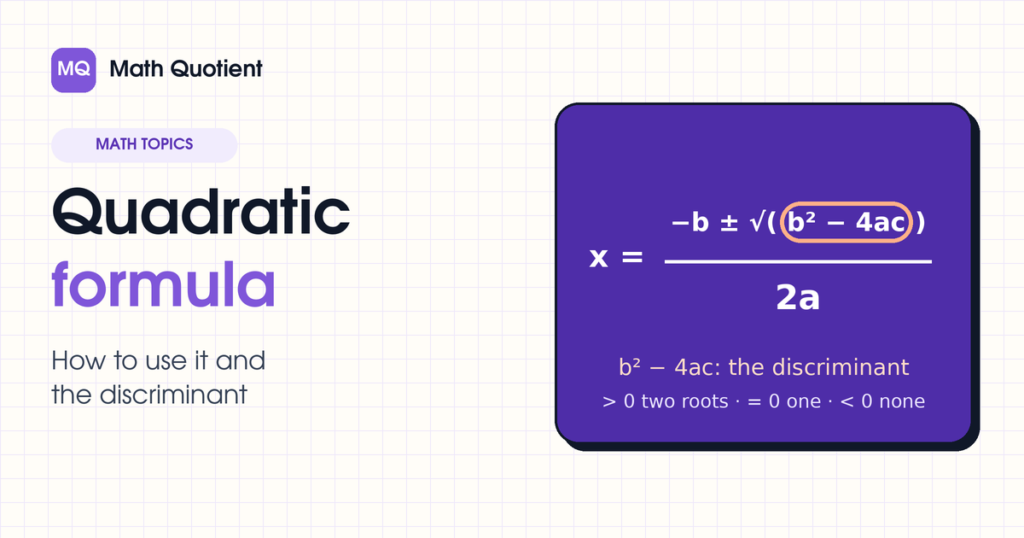
The quadratic formula solves any equation of the form ax² + bx + c = 0. It says x = (−b ± √(b² − 4ac)) ÷ 2a. Here is how to use it without sign mistakes.
Work out the part under the root first.
x =−b ± √(b² − 4ac)2a
Hello, curious mind!
What is the quadratic formula?
The quadratic formula is a rule that gives the roots of ax² + bx + c = 0, where a is not 0: x = (−b ± √(b² − 4ac)) ÷ 2a.
The sign ± means you work it out twice: once with +, once with −. For all the ways to solve, see quadratic equations.
Write a, b and c first
Most sign mistakes happen here. Get 0 on one side, then write a, b and c with their signs.
| Equation as given | Standard form, then a, b, c |
|---|---|
| 3x² = 5x + 2 | 3x² − 5x − 2 = 0 a = 3, b = −5, c = −2 |
| x² − 11 = 4x | x² − 4x − 11 = 0 a = 1, b = −4, c = −11 |
| 7 − 2x² = 3x | 2x² + 3x − 7 = 0 a = 2, b = 3, c = −7 |
| x(x + 6) = 1 | x² + 6x − 1 = 0 a = 1, b = 6, c = −1 |
Remember this
A sign belongs to the number after it. In 3x² − 5x, b is −5.
How to use the quadratic formula: 3 worked examples
Example 1: two roots, x² − 4x − 11 = 0
a = 1, b = −4, c = −11. So −b = +4.
b² − 4ac = (−4)² − 4 × 1 × (−11) = 16 + 44 = 60.
x = (4 ± √60) ÷ 2. As √60 = 2√15, this is x = 2 + √15 or x = 2 − √15.
As decimals: x ≈ 5.87 or x ≈ −1.87. It does not factorise.
Example 2: one root, 4x² + 20x + 25 = 0
b² − 4ac = 400 − 4 × 4 × 25 = 400 − 400 = 0.
√0 = 0, so + and − give the same answer: x = −20 ÷ 8 = −5/2.
The curve just touches the x-axis.
Example 3: no real roots, 2x² − 3x + 4 = 0
b² − 4ac = 9 − 32 = −23.
No real number squared is negative, so there are no real roots. Stop here.
What the discriminant tells you
Work out b² − 4ac first, and you know what to expect.
| b² − 4ac | What you get | Example |
|---|---|---|
| A square number, such as 49 | Two roots, no square roots. It factorises. | 3x² − 5x − 2: roots 2 and −1/3 |
| More than 0, not square | Two roots with a square root | Example 1: 2 ± √15 |
| Exactly 0 | One root | Example 2: −5/2 |
| Less than 0 | No real roots | Example 3 |
Check your roots fast: sum and product
For ax² + bx + c = 0, the roots add up to −b/a and multiply to c/a. This check takes seconds.
- 3x² − 5x − 2 = 0 has roots 2 and −1/3. Sum: 2 − 1/3 = 5/3, which is −(−5)/3. Product: −2/3, which is c/a.
- Example 1: (2 + √15) + (2 − √15) = 4, which is −b/a. The product is 4 − 15 = −11, which is c/a.
Check with Desmos on the digital SAT
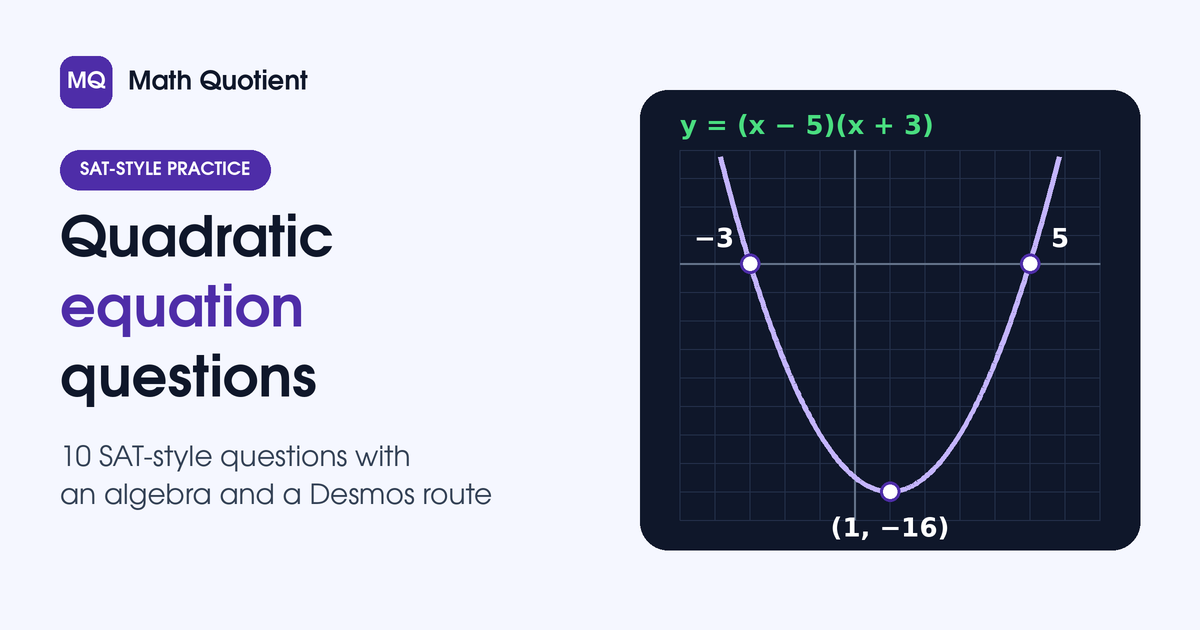
College Board says a built-in graphing calculator is available for the entire maths section. Type y = x² − 4x − 11 and tap where it crosses the x-axis: about −1.873 and 5.873. Our Desmos guide for the digital SAT shows more moves.
When to factorise instead
If a = 1 and you see the numbers fast, factorise. In x² + 9x + 20 = 0, 4 and 5 multiply to 20 and add to 9, so x = −4 or x = −5.
Common quadratic formula mistakes
- Reading c before every term is on one side. In 2x² + 3x = 9, c is not 9. Write 2x² + 3x − 9 = 0, so c = −9, and x = 1.5 or x = −3.
- Losing the minus in −b. In x² − 6x − 16 = 0, b = −6, so −b = +6. x = (6 ± 10) ÷ 2 = 8 or −2. Starting with −6 gives 2 and −8.
- Dividing only the square root by 2a. 6 ± 10 ÷ 2 gives 11 and 1. Divide the whole top.
- Copying b from the wrong term. In 5x − x² + 6 = 0, the x² term comes second. So a = −1, b = 5 and c = 6, not a = 5.
Check this with the Free BMI Maths Test
- Reads c before moving every term to one side: DRC, did not read carefully.
- Loses the minus in −b when b is negative: CMT, calculation mistake.
- Divides only the square root by 2a: CNC, concept not clear.
- Copies b from the wrong term: CWV, copied a wrong value.
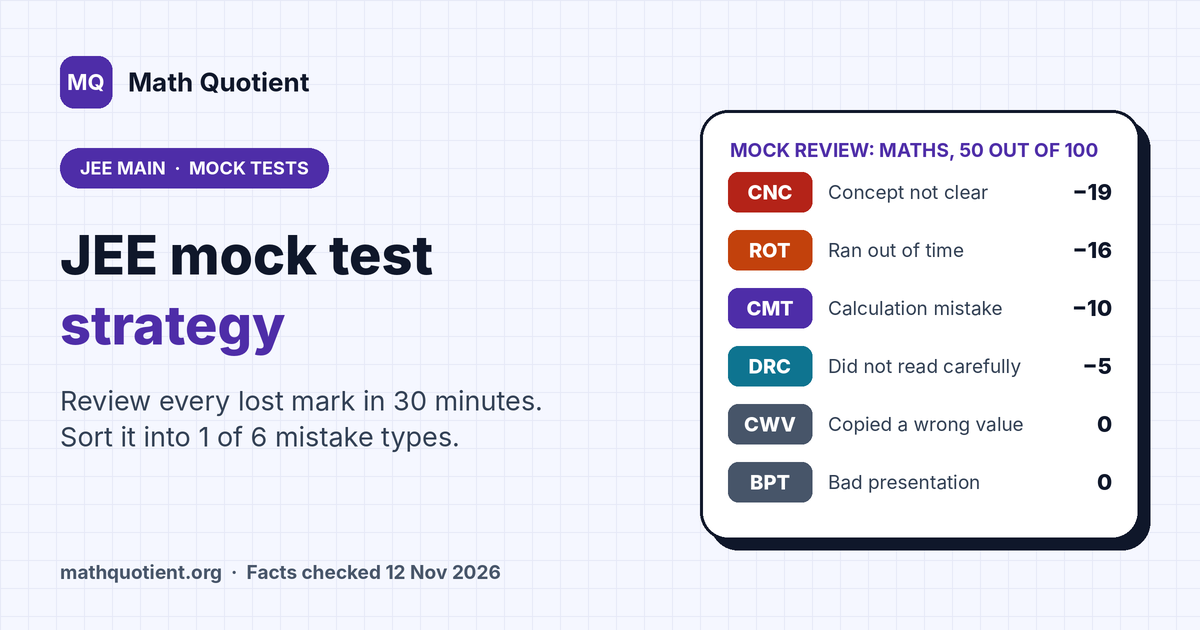
The Free BMI Maths Test finds which of the 6 mistake types your child makes, and their real maths level. About the Free BMI Maths Test
Test prep corner
The quadratic formula in SAT and JEE Main maths
On the digital SAT, each maths question has a reference sheet of common formulas. The quadratic formula is not on it, so learn it by heart. These are SAT-style and JEE-style practice questions, not real past questions.
SAT-style: What are the solutions of x² − 2x − 6 = 0?
a = 1, b = −2, c = −6. b² − 4ac = 4 + 24 = 28, and √28 = 2√7. x = (2 ± 2√7) ÷ 2 = 1 ± √7.
JEE-style: For which values of k does x² + kx + 9 = 0 have real roots?
Real roots need b² − 4ac ≥ 0. So k² − 36 ≥ 0, which means k² ≥ 36. So k ≤ −6 or k ≥ 6. Trap: forgetting k ≤ −6.
Practise more with our SAT-style maths practice questions. Read the Digital SAT maths guide or the JEE Main maths guide.
Facts checked on 9 November 2026 on satsuite.collegeboard.org.
Quick check: 5 quadratic formula questions
1. In 3x² − 7 = 2x, what are a, b and c?
Not quite. Move 2x across first: it becomes −2x.
Yes! 3x² − 2x − 7 = 0.
Not quite. b is the number with x, not the number alone.
2. What is the discriminant of x² + 5x + 7 = 0?
Yes! 25 − 28 = −3, so there are no real roots.
Not quite. It is minus 4ac: 25 − 28.
Not quite. b² is 25, not 10.
3. Solve x² + 4x − 1 = 0.
Not quite. b = 4, so −b = −4.
Not quite. b² − 4ac = 16 + 4 = 20, not 12.
Yes! (−4 ± √20) ÷ 2 = −2 ± √5.
4. How many real roots does 9x² − 12x + 4 = 0 have?
Not quite. Work out 144 − 4 × 9 × 4.
Yes! 144 − 144 = 0. The root is 2/3.
Not quite. The discriminant is 0, not negative.
5. Without solving, what is the sum of the roots of 2x² − 7x + 1 = 0?
Not quite. The sum is −b/a, and b is −7.
Not quite. 1/2 is c/a, the product.
Yes! −b/a = 7/2.
Got 2 or fewer right? Book the Free BMI Maths Test to find the cause.
Questions people ask about the quadratic formula
What is the quadratic formula?
It is x = (−b ± √(b² − 4ac)) ÷ 2a. It gives the roots of any equation ax² + bx + c = 0 where a is not 0.
What does the discriminant tell you?
b² − 4ac tells you how many real roots there are: two if it is more than 0, one if it is 0, none if it is less than 0.
When should I factorise instead?
Factorise when you see the numbers quickly, as in x² − 7x + 12 = (x − 3)(x − 4). If b² − 4ac is not a square number, use the formula.
Is the quadratic formula on the SAT formula sheet?
No. The digital SAT reference sheet lists area, volume, triangle and circle facts. It does not list the quadratic formula, so learn it by heart.
Can the formula give one answer?
Yes. When b² − 4ac = 0, both answers are the same. For example, x² + 8x + 16 = 0 has one root, x = −4.
Keep exploring
Do sign slips cost your child marks?
The Free BMI Maths Test finds your child’s real maths level and the reason for each mistake.
Written by Himanshu Jain
B.Tech, IIT Delhi. Founder of Math Quotient.