The Pythagoras theorem says that in a right-angled triangle, a² + b² = c². Here c is the longest side, opposite the right angle. If you know two sides, you can find the third side.
Two small squares fill one big square.
3² + 4² = 5² → 9 + 16 = 25
Hello, curious mind!
What is Pythagoras’ theorem?
Pythagoras’ theorem says that in any right-angled triangle, the square of the longest side equals the sum of the squares of the other two sides: a² + b² = c².
It works only when one angle is exactly 90°. It is named after Pythagoras, a Greek thinker, but people in Babylon used it earlier.
Hypotenuse
The longest side. It is opposite the right angle.
A short side
A side that makes the right angle.
The other short side
a and b can swap.
Right angle
The square corner. Find it first.
Why it is true: a picture proof
Put four copies of the triangle in the corners of a square with side a + b. The gap left is a tilted square, c². Move the triangles into two rectangles. Now the gap is two squares, a² and b². Same gap, so a² + b² = c².
Remember this
Find the right angle. The side opposite it is c. c is always the longest side.
How to use Pythagoras’ theorem: three worked examples
Each of the three jobs starts the same way: label c first.
The rule
a² + b² = c²
Example 1: find the longest side
The two short sides are 9 cm and 12 cm. Find c.
Square the short sides: 81 and 144.
Add: 81 + 144 = 225. So c² = 225.
Take the square root: c = 15 cm. It is longer than 12. Good.
Example 2: find a shorter side
The longest side is 25 m. One short side is 7 m. Find the other one.
Write the rule: 7² + b² = 25².
Subtract: b² = 625 − 49 = 576.
Take the square root: b = 24 m. It is shorter than 25. Good.
Example 3: is there a right angle?
This is the converse. Compare the square of the longest side with the sum of the other two squares.
Sides 8, 15 and 17: 8² + 15² = 64 + 225 = 289, and 17² = 289. They are equal, so the triangle has a right angle.
Sides 6, 9 and 11: 6² + 9² = 36 + 81 = 117, but 11² = 121. They are not equal, so there is no right angle. As 121 is bigger, the largest angle is over 90°.
Short sides 4 and 7 give c = √65, about 8.06. Sides can be fractions: short sides 3/4 and 1 give c² = 9/16 + 16/16 = 25/16, so c = 5/4.
Pythagoras’ theorem in real life: two Dubai examples
The numbers below are made up for practice.
A ladder on a villa wall
5² − 1.4² = 23.04
A 5 m ladder leans on a wall, its foot 1.4 m out. The ladder is c, so subtract: 25 − 1.96 = 23.04. The top is 4.8 m up.
Across a football pitch
105² + 68² = 15,649
A pitch is 105 m by 68 m. The corner-to-corner run is c, so add: 11,025 + 4,624 = 15,649. The diagonal is about 125.1 m.
Builders check a square corner with 3 m, 4 m and 5 m marks.
Common Pythagoras theorem mistakes
- Using the wrong side as c. For sides 10, 24 and 26, c is 26, the side opposite the right angle.
- Adding when you must subtract. For a short side, 26² + 10² gives about 27.9, longer than c. Subtract: 676 − 100 = 576, so the side is 24.
- Stopping at c². In Example 1, 225 is c², not c. The side is √225 = 15.
- Copying the sides from the wrong labels. In triangle PQR with the right angle at Q, PR is c. Mark the right angle first.
- Squaring wrongly. 7² is 7 × 7 = 49, not 7 × 2 = 14.
Check this with the Free BMI Maths Test
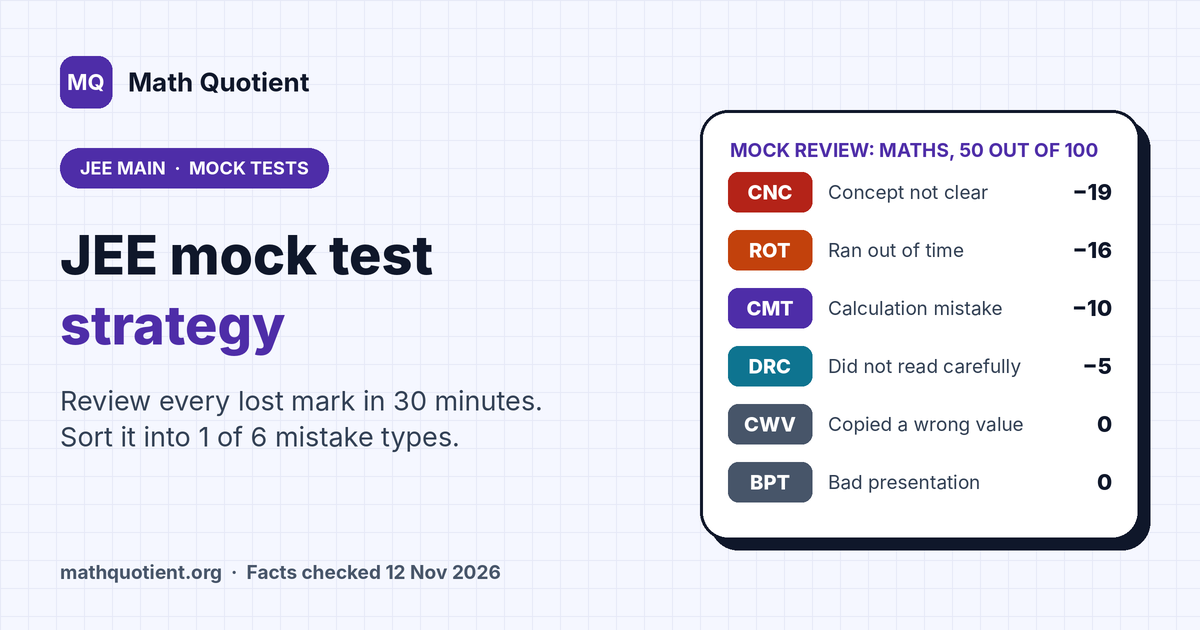
- Uses a side that is not opposite the right angle as c: CNC, concept not clear.
- Adds the squares when finding a shorter side: CNC, concept not clear.
- Forgets the square root at the end: BPT, bad presentation.
- Reads the side lengths from the wrong labels: CWV, copied a wrong value.
- Writes 7² = 14: CMT, calculation mistake.
The Free BMI Maths Test finds which of the 6 mistake types your child makes, and their real maths level. About the Free BMI Maths Test
Quick check: 5 Pythagoras questions
1. The short sides are 5 and 12. How long is the longest side?
Not quite. 5 + 12 = 17 adds the sides, not their squares.
Yes! 25 + 144 = 169, and √169 = 13.
Not quite. 169 is c². Take the square root.
2. Which side is the hypotenuse?
Yes! It is also always the longest side.
Not quite. Look for the right angle.
Not quite. Those two are the short sides, a and b.
3. The longest side is 10. One short side is 6. Find the other side.
Not quite. That adds 100 + 36. For a short side, subtract.
Not quite. 10 − 6 subtracts the sides, not the squares.
Yes! 100 − 36 = 64, and √64 = 8.
4. Does a triangle with sides 7, 24 and 25 have a right angle?
Yes! 49 + 576 = 625 = 25².
Not quite. Work out 7² + 24² and compare it with 25².
Not quite. The lengths are enough.
5. Does a triangle with sides 2, 3 and 4 have a right angle?
Not quite. Check the squares.
Yes! 4 + 9 = 13, but 4² = 16.
Not quite. Compare the squares.
Got 2 or fewer right? Book the Free BMI Maths Test to find the cause.
Test prep corner
Pythagoras’ theorem in SAT and JEE Main maths
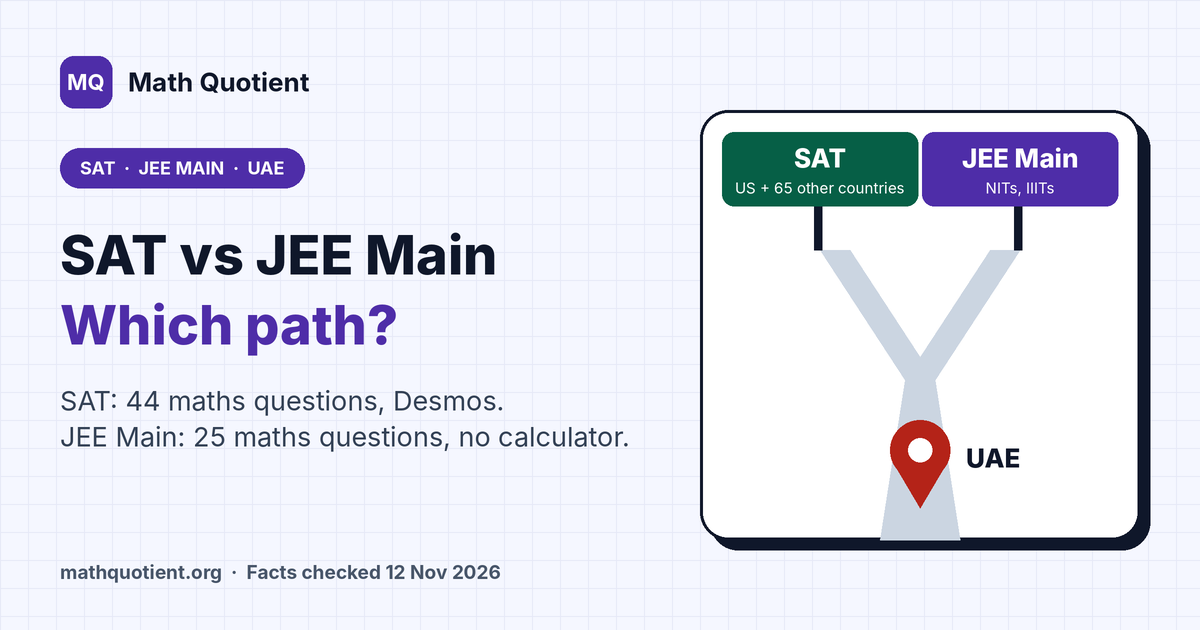
College Board names the Pythagorean theorem in the Geometry and Trigonometry area of SAT maths. In JEE Main, it gives the distance between two points in 2D and 3D. These are SAT-style and JEE-style practice questions, not real past questions.
SAT-style: In triangle ABC, angle C is 90°. AB = 20 and BC = 16. What is AC?
AB is opposite the right angle, so AB is c. AC² = 400 − 256 = 144, so AC = 12. Fast way: 12, 16, 20 is 3, 4, 5 times 4.
JEE-style: Find the distance between the points (1, 2, 3) and (4, 6, 15).
The gaps are 3, 4 and 12. Use the theorem twice: d² = 3² + 4² + 12² = 9 + 16 + 144 = 169. So d = 13.
Try more questions in our SAT maths practice questions, or read the digital SAT maths guide.
Facts checked on 9 November 2026 on satsuite.collegeboard.org.
Questions people ask about Pythagoras’ theorem
What is Pythagoras’ theorem?
In a right-angled triangle, a² + b² = c². Here c is the side opposite the right angle, and a and b are the two shorter sides.
Does it work for every triangle?
No. It works only when one angle is exactly 90°. Sides 6, 9 and 11 fail: 36 + 81 = 117, not 121.
How do I find a shorter side?
Subtract the square of the known short side from c², then take the square root. For 25 and 7: 625 − 49 = 576, so the side is 24.
How do I know if a triangle has a right angle?
Square all three sides. If the two smaller squares add up to the largest, there is a right angle.
Is the theorem on the SAT formula sheet?
Yes. The reference box in College Board’s official digital SAT practice tests gives c² = a² + b² and the 30-60-90 and 45-45-90 triangles.
Keep exploring
Mixing up c, or adding when you should subtract?
The Free BMI Maths Test finds your child’s real maths level and the reason for each mistake.
Written by Himanshu Jain
B.Tech, IIT Delhi. Founder of Math Quotient.