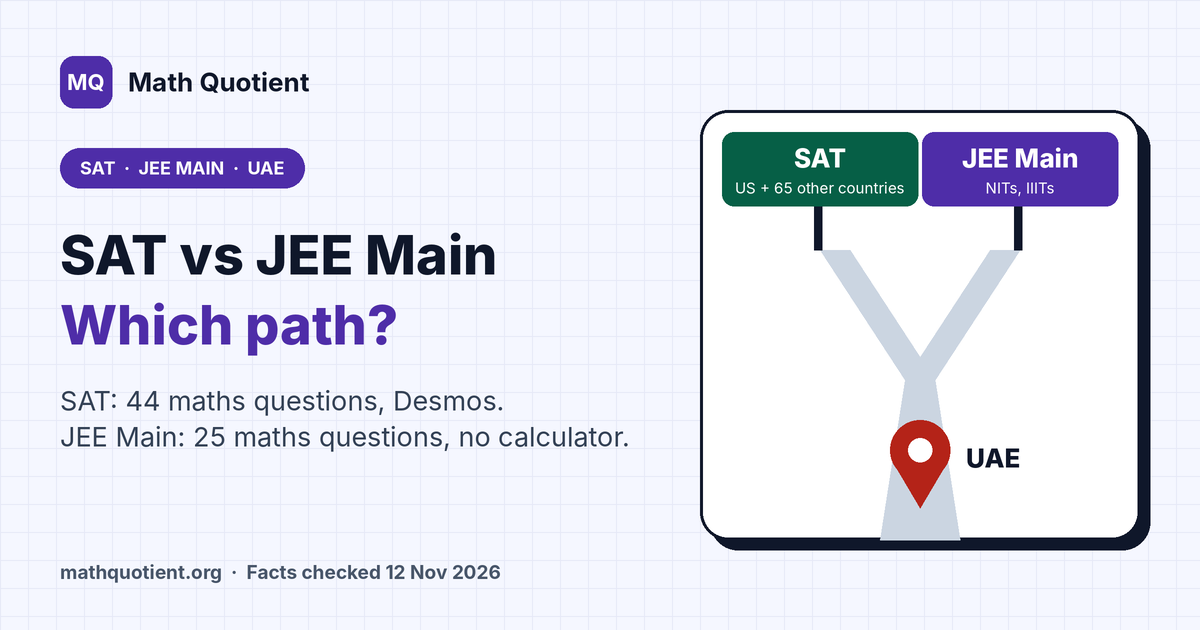
In JEE Main maths, a right answer gives +4 marks, a wrong answer gives −1 and a question you leave gives 0. This is true in both parts of the maths section, including the 5 questions where you type a number. This page shows how the marks add up, when an answer is worth the risk, and how your marks turn into the score NTA uses.
25 maths questions · 100 marks · −1 for each wrong answer
+4 · −1 · 0
JEE Main maths marking scheme in one table
Quick answer
Maths has 25 questions worth 100 marks: 20 with four options and 5 with a number answer.
Each right answer adds 4 marks. Each wrong answer takes away 1 mark, in both sections.
A blank question, or one you only mark for review, scores 0.
| Part | Questions | Right | Wrong | Blank | Most marks |
|---|---|---|---|---|---|
| Section A: four options, one right | 20 | +4 | −1 | 0 | 80 |
| Section B: type a whole number | 5 | +4 | −1 | 0 | 20 |
| Maths total | 25 | All 25 count. There is no choice of questions. | 100 | ||
Physics and chemistry follow the same pattern: 75 questions and 300 marks in 3 hours. The bulletin gives “marked for review” 0 marks, so do not use that button to save an answer.
Section B: how to enter a number answer
In Section B there are no options. You type the answer with the mouse on a number pad on the screen. The bulletin sets two rules.
The answer is a whole number. NTA asks for the correct integer value.
Round to the nearest whole number. If your working gives 12.6, you enter 13. If it gives 12.3, you enter 12.
A wrong number costs 1 mark, the same as a wrong option. Older web pages say Section B has no negative marks. That is out of date. The 2027 bulletin says there is negative marking for a wrong answer in Section A and in Section B.
Where number answers lose marks
- The question asks for a different thing. You find x, but the question wants x². Read the last line again before you type.
- A slip between paper and screen. Your rough sheet says 64 and you type 46. Look at the box once more.
- No time left. Section B often comes last, so it is the part students rush.
Dropped questions and questions with two right options
NTA marks every answer with its final answer key. Three special cases change the marks.
A question is dropped
Every candidate in that shift gets the full 4 marks, whether they answered it or not.
Two or more options are right
Only the students who chose one of the right options get +4. A student who chose a wrong option still loses 1.
All four options are right
Every student who answered the question gets +4. A student who left it blank gets 0.
So a blank answer gains only when a question is dropped. In every other case, an answer you are fairly sure of is worth more than a blank.
Should you answer a question you are not sure of?
Use the average marks an answer gives you over many questions. A right answer is +4 and a wrong one is −1, so the gap between them is 5 marks.
| How many options are still possible? | Chance of a right answer | Average marks |
|---|---|---|
| 4 (a pure guess) | 1 in 4 | +0.25 |
| 3 (you ruled out one) | 1 in 3 | about +0.67 |
| 2 (you ruled out two) | 1 in 2 | +1.5 |
| Break-even point | 1 in 5 | 0 |
The rule: an answer pays on average when your chance of being right is better than 1 in 5. In Section A, even a pure guess passes that line. In Section B, a guess at a number is almost never better than 1 in 5, so leave it blank unless you have done the working.
The average is not the whole story
An average holds over many questions. One paper has only a few guesses. Here is what happens to 5 Section A answers.
| Result for the 5 answers | 5 pure guesses | 5 answers with 2 options left |
|---|---|---|
| Lose 5 marks (none right) | about 24% | about 3% |
| No change (one right) | about 40% | about 16% |
| Gain marks (two or more right) | about 37% | about 81% |
So: rule out two options first, and then answer. A pure guess is a small gain on average, but one paper in four loses 5 marks on it. Spend the time on a question you can solve instead.
Free BMI Maths Test
Losing marks to wrong answers? Find the reason.
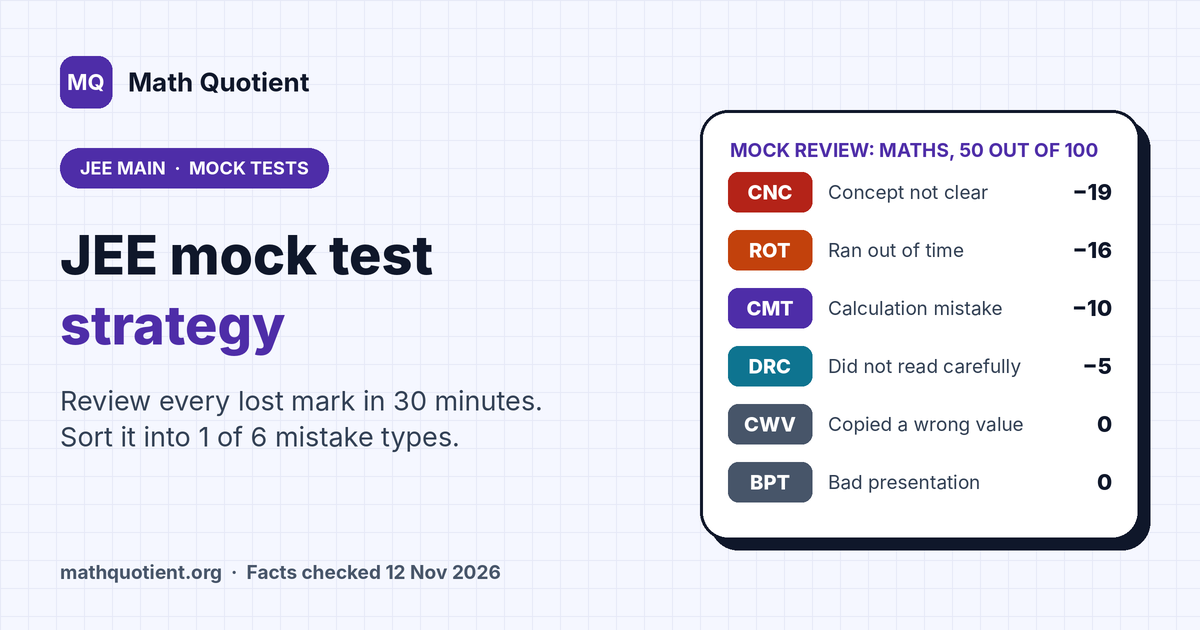
The Free BMI Maths Test sorts every mistake into one of 6 types, such as DRC (did not read carefully), CWV (copied a wrong value) and ROT (ran out of time). It also finds your child’s real maths level.
Three JEE Main maths score sums
These three students are made up for the sums. Each sum is marks = 4 × right − 1 × wrong.
| Student | Right | Wrong | Blank | Marks |
|---|---|---|---|---|
| Aisha: answers almost everything | 15 | 10 | 0 | 60 − 10 = 50 |
| Rohan: answers only what he has solved | 14 | 1 | 10 | 56 − 1 = 55 |
| Meera: careful, and faster | 18 | 4 | 3 | 72 − 4 = 68 |
Rohan gets one question fewer right than Aisha, but he scores 5 marks more. Her 10 wrong answers cost her 10 marks. Meera shows the bigger point. Each wrong answer that becomes a right one is worth 5 marks, because you move from −1 to +4. Fixing the reason behind wrong answers adds far more than a guessing plan.
From raw marks to the NTA score
Your marks from the answer key are raw marks. JEE Main runs in many shifts, and one shift can be harder than another. So NTA does not rank students on raw marks.
Raw marks. NTA marks each answer with the final answer key and the rules above.
NTA score. NTA turns the raw marks into a percentile score, worked out among the students in the same shift. You get an NTA score for maths, physics, chemistry and the total.
Rank. If you take both sessions, NTA uses the better of your two total NTA scores. The rank list comes after Session 2.
Maths breaks ties
When two students have the same total NTA score, NTA looks at the maths NTA score first, then physics, then chemistry.
Our page on percentile and rank (coming soon) explains what the NTA score means for a rank.
A maths pace plan on the UAE clock
The test runs from 7:30 to 10:30 am UAE time in the morning shift, and from 1:30 to 4:30 pm in the afternoon shift. The bulletin gives these times in India time (9:00 am and 3:00 pm). Always follow the time on your own admit card.
NTA does not fix the time for each subject. Here is one plan for a student who starts with maths and gives it one hour. It is a suggestion, not a rule. Use any time left for skipped questions.
| Time | What to do | Time for each question |
|---|---|---|
| 7:30 to 8:15 am | Section A, 20 questions. Skip any question that stalls you. | about 2 min 15 s |
| 8:15 to 8:30 am | Section B, 5 number answers. Check each typed number. | 3 min |
For UAE families: what to do now
Session 1 runs on 20, 21, 22, 23, 24 and 28 January 2027. Use the marking rules to plan the weeks before it.
- Mark every practice paper with +4, −1 and 0, never as a simple count of right answers.
- After each paper, write down the number of wrong answers in maths. Aim to bring it down each week.
- For each wrong answer, note why it happened: an idea not clear, a misread line, a copied number or no time.
- Practise Section B on a screen, with the mouse.
- Do some full papers at 7:30 am UAE time, the start of the morning shift.
For the dates, the paper format and the maths topics, read our JEE Main maths guide. If you have not applied yet, our JEE Main registration guide for the UAE has the form steps. To see how the scoring compares with the second test, read JEE Main vs JEE Advanced maths.
A JEE-style number answer, marked
This is a practice question in the style of JEE Main. It is not a real past question.
Number answer: How many integers x satisfy x² − 5x − 14 ≤ 0?
Factorise: x² − 5x − 14 = (x − 7)(x + 2). The product is 0 or less when x is between −2 and 7, both ends included. The integers are −2, −1, 0, 1, 2, 3, 4, 5, 6 and 7. That is 10. Type 10 for +4 marks. A common slip is to leave out the two end values and type 8. That costs 1 mark, so the slip is worth 5 marks in total.
Questions people ask about the JEE Main marking scheme
Is there negative marking in Section B of JEE Main?
Yes. The JEE Main 2027 bulletin says a wrong answer loses 1 mark in Section A and in Section B. A right number answer gives 4 marks.
How many marks is JEE Main maths out of?
100 marks. There are 25 maths questions, 20 in Section A and 5 in Section B, at 4 marks each. The full Paper 1 is out of 300.
Should I guess in JEE Main?
An answer pays on average when your chance of being right is better than 1 in 5. With two options ruled out, an answer gives +1.5 marks on average. A guessed number in Section B is almost never worth it.
What happens if a question is dropped?
Every candidate in that shift gets the full 4 marks for it, even those who left it blank.
Do blank answers lose marks?
No. A question you leave blank, or only mark for review, gives 0 marks.
Keep exploring
Where do your maths marks go?
The Free BMI Maths Test finds your real maths level and the reason for each mistake, so you know which wrong answers you can turn into +4.
Sources
- NTA, JEE (Main) 2027 Information Bulletin: question counts, marking, number answers, dropped questions, NTA score, tie rules, test times.
- NTA, jeemain.nta.nic.in: public notices.
Facts checked on 9 November 2026 on jeemain.nta.nic.in. UAE times are the official India times minus 1 hour 30 minutes. The guessing and score tables are our own sums, checked in Python. NTA can change its rules, so check its public notices before the test.
Written by Himanshu Jain
B.Tech, IIT Delhi. Founder of Math Quotient, Bur Dubai.