Mental maths tricks save time on both tests, but not the same tricks. On the SAT, Desmos is built in, so the best tricks are estimates and quick checks. In JEE Main, no calculator is allowed, so fast squares, fractions and hand checks matter more. This page shows five tricks, which test each one helps, and when a trick costs you marks instead of saving time.
A trick is a tool. It is not the goal.
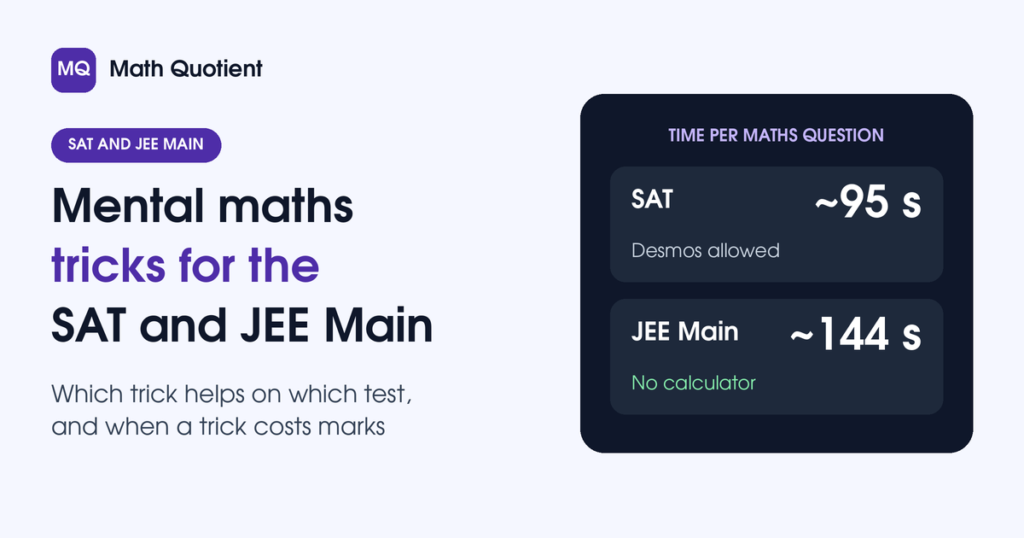
95 s vs 144 s
Quick answer: why the two tests need different tricks
The short version
SAT: you may use a calculator on every maths question. Bluebook, the SAT test app, has Desmos built in. So you do not need fast long multiplication. You need to estimate the answer first, so you catch a typing slip in Desmos and skip it when the sum is easy.
JEE Main: NTA lists calculators and log tables as barred items. Every sum is by hand. A wrong answer costs 1 mark in both sections. So fast squares, clean fraction work and a quick check before you click are worth real marks.
Which mental maths trick helps on which test
Use this table to decide where to spend your practice time. “What it saves” tells you the work the trick replaces.
| Trick | SAT use | JEE Main use | What it saves |
|---|---|---|---|
| 1. Estimate first | High: rule out options and catch Desmos typing slips | High: rule out options before you risk a minus mark | Often the whole sum |
| 2. Percent by 10% and 1% | High: percent and rate questions | Low: few percent questions | Typing a simple percent into Desmos |
| 3. Squares near 50 and 100 | Low: Desmos does it | High: discriminants, distances, right triangles | A long multiplication with 4 part products |
| 4. Fraction to decimal | Medium: compare options in different forms | High: round Section B answers to the right whole number | A long division |
| 5. Quick answer checks | Medium: check the Desmos result makes sense | High: no calculator to check with | Marks lost to slips |
We do not give seconds saved for each trick. That depends on the student. Time yourself instead: do 10 sums the long way, then 10 with the trick, and compare.
The five tricks, with a short sum for each
1
Estimate first
Round each number to one easy figure before you work. 398 × 21 is close to 400 × 20 = 8,000. The exact answer is 8,358. If an option is 835 or 83,580, you know it is wrong without a full sum.
SAT: estimate, then type into Desmos. If Desmos shows 835.8, you typed a decimal point wrong. JEE Main: an estimate often removes two of the four options.
2
Percent by 10% and 1%
Build any percent from 10%, 5% and 1%. For 17% of 360: 10% is 36, 5% is 18 and 2% is 7.2. Add them: 36 + 18 + 7.2 = 61.2.
SAT: percent change, discounts and rates are common in context questions. JEE Main: you meet percents less often, but the same split helps with probabilities written as decimals.
3
Squares near 50 and 100
Near 50: (50 + k)² = 2,500 + 100k + k². So 53² = 2,500 + 300 + 9 = 2,809, and 47² = 2,500 − 300 + 9 = 2,209. Near 100: (100 − k)² = 10,000 − 200k + k². So 96² = 10,000 − 800 + 16 = 9,216.
Three more short ones: × 25 is × 100 then ÷ 4 (36 × 25 = 900). × 99 is × 100 minus the number (47 × 99 = 4,700 − 47 = 4,653). × 11 for two digits: put the sum of the digits in the middle (52 × 11 = 572).
4
Fraction to decimal
Know the eighths by heart: 1/8 = 0.125, 3/8 = 0.375, 5/8 = 0.625. Also 1/6 ≈ 0.167, 1/7 ≈ 0.143 and 1/12 ≈ 0.083.
JEE Main: NTA asks you to round Section B answers to the nearest whole number. If your working gives 37/8, that is 4.625, so you type 5, not 4. SAT: this helps when one option is a fraction and another is a decimal.
5
Quick answer checks
Before you click, ask three questions. Is the size right? Is the sign right? Is the last digit right? Then use the digit sum for products. 238 × 46 = 10,948. The digit sums give 4 × 1 = 4, and 1 + 0 + 9 + 4 + 8 = 22, which gives 4 again. A wrong answer of 10,848 gives 3, so you catch it.
The digit sum does not catch swapped digits: 10,984 also gives 4. Use it with the size check, not alone.
Always short of time?
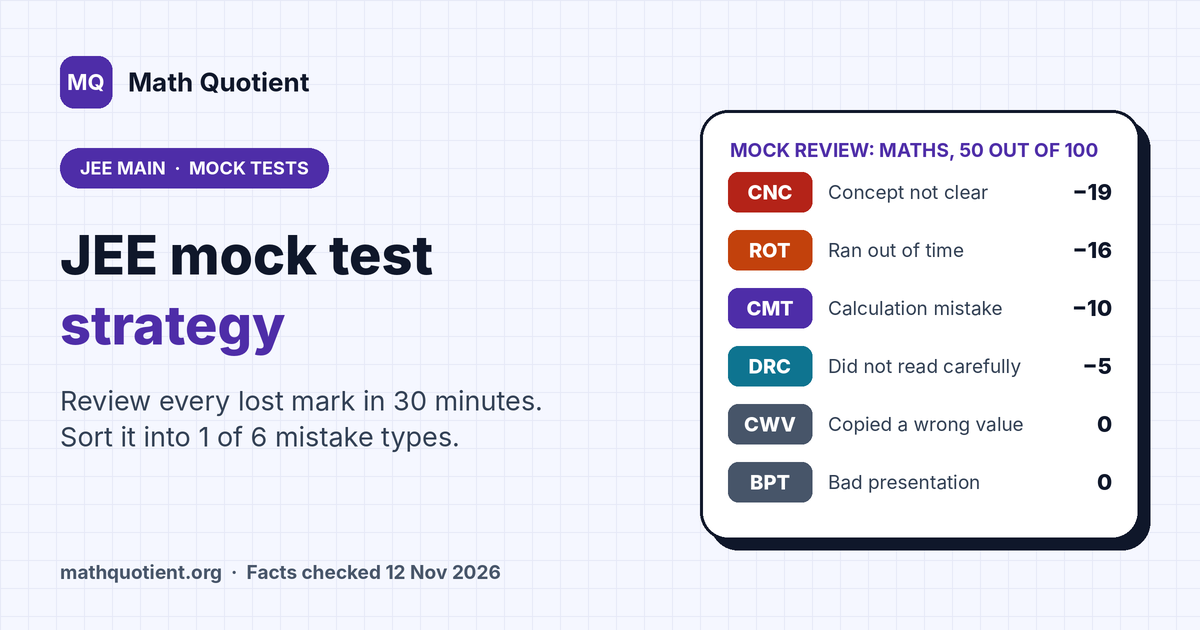
Running out of time is ROT, one of the 6 mistake types the Free BMI Maths Test finds. Often the cause is a slow method or a concept that is not clear (CNC), not slow sums.
The test also finds the student’s real maths level. It maps maths into 148 topics, 3,200 concepts and 320 levels, and every student starts at Level 1. Read about the Free BMI Maths Test.
When a trick costs more than it saves
Stop and do it the normal way when:
- The numbers are not near an easy anchor. 73² is far from 50 and 100. The trick adds steps. On the SAT, use Desmos. In JEE Main, multiply in full.
- You learned the trick last week. A new trick under time pressure leads to calculation mistakes (CMT). Practise it for two weeks before you use it in a timed test.
- The question asks for a form, not a number. If the options are in terms of k, a number trick does not help. Work with the algebra.
- A shortcut changes the question. “15% off, then 5% tax” is not “10% off”. The worked SAT-style question below shows this trap.
- You use an estimate as the final answer. An estimate rules out options. It does not choose between two close ones.
For UAE families: a 10-minute daily plan
Ten minutes a day works better than one long session a week. Do it at the same time each day, such as straight after school or after dinner. A parent can time it with a phone.
2 minutes: squares. Five numbers from 41 to 59 or 91 to 109. Say each square out loud before you write it.
3 minutes: percents and fractions. Five percents of a price, then five fractions to decimals.
3 minutes: estimate. Take five questions from your last practice set. Estimate each answer before you look at the options.
2 minutes: check. Check two of yesterday’s answers with the size, sign and digit-sum checks.
SAT students: the next SAT is on Saturday 5 December 2026. Practise in Bluebook, so you use the same Desmos you meet on test day. JEE Main students: Session 1 starts on 20 January 2027. Do all practice without a calculator, as on the day.
Want a plan counted back from your test date? See SAT maths prep in Dubai or JEE Main maths prep in Dubai.
Two worked questions: one SAT-style, one JEE-style
These are practice questions in the style of each test. They are not real past questions.
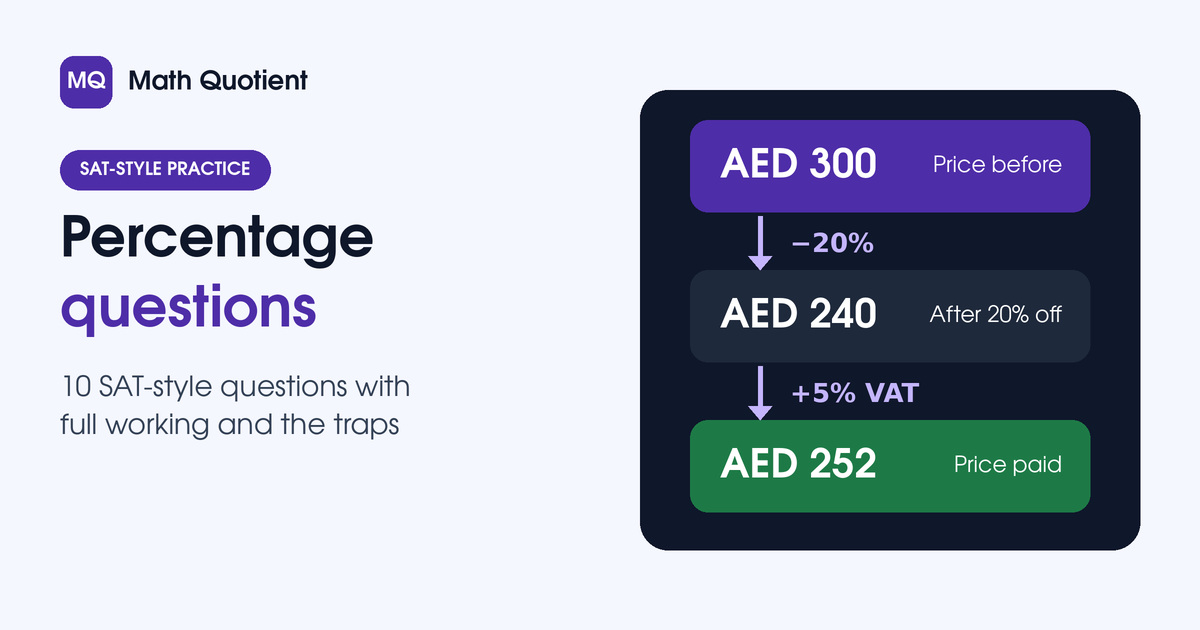
SAT-style: A jacket costs 240 dirhams. The shop takes 15% off, then adds 5% tax to the new price. What is the final price?
Percent trick: 10% of 240 is 24 and 5% is 12, so 15% is 36. The new price is 240 − 36 = 204. Tax: 10% of 204 is 20.4, so 5% is 10.2. The final price is 204 + 10.2 = 214.20 dirhams.
The trap: “15% off and 5% on is 10% off” gives 216. That is wrong, because the 5% is taken from the lower price. One step: 240 × 0.85 × 1.05 = 214.2. Reading the order too fast is DRC, did not read carefully. Mixing up the percents is CNC.
JEE-style, number answer: The equation x² − 98x + k = 0 has two equal roots. Find k.
Equal roots mean the discriminant is zero: 98² − 4k = 0, so k = 98² ÷ 4 = 49².
Square trick: 49 is 50 − 1, so 49² = 2,500 − 100 + 1 = 2,401. Check the size: 49² is just under 50² = 2,500. Check the last digit: 9 × 9 ends in 1. Both fit. The answer is a whole number, so you type 2401 on the number keypad.
Questions people ask about mental maths for the SAT and JEE Main
Do mental maths tricks help on the SAT if Desmos is allowed?
Yes, but not for big sums. Desmos does those. Estimates and quick checks help most: they catch typing slips and save the time you spend typing easy sums.
Is a calculator allowed in JEE Main?
No. The JEE Main 2027 bulletin lists calculators and log tables as barred items. You type Section B answers with an on-screen number keypad.
Which trick saves the most time?
Estimate first. It works on both tests and on every topic, and it often removes wrong options with no full sum. In JEE Main, fast squares come next.
How long a day should I practise mental maths?
About 10 minutes a day is enough. Spend more time on the maths topics themselves. Tricks only help when the method is already clear.
How many maths questions are on each test?
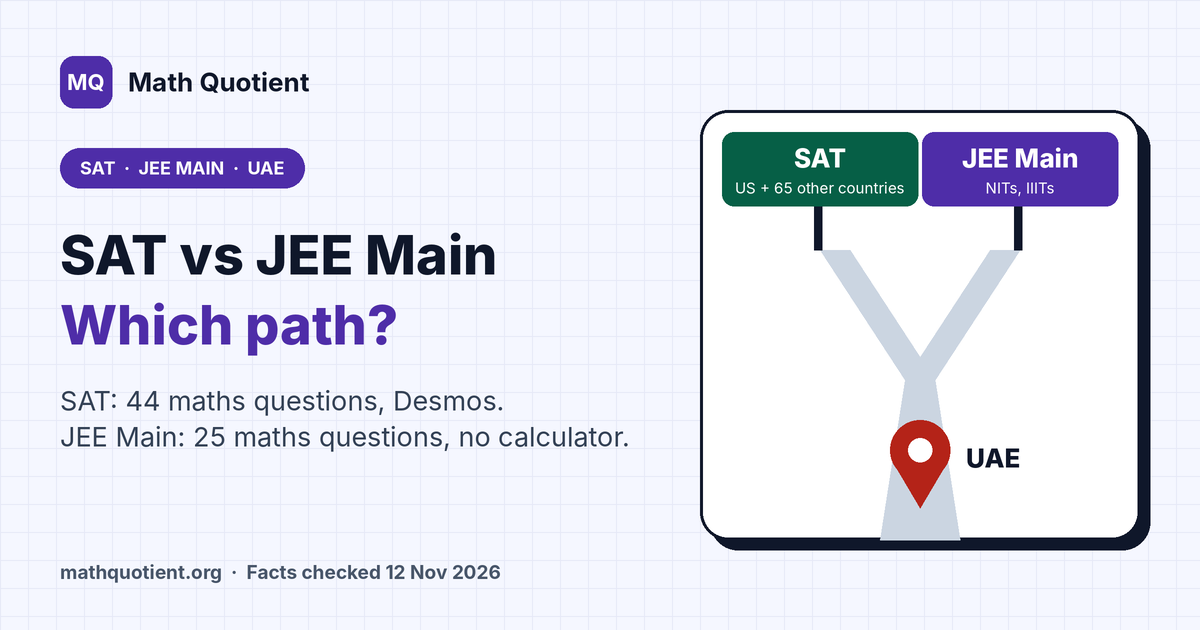
The SAT has 44 maths questions in 70 minutes, in two modules of 35 minutes. JEE Main Paper 1 has 25 maths questions: 20 multiple choice and 5 number answers, inside a 3-hour paper.
Keep exploring
Still short of time in maths?
The Free BMI Maths Test finds the real reason: a slow method, a concept that is not clear, or a calculation slip.
Sources
- College Board, How the SAT is structured: 44 maths questions, 70 minutes, two 35-minute modules.
- College Board, SAT calculator policy: calculator allowed on the whole maths section, Desmos built into Bluebook.
- College Board, SAT maths overview: the four maths areas and question formats.
- College Board, SAT dates and deadlines: 5 December 2026 test date.
- NTA, JEE (Main) 2027 Information Bulletin: paper pattern (2.4), marking (+4, −1), 3-hour paper (2.5), barred items (Chapter 10), Session 1 test days.
Facts checked on 7 November 2026 on satsuite.collegeboard.org and in the NTA bulletin. The time per question is our own sum from these official figures. Practice questions are our own, in the style of each test.
Written by Himanshu Jain
B.Tech, IIT Delhi. Founder of Math Quotient, Bur Dubai.