A ratio in maths compares two amounts. The ratio 3:2 means “for every 3 of one thing, there are 2 of the other”. You use ratios to share money, scale a recipe and read a map.
Read 3:2 as “3 to 2”.
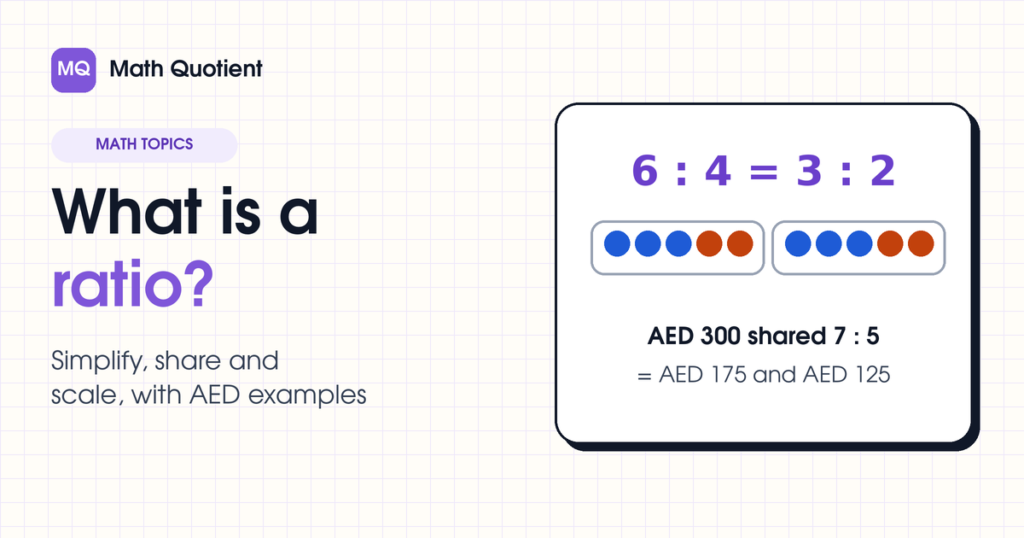
6 : 4 = 3 : 2
Hello, curious mind!
What is a ratio in maths?
A ratio tells you how much of one thing there is compared with another, written with a colon, as a:b.
Say a metro carriage has 8 people sitting and 12 standing. The ratio of sitting to standing is 8:12. The order matters: standing to sitting is 12:8.
One set of numbers gives you two kinds of ratio. Here are both for the carriage, with its 20 people in all.
Part to part
Sitting to standing, 8:12
Part to whole
Sitting to everyone, 8:20
As a fraction
2 in every 5 people sit
The other part
3 in every 5 people stand
A fraction is always a part of the whole. So a ratio of 2:3 does not mean 2/3. Add the parts first: 2 + 3 = 5, so the first part is 2/5 of the whole.
Remember this
To turn a ratio into fractions, add the parts. That sum is the bottom of each fraction.
How to simplify a ratio
Divide both numbers by the biggest number that goes into both. This is called the highest common factor.
Simplify 45:60. The highest common factor of 45 and 60 is 15.
45 ÷ 15 = 3 and 60 ÷ 15 = 4, so 45:60 = 3:4.
With decimals, multiply first. 1.5:2 becomes 15:20, which is also 3:4.
Watch out: same units first!
Compare 30 minutes with 2 hours. 2 hours is 120 minutes, so the ratio is 30:120 = 1:4. Writing 30:2 gives 15:1, which says the 30 minutes is 15 times longer.
How to share an amount in a ratio
Example 1: Omar and Layla share AED 300 in the ratio 7:5. How much does each get?
Add the parts: 7 + 5 = 12 parts.
Find one part: 300 ÷ 12 = AED 25.
Multiply: Omar gets 7 × 25 = AED 175. Layla gets 5 × 25 = AED 125.
The rule and the check
one part = total ÷ sum of the parts
Check: 175 + 125 = 300, and 175:125 = 7:5
Before you write the answer, read the question again. If it asks for Layla’s share, the answer is AED 125, not AED 175.
Ratios in real life: recipes and map scales
Example 2: scale a recipe
rice : water = 2 : 3
A rice recipe uses 2 cups of rice to 3 cups of water. You want to cook 5 cups of rice. 5 ÷ 2 = 2.5, so multiply both parts by 2.5. You need 3 × 2.5 = 7.5 cups of water.
Example 3: read a map scale
1 : 25,000
1 cm on the map is 25,000 cm on the ground. Two places are 6 cm apart on the map. 6 × 25,000 = 150,000 cm. That is 1,500 m, or 1.5 km.
A map scale is a ratio with no units. Both sides use the same unit, so change to metres or kilometres only at the end.
Common ratio mistakes
- Reading 2:3 as 2/3 of the whole. The whole has 2 + 3 = 5 parts, so the first part is 2/5.
- Giving the wrong person’s share. The question asks for Layla’s AED 125, but the student writes Omar’s AED 175.
- Mixing units. 30 minutes to 2 hours written as 30:2. Change both to minutes first: 30:120 = 1:4.
- Dividing by the wrong total. Sharing AED 300 in 7:5, the student divides 300 by 7, not by 12.
Check this with the Free BMI Maths Test
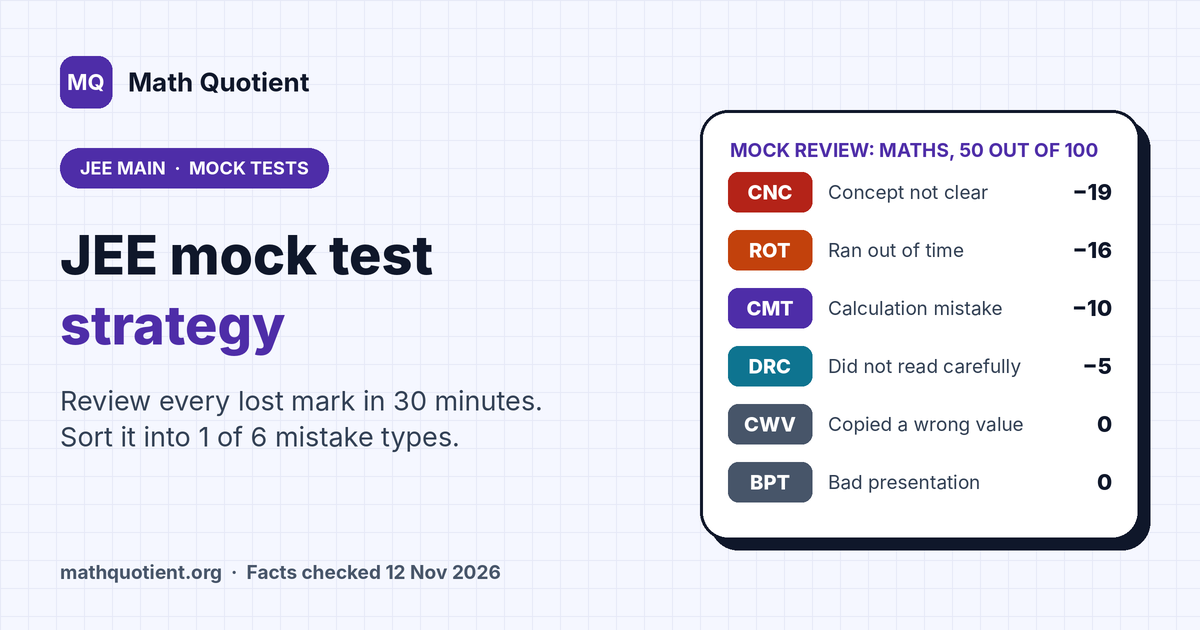
- Treats 2:3 as 2/3 of the whole, when it is 2/5: CNC, concept not clear.
- Shares the amount right but gives the other person’s share: DRC, did not read carefully.
- Compares 30 minutes with 2 hours as 30:2: CNC, concept not clear.
- Divides by the wrong total when sharing: CMT, calculation mistake.
The Free BMI Maths Test finds which of the 6 mistake types your child makes, and their real maths level. About the Free BMI Maths Test
Quick check: 5 ratio questions
1. Write 18:24 in its simplest form.
Not quite. 9 and 12 can both still be divided by 3.
Yes! Divide both by 6: 18 ÷ 6 = 3 and 24 ÷ 6 = 4.
Not quite. Keep the order: 18 comes first.
2. Red beads to blue beads is 2:3. What fraction of the beads is red?
Not quite. 3 is the blue part, not the whole.
Yes! 2 + 3 = 5 parts, and 2 of them are red.
Not quite. That is the blue fraction.
3. Share AED 40 in the ratio 3:1. What is the bigger share?
Yes! 4 parts, so one part is AED 10, and 3 parts are AED 30.
Not quite. That is the smaller share.
Not quite. Divide by 3 + 1 = 4, not by 3.
4. What is 45 seconds to 3 minutes, in its simplest form?
Not quite. That is 45:3. Change minutes to seconds first.
Not quite. 3 minutes is 180 seconds, not 135.
Yes! 45:180, and both divide by 45.
5. A drink is 1 part syrup to 6 parts water. How much water goes with 50 ml of syrup?
Not quite. That adds 6. A ratio multiplies.
Yes! 1 part is 50 ml, so 6 parts are 300 ml.
Not quite. 350 ml is the whole drink.
Got 2 or fewer right? Book the Free BMI Maths Test to find the cause.
Test prep corner
Ratios in SAT maths
College Board lists “ratios, rates, proportional relationships, and units” in the Problem-Solving and Data Analysis area of SAT maths. These are SAT-style practice questions, not real past questions.
SAT-style: A car uses 12 litres of fuel to travel 150 km. At this rate, how many litres does it need for 250 km?
Fuel to distance stays the same ratio. 250 ÷ 150 = 5/3, so the car needs 12 × 5/3 = 20 litres. Check: 20:250 and 12:150 both simplify to 2:25.
SAT-style: x:y = 3:4 and y:z = 2:5. What is x:z?
Make the y parts match. Multiply y:z by 2 to get 4:10. Now x:y:z = 3:4:10, so x:z = 3:10. Joining 3 with 5 to get 3:5 is wrong, because the two y parts were not equal.
Read our Digital SAT maths guide. For more questions to try, see our SAT maths practice questions.
Fact checked on 7 November 2026 on satsuite.collegeboard.org.
Questions people ask about ratios
What is a ratio in maths?
A ratio compares two or more amounts, written as a:b. If a bag has 4 green and 6 yellow sweets, the ratio of green to yellow is 4:6, which simplifies to 2:3.
How do I simplify a ratio?
Divide both numbers by their highest common factor. For 16:40, the highest common factor is 8, so 16:40 = 2:5. Make the units the same first.
How do I share an amount in a ratio?
Add the parts, divide the amount by that sum to find one part, then multiply. To share AED 56 in the ratio 3:4: 3 + 4 = 7, 56 ÷ 7 = 8, so the shares are AED 24 and AED 32.
What is the difference between a ratio and a fraction?
A fraction compares a part with the whole. A ratio can compare one part with another part. A ratio of 2:3 means the first part is 2/5 of the whole, not 2/3.
Keep exploring
Do ratios still trip your child up?
The Free BMI Maths Test finds your child’s real maths level and the reason for each mistake.
Written by Himanshu Jain
B.Tech, IIT Delhi. Founder of Math Quotient.