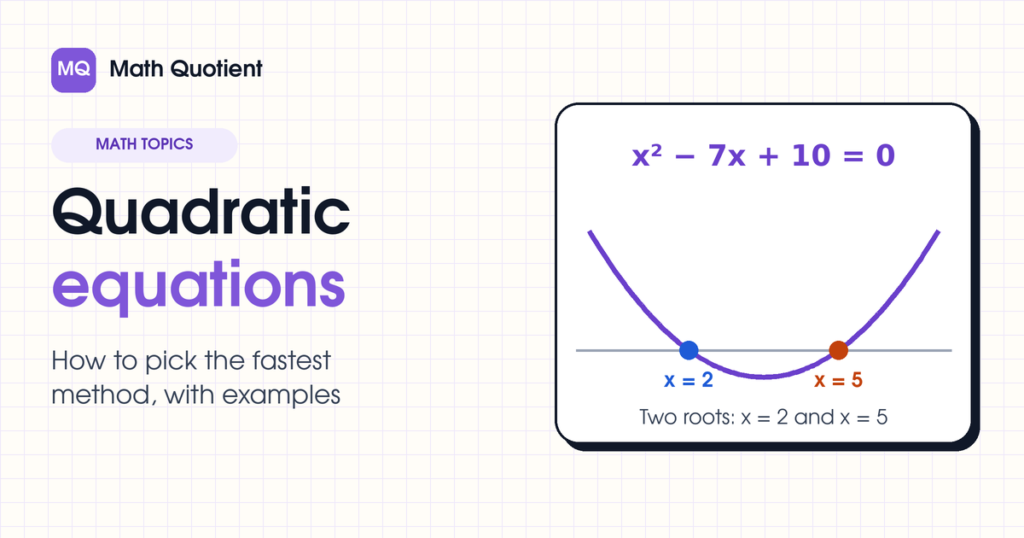
A quadratic equation is an equation where the highest power of x is 2, such as x² − 7x + 10 = 0. Most quadratic equations have two answers, called roots. This page shows you how to pick the fastest way to find them.
Quad comes from “square”: x is squared.
x² − 7x + 10 = 0 → (x − 2)(x − 5) = 0
Hello, curious mind!
What is a quadratic equation?
A quadratic equation is an equation you can write as ax² + bx + c = 0, where a, b and c are numbers and a is not 0.
If a were 0, the x² part would vanish and you would have a straight-line equation.
The name comes from the Latin quadratus, “square”.
The x² number
In 3x² − 4x − 7 = 0, a = 3.
The x number
Here b = −4. Keep the sign.
The number alone
Here c = −7.
A root
A value of x that makes it true.
Get 0 on one side first. x² = 4x + 12 becomes x² − 4x − 12 = 0, so b = −4 and c = −12.
Remember this
First make it = 0. Then read a, b and c with their signs.
How to solve a quadratic equation: which method first?
There are four ways to solve a quadratic equation. Go down this list. Stop at the first step that fits.
No x term (b = 0)? Take square roots. 2x² = 50 gives x² = 25, so x = 5 or x = −5.
No number term (c = 0)? Take x out as a factor. x² − 6x = 0 gives x(x − 6) = 0, so x = 0 or x = 6.
Is b² − 4ac a square number? Then it factorises. With whole-number a, b and c, this test never fails. For 2x² + 3x − 4 = 0, b² − 4ac = 41, so skip to step 4.
Not a square number? Use the quadratic formula. Do not hunt for factors that do not exist.
Use completing the square when a question asks for the smallest value of the expression, or for the turning point of its graph.
Three methods, three worked examples
Example 1: factorising x² + x − 20 = 0
Find two numbers that multiply to c = −20 and add to b = +1. They are 5 and −4.
Write the brackets: (x + 5)(x − 4) = 0.
One bracket must be 0. So x + 5 = 0 or x − 4 = 0, which gives x = −5 or x = 4. Check: 16 + 4 − 20 = 0.
Example 2: the quadratic formula for 2x² − 7x + 3 = 0
The formula
x = (−b ± √(b² − 4ac)) ÷ 2a
Read the numbers: a = 2, b = −7, c = 3. So −b = +7.
Work out b² − 4ac: (−7)² − 4 × 2 × 3 = 49 − 24 = 25. Its square root is 5.
x = (7 ± 5) ÷ 4. So x = 12 ÷ 4 = 3, or x = 2 ÷ 4 = 1/2.
A root can be a fraction. As 25 is a square number, this also factorises: (2x − 1)(x − 3) = 0.
Example 3: completing the square for x² + 10x + 21 = 0
Halve b: 10 ÷ 2 = 5. Write (x + 5)², which is x² + 10x + 25.
Take away the extra 25: (x + 5)² − 25 + 21 = 0, so (x + 5)² − 4 = 0.
(x + 5)² = 4, so x + 5 = 2 or x + 5 = −2. That gives x = −3 or x = −7.
Bonus: the smallest value of x² + 10x + 21 is −4, when x = −5.
How many answers? The discriminant
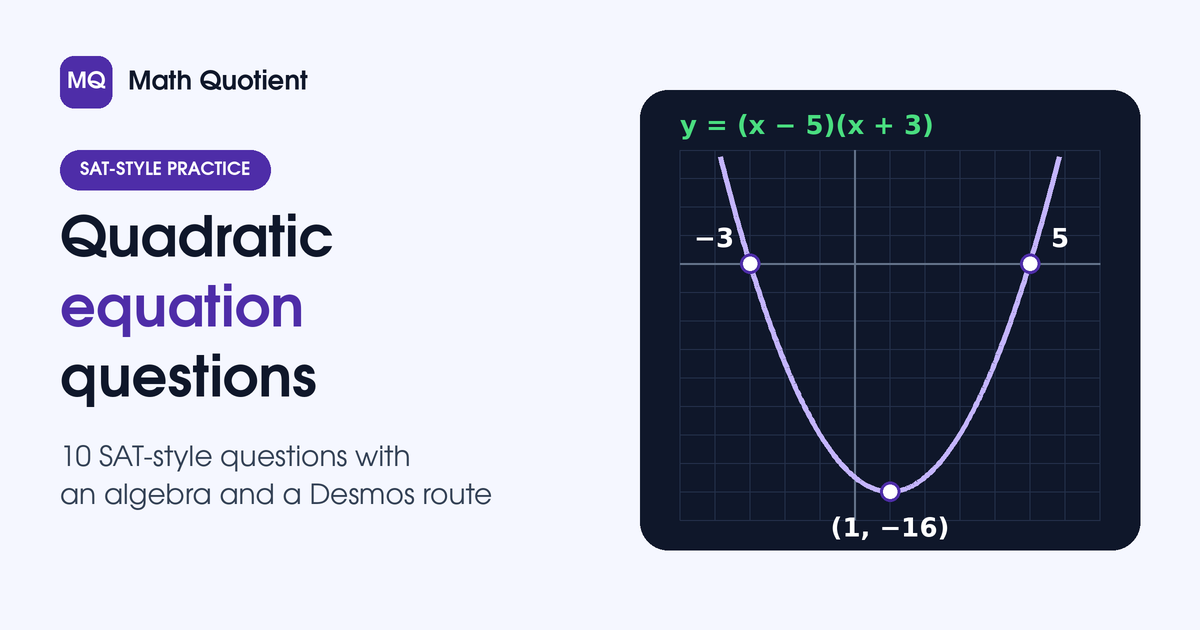
The part under the square root, b² − 4ac, is the discriminant. It tells you how many real roots there are.
More than 0: two roots
x² + x − 20
1 + 80 = 81. Two roots. 81 is a square number, so it factorises.
Equal to 0: one root
x² − 6x + 9
36 − 36 = 0. One root, x = 3. The curve touches the x-axis.
Less than 0: no real roots
x² + 2x + 5
4 − 20 = −16. A negative number has no real square root.
Common quadratic equation mistakes
- Dividing both sides by x. From 5x² = 15x, dividing by x gives only x = 3. But x = 0 also works. Write 5x² − 15x = 0, so 5x(x − 3) = 0, and x = 0 or x = 3.
- Using +b, not −b. For x² − 8x + 12 = 0, −b is +8, so x = (8 ± 4) ÷ 2 = 6 or 2. Starting with −8 gives −2 and −6.
- Answering the wrong question. “x² − 9x + 14 = 0 and x > 3. What is x²?” The roots are 2 and 7, so x = 7, and the answer is 49.
- Getting b² − 4ac wrong with a negative. For x² − 3x − 10 = 0, it is 9 − 4(1)(−10) = 9 + 40 = 49. Writing 9 − 40 = −31 gives a false “no real roots”.
Check this with the Free BMI Maths Test
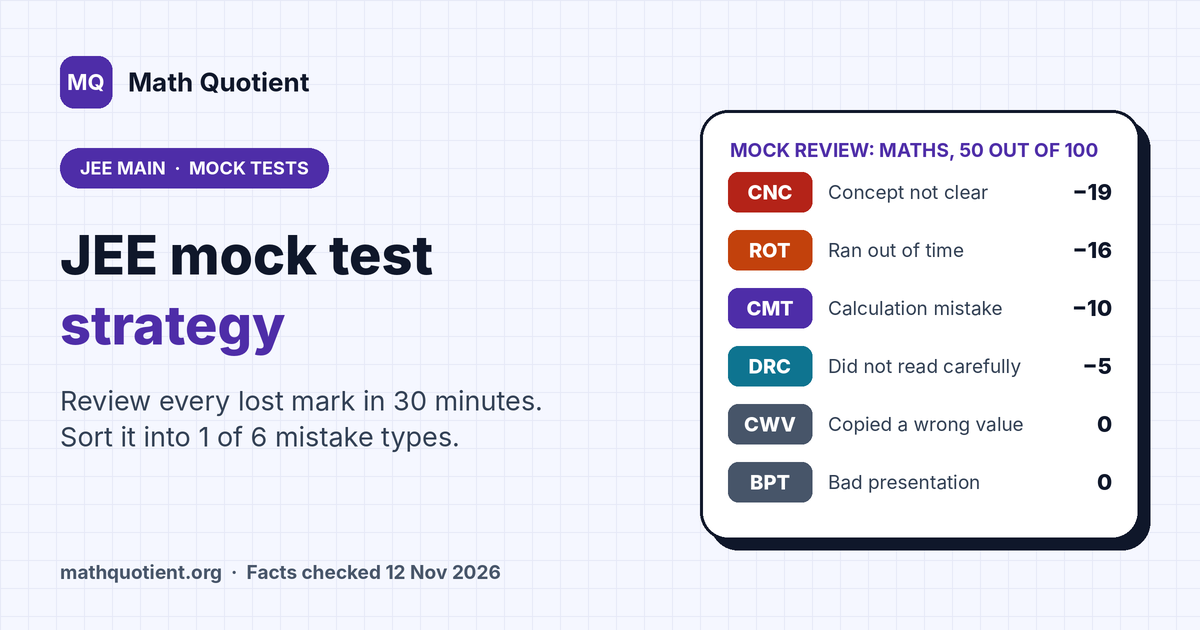
- Divides both sides by x and loses x = 0: CNC, concept not clear.
- Uses +b where the formula needs −b: CWV, copied a wrong value.
- Solves for x when the question asks for x² or the sum of the roots: DRC, did not read carefully.
- Gets b² − 4ac wrong when b or c is negative: CMT, calculation mistake.
The Free BMI Maths Test finds which of the 6 mistake types your child makes, and their real maths level. About the Free BMI Maths Test
Quick check: 5 quadratic equation questions
1. Which of these is a quadratic equation?
Not quite. There is no x².
Yes! The highest power of x is 2.
Not quite. The power 3 makes it a cubic.
2. Solve x² = 36.
Not quite. (−6)² is also 36.
Yes! 6 × 6 = 36 and −6 × −6 = 36.
Not quite. That halves 36.
3. What are the roots of (x − 3)(x + 8) = 0?
Yes! x − 3 = 0 gives 3, and x + 8 = 0 gives −8.
Not quite. Each sign flips: x − 3 = 0 gives x = 3.
Not quite. x + 8 = 0 gives x = −8.
4. How many real roots does x² + 4x + 7 = 0 have?
Not quite. Work out b² − 4ac: 16 − 28.
Not quite. One root needs b² − 4ac = 0.
Yes! 16 − 28 = −12, which is less than 0.
5. Solve x² = 9x.
Not quite. Dividing by x loses a root. Try x = 0.
Yes! x² − 9x = 0, so x(x − 9) = 0.
Not quite. 3² = 9, but 9 × 3 = 27.
Got 2 or fewer right? Book the Free BMI Maths Test to find the cause.
Test prep corner
Quadratic equations in SAT and JEE Main maths
College Board lists nonlinear equations in one variable, which include quadratics, in the Advanced Math area of SAT maths. These are SAT-style and JEE-style practice questions, not real past questions.
SAT-style: In x² − 12x + k = 0, k is a constant. The equation has exactly one real solution. What is k?
One solution means b² − 4ac = 0. So 144 − 4k = 0, and k = 36. Check: x² − 12x + 36 = (x − 6)², with one root, x = 6.
JEE-style: α and β are the roots of x² − 5x + 3 = 0. Find α² + β² without solving the equation.
For x² + bx + c = 0, the sum of the roots is −b and the product is c. So α + β = 5 and αβ = 3. So α² + β² = (α + β)² − 2αβ = 25 − 6 = 19.
Read our Digital SAT maths guide or our JEE Main maths guide. For more questions to try, see our SAT maths practice questions.
Fact checked on 7 November 2026 on satsuite.collegeboard.org.
Questions people ask about quadratic equations
What is a quadratic equation?
It is an equation you can write as ax² + bx + c = 0, where a is not 0. It can have two, one or no real roots.
How do I know which method to use?
No x term: take square roots. No number term: take x out. Otherwise, if b² − 4ac is a square number, factorise. If not, use the formula.
Can a quadratic have no real answer?
Yes. If b² − 4ac is less than 0, there is no real root. For example, no real number squared gives −1, so x² + 1 = 0 has no real answer.
What is the discriminant?
It is b² − 4ac, the part under the square root in the quadratic formula. More than 0 means two real roots, 0 means one, and less than 0 means none.
Keep exploring
Do quadratics still trip your child up?
The Free BMI Maths Test finds your child’s real maths level and the reason for each mistake.
Written by Himanshu Jain
B.Tech, IIT Delhi. Founder of Math Quotient.