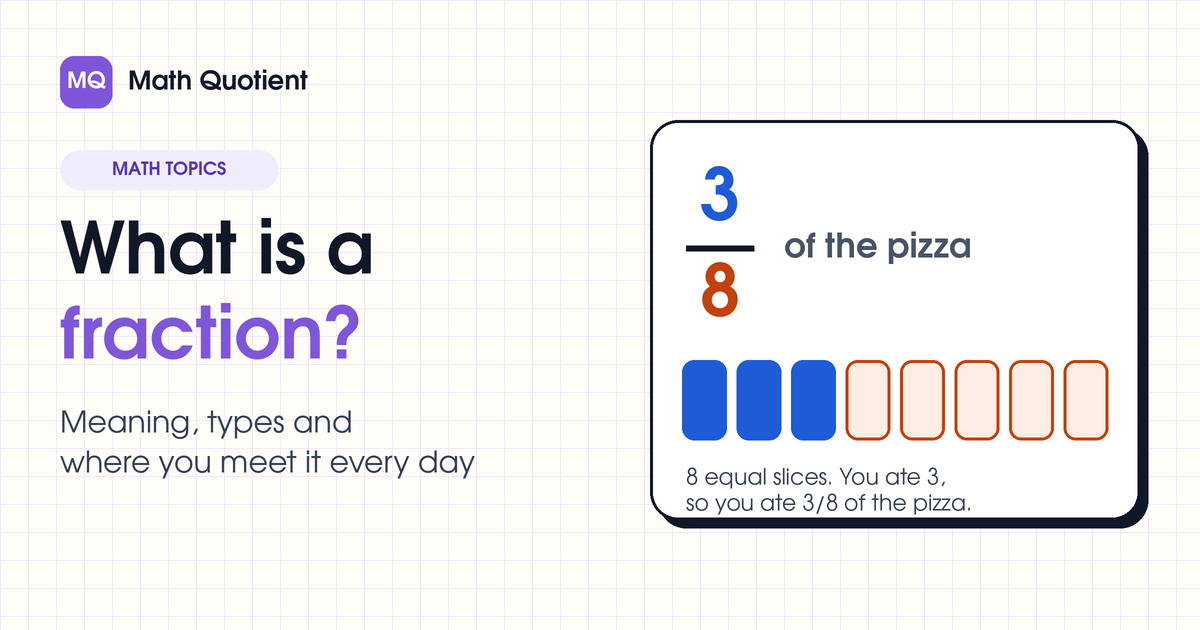
You cut a pizza into 8 equal slices and eat 3 of them. What part of the pizza did you eat? The answer is a fraction: three eighths, or 3/8. In this guide you will learn what a fraction in maths is, how to read one, and where you meet fractions every day.
Psst: every fraction is a division too!
38 of the pizza
Hello, curious mind!
What is a fraction in maths?
A fraction is a number that shows part of a whole. You write it as one number over another, like 3/8. The bottom number tells you how many equal parts the whole has. The top number tells you how many of those parts you take.
The word fraction comes from the Latin word fractio. It means “breaking”. A fraction is a whole that you break into equal parts.
Remember this
A fraction shows part of a whole. The parts must always be equal.
Numerator and denominator: the parts of a fraction
Every fraction has two numbers and a line between them. Each part has its own colour on this page, so you can spot it fast.
Numerator
The top number. How many parts you take.
Denominator
The bottom number. How many equal parts make the whole.
Fraction bar
The line in the middle. It means “divided by”.
Whole
All the parts together. 8/8 is 1 whole pizza.
Memory trick: Denominator and Down both start with D. The denominator is the number down below.
Fraction example: 4 dates out of 12, step by step
A box has 12 dates. You eat 4 of them. What fraction of the box did you eat?
Count the equal parts in the whole. The box has 12 dates, so the denominator is 12.
Count the parts you take. You ate 4, so the numerator is 4. The fraction is 4/12.
Make it simpler. Divide the top and the bottom by the same number, 4. You get 1/3. You ate one third of the box.
Simplify with this rule
Divide the top and the bottom by the same number
4/12 = 1/3
Watch out!
The parts must be equal. If you cut a cake into 4 pieces of different sizes, one piece is not 1/4 of the cake. Fair shares need equal parts.
Types of fractions: proper, improper and mixed
Fractions come in three main types. The type tells you if the fraction is less than one whole or more.
- Proper fraction: the top number is smaller than the bottom number, like 3/8. It is less than 1 whole.
- Improper fraction: the top number is the same as the bottom number or bigger, like 7/4. It is 1 whole or more.
- Mixed number: a whole number and a fraction together, like 1¾. It means 1 whole and three quarters more.
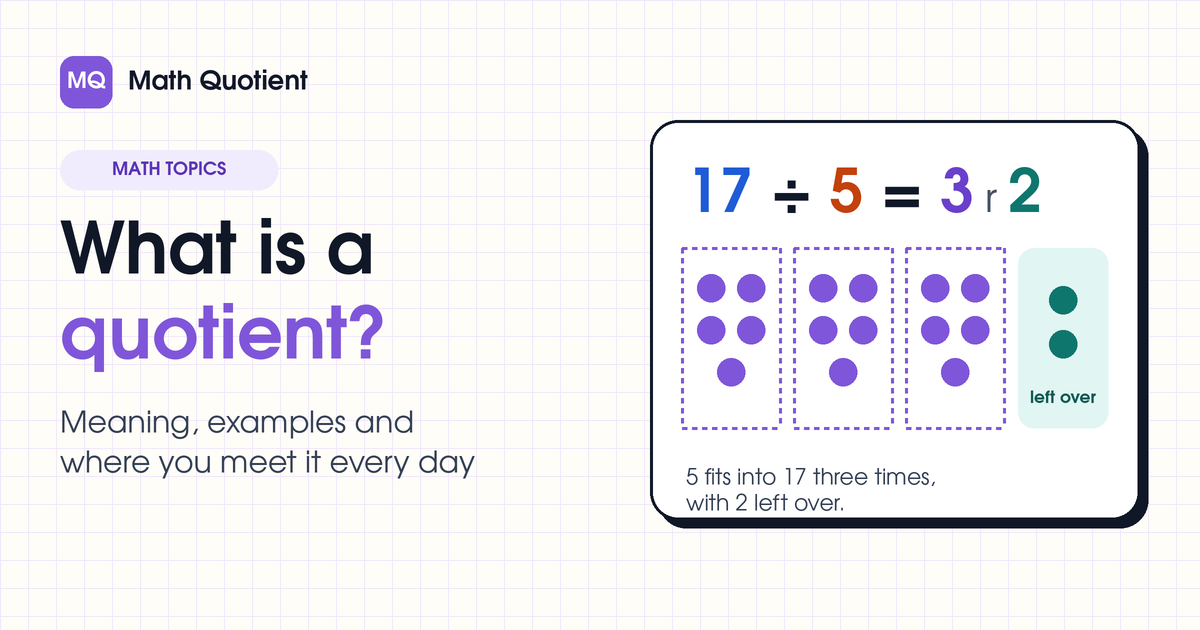
To change 7/4 into a mixed number, divide: 7 ÷ 4 = 1, remainder 3. So 7/4 = 1¾. The quotient gives the whole number, and the remainder goes on top of the fraction.
Equivalent fractions
Different fractions can show the same amount. 1/2, 2/4 and 4/8 are all one half. We call them equivalent fractions. Multiply or divide the top and the bottom by the same number, and the amount does not change.
And here is the big secret: the fraction bar means “divided by”. So 3/4 is the same as 3 ÷ 4, which is 0.75.
Where you meet fractions in real life
You use fractions every day, often without noticing.
Sale signs
A shirt costs AED 80. The sign says “1/4 off”. One quarter of 80 is 20, so you pay AED 60.
Quarter past
15 minutes is 15/60 of an hour. That simplifies to 1/4. That is why 4:15 is “quarter past four”.
In the kitchen
A recipe needs 1/2 cup of milk. You want to make it 3 times. 3 × 1/2 = 3/2, which is 1½ cups.
Two halves of a match
A football match lasts 90 minutes. Each half is 45 minutes, and 45/90 = 1/2.
Did you know?
The words “fraction” and “fractal” come from the same Latin word. It means “to break”. Fractals are shapes made of smaller copies of themselves. You can see them in broccoli, snowflakes and phone antennas.
Quick check
Which fraction is the same as one half?
Yes! 2/4 means 2 parts out of 4 equal parts. That is exactly half.
Not quite. 2/3 is more than a half. Try again.
Not quite. 1/4 is a quarter, which is less than a half. Try again.
Try it yourself: fraction questions with answers
Work each one out first. Then tap to check.
1. Write 6/9 in its simplest form.
Divide the top and the bottom by 3. The answer is 2/3.
2. Change 11/4 into a mixed number.
11 ÷ 4 = 2, remainder 3. So 11/4 = 2¾.
3. What is 3/4 of 20?
20 ÷ 4 = 5. Then 5 × 3 = 15.
4. Which is bigger, 2/3 or 3/5?
Give them the same denominator: 2/3 = 10/15 and 3/5 = 9/15. So 2/3 is bigger.
Deep dive: fractions in higher maths
Fractions grow up into some of the biggest ideas in maths.
Rational numbers
p/q, where q ≠ 0
Any number you can write as a fraction of two whole numbers is a rational number. Some numbers, like √2, can never be written this way. They are irrational.
Fractions as decimals
1/8 = 0.125 1/7 = 0.142857…
Turn a fraction into a decimal and the digits always stop or repeat. For 1/7, the six digits 142857 repeat forever.
Test prep corner
Fractions in SAT and IIT-JEE maths
Students who prepare for the SAT or IIT-JEE use fractions all the time. Fractions hide inside ratio, rate, probability and algebra questions. Strong fraction skills now make those tests feel easier later.
SAT-style: 3/4 of a number is 18. What is 2/3 of the same number?
The number is 18 ÷ 3 × 4 = 24. Then 2/3 of 24 is 16.
IIT-JEE-style puzzle: Find 1/(1×2) + 1/(2×3) + 1/(3×4) + … + 1/(9×10).
Split each part: 1/(n × (n+1)) = 1/n − 1/(n+1). Almost every part cancels out. You are left with 1 − 1/10 = 9/10.
Getting ready for the SAT or IIT-JEE? Message us on WhatsApp.
Questions people ask about fractions
What is a fraction in simple words?
A fraction is a part of a whole. 3/8 means 3 parts out of 8 equal parts.
What are the numerator and the denominator?
The numerator is the top number. It tells you how many parts you take. The denominator is the bottom number. It tells you how many equal parts make the whole.
What are the 3 types of fractions?
Proper fractions, like 3/8, are less than 1. Improper fractions, like 7/4, are 1 or more. Mixed numbers, like 1¾, have a whole number and a fraction.
Is a fraction the same as a division?
Yes. The fraction bar means “divided by”. So 3/4 is the same as 3 ÷ 4, which is 0.75.
Can the denominator be zero?
No. A denominator of zero means you divide by zero, and that has no answer. Mathematicians call it undefined.
Keep exploring
How strong is your number sense?
Our BMI maths check shows what you already know and what to practise next.
Written by Himanshu Jain
B.Tech, IIT Delhi. Founder of Math Quotient.