You share 50 dates among 7 friends. How many does each friend get, and how many are left over? You just asked for a quotient. In this guide you will learn what a quotient in maths is, how to find it, and where you meet it every day.
Fun fact: it is in our name too!
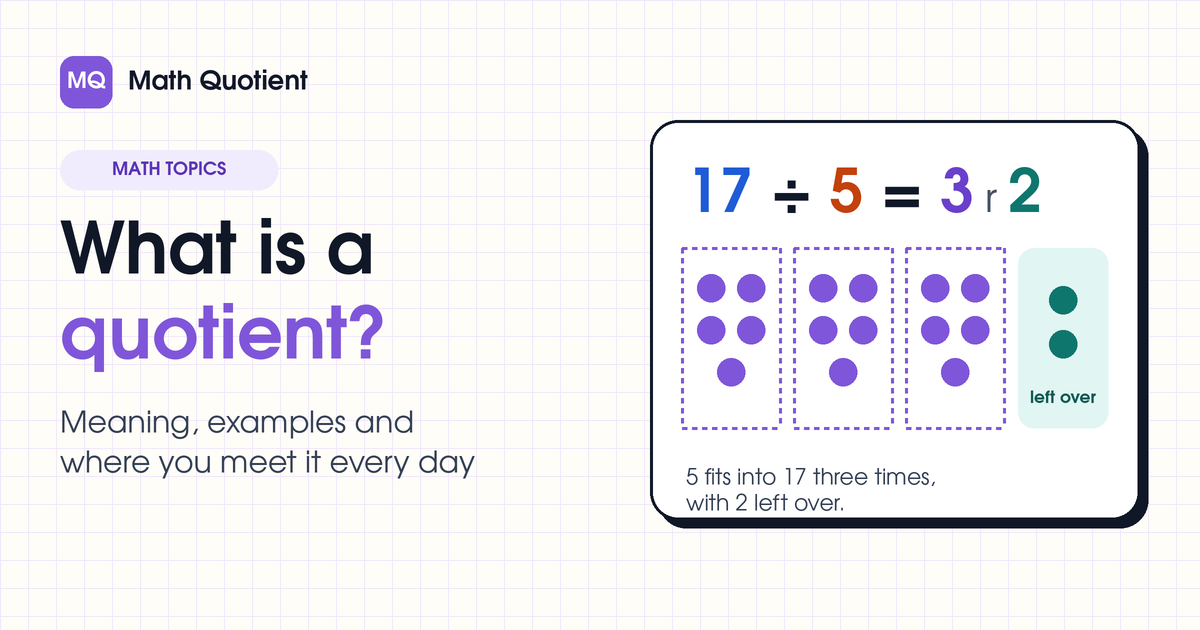
17 ÷ 5 = 3 r 2
Hello, curious mind!
What is a quotient in maths?
A quotient is the answer you get when you divide one number by another. It tells you how many times one number fits into the other. For example, 12 ÷ 3 = 4, so the quotient is 4.
The word quotient comes from the Latin word quotiens. It means “how many times”. That is exactly what a quotient tells you.
Remember this
A quotient is the answer to a division. It tells you how many times one number fits into another.
Dividend, divisor, quotient and remainder
Every division has up to four parts. Each part has its own colour on this page, so you can spot it fast.
Dividend
The number you share out.
Divisor
The size of each group.
Quotient
How many full groups you make.
Remainder
What is left over.
Quotient example: 17 ÷ 5, step by step
Let’s find the quotient of 17 ÷ 5 together.
Count up in fives: 5, 10, 15. The next one, 20, is too big.
You counted 3 fives. So the quotient is 3.
17 − 15 = 2. So the remainder is 2.
Check your answer with this rule
Dividend = Divisor × Quotient + Remainder
5 × 3 + 2 = 17
Quotient and remainder: what is the difference?
The quotient counts the full groups. The remainder is the part that does not make a full group. Back to the dates: 50 ÷ 7 gives a quotient of 7 and a remainder of 1. Each friend gets 7 dates, and 1 date is left. (We suggest you eat it.)
Sometimes you want only full groups. Sometimes you want the exact answer:
- Whole-number quotient: 17 ÷ 5 = 3, remainder 2. Use it when you cannot cut things, like people in cars or chairs in rows.
- Exact quotient: 17 ÷ 5 = 3.4. This is the same as the fraction 17/5. Use it for money, distance and measurements.
Every fraction is a quotient in disguise: ¾ means 3 ÷ 4, which is 0.75.
Watch out!
The remainder must always be smaller than the divisor. If it is not, one more group fits, so the quotient goes up by one. If the remainder is 0, the divisor divides the dividend exactly, like 20 ÷ 4 = 5.
Where you meet quotients in real life
You use quotients every day, often without noticing.
Find the better deal
2 litres of juice for AED 9 is AED 4.50 per litre. 3 litres for AED 12.75 is AED 4.25 per litre. The big bottle wins.
How fast is the car?
Dubai to Abu Dhabi is about 120 km. If the trip takes 1.5 hours, the speed is 120 ÷ 1.5 = 80 km per hour.
Your screen shape
A screen 1920 pixels wide and 1080 high: 1920 ÷ 1080 ≈ 1.78, the same as 16 ÷ 9. That is why we call it a “16:9” screen.
The Q in IQ
IQ stands for Intelligence Quotient. In the early 1900s it was a real division: a child’s “mental age” divided by their real age, times 100.
Did you know?
You can never divide by zero. Ask “how many zeros make 10?” No number of zeros adds up to 10, so the answer does not exist. Mathematicians call it undefined.
Quick check
What is the remainder when 23 is divided by 4?
Yes! 4 × 5 = 20, and 23 − 20 = 3. The remainder is 3.
5 is the quotient, not the remainder. Look at what is left over, then try again.
Not quite. The remainder must be smaller than 4. Try again.
Try it yourself: quotient questions with answers
Work each one out first. Then tap to check.
1. What are the quotient and remainder of 100 ÷ 7?
Quotient 14, remainder 2. Check: 7 × 14 + 2 = 100.
2. The divisor is 6, the quotient is 9 and the remainder is 4. What is the dividend?
6 × 9 + 4 = 58.
3. A number divided by 8 gives a quotient of 12 and a remainder of 5. What is the number?
8 × 12 + 5 = 101.
4. Can the remainder be 9 when the divisor is 7?
No. The remainder must be smaller than 7. A remainder of 9 means one more group of 7 still fits.
Deep dive: quotients in higher maths
The same question, “how many times does it fit?”, leads all the way to calculus.
The difference quotient
(f(x + h) − f(x)) ÷ h
It measures how fast a function changes. It is the first step to the idea of a derivative.
The quotient rule
y′ = (u′v − uv′) ÷ v²
Use it to find the derivative when y = u ÷ v.
Questions people ask about quotients
What is the quotient in division?
The quotient is the answer to a division. It tells you how many times the divisor fits into the dividend.
What is the difference between a quotient and a remainder?
The quotient is the number of full groups. The remainder is what is left over. In 17 ÷ 5, the quotient is 3 and the remainder is 2.
Is the quotient the same as the answer?
Yes. In a division, the answer is called the quotient. In a multiplication, the answer is called the product.
Can a quotient be a decimal or a fraction?
Yes. 17 ÷ 5 has an exact quotient of 3.4, which is the same as the fraction 17/5.
Why can we not divide by zero?
No number of zeros adds up to a number that is not zero. So the question “how many times does 0 fit?” has no answer.
Keep exploring
How strong is your number sense?
Our BMI maths check shows what you already know and what to practise next.
Written by Himanshu Jain
B.Tech, IIT Delhi. Founder of Math Quotient.